

Upward Growth is a health plan market advisory firm. Our weekly newsletter covers payor market strategy, regulatory shifts, and go-to-market insights for health tech vendors, investors, provider organizations, and consultancies competing in the health plan market.
🤝 Work with us on payor market strategy: Contact us
🟦 Connect with the author, Ryan Peterson, on LinkedIn.
🎧 Listen to the Upward Growth Podcast: Apple | Spotify
📰 Newsletter sponsorships: Learn More
Today’s Upward Growth newsletter is sponsored by
Strategic Solutions Network

With CMS expanding RADV audits, health plans that prepare now will be in a much stronger position when the notice arrives. On January 20th in Orlando, the one-day RADV & Compliance Workshop walks through the full audit lifecycle: readiness before an audit, documentation and coding that hold up to review, managing retrieval and communications during an audit, and appeals and financial planning afterward. Sessions are led by risk adjustment and compliance leaders from Select Health, Humana, Healthfirst, Blue Cross and Blue Shield of Nebraska, Blue Cross Minnesota, and more.
A few updates before we get into this week’s article:
We won’t be publishing our newsletter next Tuesday, November 24. Our team is taking Thanksgiving week off for some much-needed rest, and we hope you get some too. We’ll be back in your inbox on Tuesday, December 1, and that Friday, December 4 at 1pm ET / 10am PT, we’ll host the next Upward Growth Debrief. It’s a live, candid conversation about what’s moving in the health plan market, and the Q&A stays off the record so people can speak freely. If you’d like to join us, upgrade for $10 a month or less before then, and the Zoom invite will land in your inbox a couple of days before the call.
Since we’re off next week, this is the last newsletter before the Upward Growth audience survey closes on November 24. It takes about three minutes, and what you tell us will help decide what we build next for you across the newsletter, the podcast, and the Debrief. If you haven’t weighed in yet, share your thoughts here. And if you already have, thank you!
In the spirit of the week, I also want to thank the sponsors who’ve supported the newsletter this year. Their support helps keep this coming to your inbox on Tuesdays. Each issue carries a single sponsor, and we’re booking Q1 2027 now. If your team has launches planned for early next year and wants them in front of more than 8,000 weekly subscribers who work in and around health plans, request your Q1 dates here.
When a health system and a Medicare Advantage (MA) plan part ways, the member, the system, and the plan each lose something, and in 2027 the plan’s loss is larger and lasts longer than it would have two years ago. Dozens of health systems ended contracts with at least one MA plan this year, most citing denials, prior authorization, and slow payment, and some separations started with the plan instead. The dispute plays out between two organizations, but its costs reach the members who get the termination letters, the physicians whose patients go elsewhere, and the plan that loses the visits its revenue increasingly depends on.
What’s changed for 2027 is how much of an MA plan’s revenue gets produced inside the provider encounter. CMS finalized changes that tie more of a plan’s risk scores and Star Ratings to what happens at the visit, and plans are leaning on Health Maintenance Organization (HMO) products for the margin they need in 2027. HMOs are also the products where a member has the fewest ways to keep seeing a system that left.
This article explains why health systems and MA plans are separating, how Medicare’s switching rules shape who loses what, what each side gives up, and what should change the next time a plan and a health system negotiate a contract.
Health Systems and MA Plans Are Separating Over Denials, Documentation, and Narrower Networks
Contract disputes between health systems and MA plans have mostly been about rates, and they still are. Over the past few years, pressure has built up on both sides, making renewal harder. Health systems say MA plans deny too much, request too many records, and pay too slowly, while plans cut costs and narrow networks to protect margins. Those pressures meet at the medical record.
Ascension, reviewing its own claims from April 2023 through March 2024, found MA plans were nearly twice as likely to deny for medical necessity as traditional Medicare and more than 2.5 times as likely to deny for insufficient information. Those are a system’s own figures, and plans would describe their review programs differently, but they explain why so many systems put denials at the top of their exit announcements.
Health plans are making their own network decisions, too. Aetna and Humana ended their MA contracts with Moffitt, the Tampa cancer center, in December 2025 and July 2026, and Moffitt says it didn’t choose to leave either one. With margins as tight as they are for 2027, health plans have reasons of their own to drop a system they see as expensive, and each side tends to make its case in public before members choose next year’s coverage.
The same health plans asking providers for more documentation to adjudicate claims depend on that documentation to capture risk and close quality gaps. I’ve described the prior auth version of this as parallel defense, where both sides automate for their own defensive reasons, spend compounds instead of resolving, and documentation heads the same way. When a contract ends over that friction, what members do next decides how much each side loses.

Member Switching Rules Shape What Plans and Health Systems Each Lose
After a separation, each member either stays with the plan and finds new doctors or switches coverage to keep seeing the system. Medicare’s switching rules make the first choice much easier than the second, which tends to protect the plan’s enrollment and cost the system patients. The members who do switch, though, are often the ones whose care matters most to the plan’s risk scores and Star Ratings.
For more than half of MA enrollees in HMOs, a system that leaves the network drops out of their routine coverage. Outside of emergencies and a few other exceptions, HMO members may pay the full cost of care outside the network, and HMO networks include, on average, about 45% of the physicians available to traditional Medicare beneficiaries in the same area. PPO members can keep seeing the system at out-of-network cost sharing, so a separation lands harder in HMO-heavy markets.
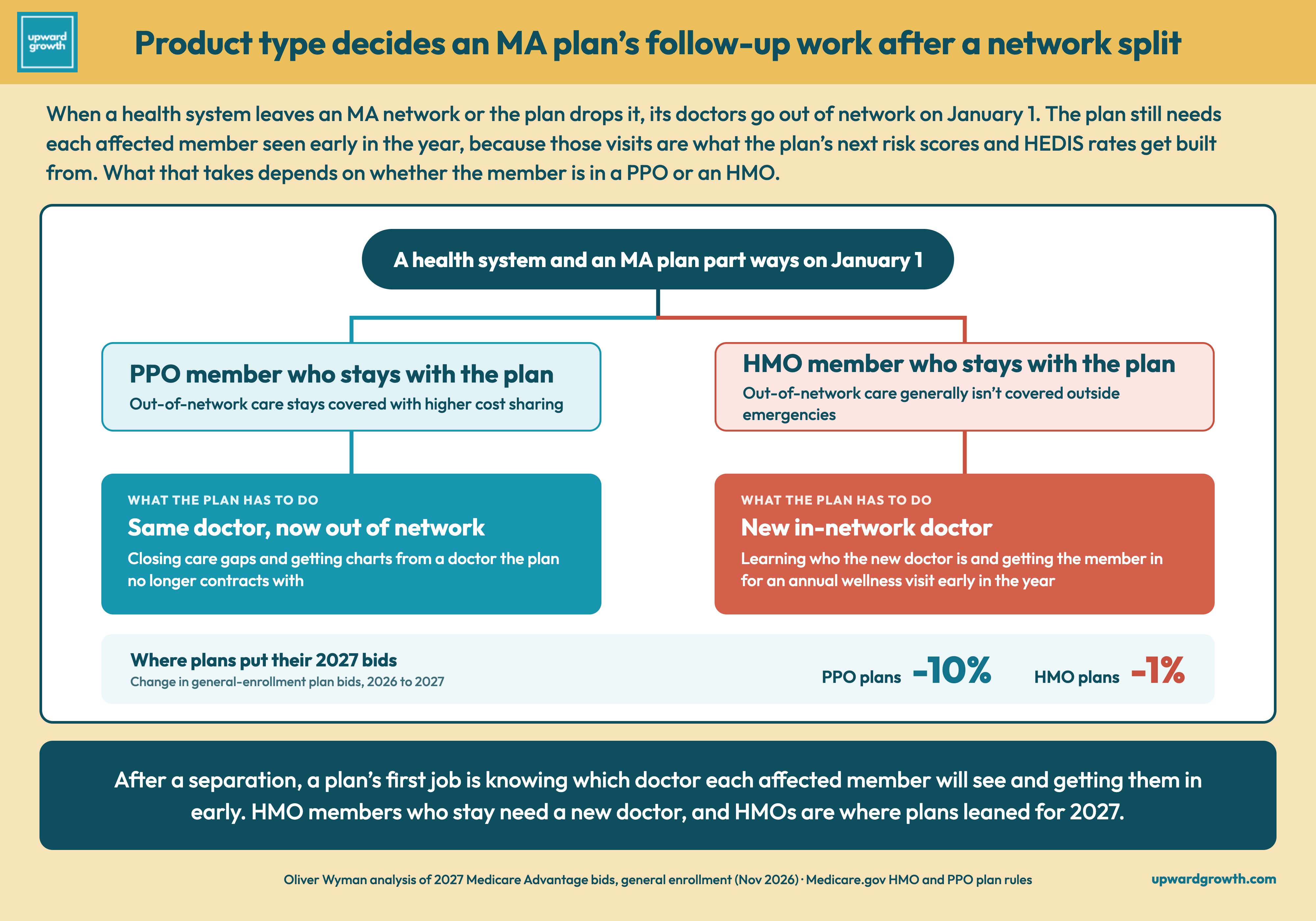
Once the Annual Enrollment Period (AEP) closes December 7, a member’s main way to follow the system is the MA Open Enrollment Period from January 1 through March 31, which allows one change, either to another MA plan or to traditional Medicare. CMS can also grant a special enrollment period (SEP) when a plan loses providers, but it decides on a case-by-case basis. When systems left MA plans in Minnesota in an earlier round of exits, CMS granted an SEP to about 14,000 members of one plan and not to 46,000 members of two others, after finding those plans still had enough other providers.
A member who moves to traditional Medicare to keep their doctors can be turned down or charged more for a Medigap supplement based on their health, outside a few federal protections, and only four states guarantee access to anyone making that switch. For members with health conditions outside those states, following their doctors into traditional Medicare can mean going without a supplement or paying more for one.
Those limits help the health plan maintain enrollment, but the members most motivated to switch are those with the strongest ties to the system, such as members seeing its specialists for cancer, heart disease, or another chronic condition. Those members also tend to carry the most documented conditions, so a small number of switchers can take a larger share of the plan’s risk score revenue with them than their headcount suggests.
Members who stay with the plan rely on its provider directory to find new care, and CMS’s October proposal for 2028 would make a stale directory more expensive. Plans would have to verify listings at least once per 90 days, publicly post their directory accuracy results starting in 2029, and hold members to in-network cost sharing when they rely on a wrong listing, so a plan that’s slow to update its directory after a system leaves would carry that cost. Member experience is where disruption surfaces next, through access measures like Getting Needed Care and Getting Appointments and Care Quickly that remain in the Star Ratings.
Health Systems Weigh a Money-Losing MA Contract Against the Patients They Lose by Leaving
A health system considering an exit faces a choice with no clean answer: stay in a contract that loses money and hope the terms improve, or leave and lose the patients who stay with their plan. Leaving ends the contract’s losses but puts at risk the volume, referrals, and physician arrangements built around those members. Which choice costs less depends on how many patients follow the system, what it can earn from them outside MA, and how much it invested to serve MA in the first place.
The losses from staying show up on the P&L each quarter, while the cost of leaving shows up more slowly, as patients who stay with their plan move their care elsewhere. MA now covers more than half of eligible Medicare beneficiaries, so a system that leaves a large MA plan gives up in-network status for a sizable share of its local Medicare patients, along with the visits, procedures, and referrals that come with them. Leaving also means writing off the infrastructure built for MA, including care management teams and contracting capabilities, while betting that volume holds.
Physicians tied to the system lose more than a fee schedule when a contract ends, because about 43% of MA payments in 2023 went through contracts where providers took on downside risk, a larger share than in traditional Medicare or commercial coverage. When the plan relationship ends, the shared savings, quality incentives, and care management support built into those contracts end with it.
Scripps Health in San Diego left most of its MA contracts with outside payers in January 2024, covering about 32,000 beneficiaries, after losing about $75 million a year on them. Scripps hasn’t reported a quarterly loss since, and inpatient volume largely held, but ambulatory volume may have fallen further, and its physician foundation gave up its full-risk MA contracts. Scripps’ market position helped it keep patients, many of whom switched coverage to stay with its doctors, and Scripps has said the same move would be much riskier for the average hospital. For example, in North Carolina, CarolinaEast Medical Center left Blue Cross NC’s MA network on July 1 and is rejoining on January 1, six months later, without saying publicly what changed.
Traditional Medicare is a weaker fallback in 2027, since the Physician Fee Schedule cuts the conversion factor 2.31% for most clinicians. Meanwhile, Accountable Care Organizations (ACOs) give some systems a better path, with 75% of Shared Savings Program ACOs earning shared savings in 2024, but the patients still have to come with the system.
Launching its own plan lets a system keep the premium along with the visit, which is why integration earns its keep in MA more than in Marketplace or Medicaid, but a health plan requires scale that few systems have. For example, UCLA Health’s MA plans need at least 15,000 members to be sustainable and enrolled about 7,300 in their first year, and Presbyterian is ending most of its MA plans for 2027 after losses tied partly to them.
A system’s loss depends heavily on its market and is hard to predict in advance, while a plan’s loss follows from how CMS now pays and rates MA, which makes it easier to see coming and harder to avoid.
Plans Lose the Visits and Records Their 2027 Risk Scores and Star Ratings Depend On
Two years ago, a plan that lost a health system still had some cushion. It could add diagnoses through chart reviews that weren’t tied to a visit, and part of its Star Rating came from measures it managed through its own operations, like appeals and call center performance. For 2027, CMS narrowed both, and plans shifted their product lineups toward HMOs, where a lost system is hardest to work around. A separation now takes away inputs the plan needs to get paid and rated, with effects that run through 2030 quality bonuses.
CMS finalized excluding diagnoses from unlinked chart reviews and audio-only visits from 2027 risk scores, except for members who switch MA organizations. An unlinked chart review isn’t tied to a specific encounter, and CMS estimates the average impact at -1.53%, or -1.78% without the switcher exception. Because the exclusion applies to 2026 dates of service, a plan that loses a system on January 1 still needs that system’s 2026 encounter data and charts to line up before the early March submission deadline for the July 2027 midyear run. With CMS moving to audit eligible contracts each year, records from the years a system was in network can be requested long after the contract ends.
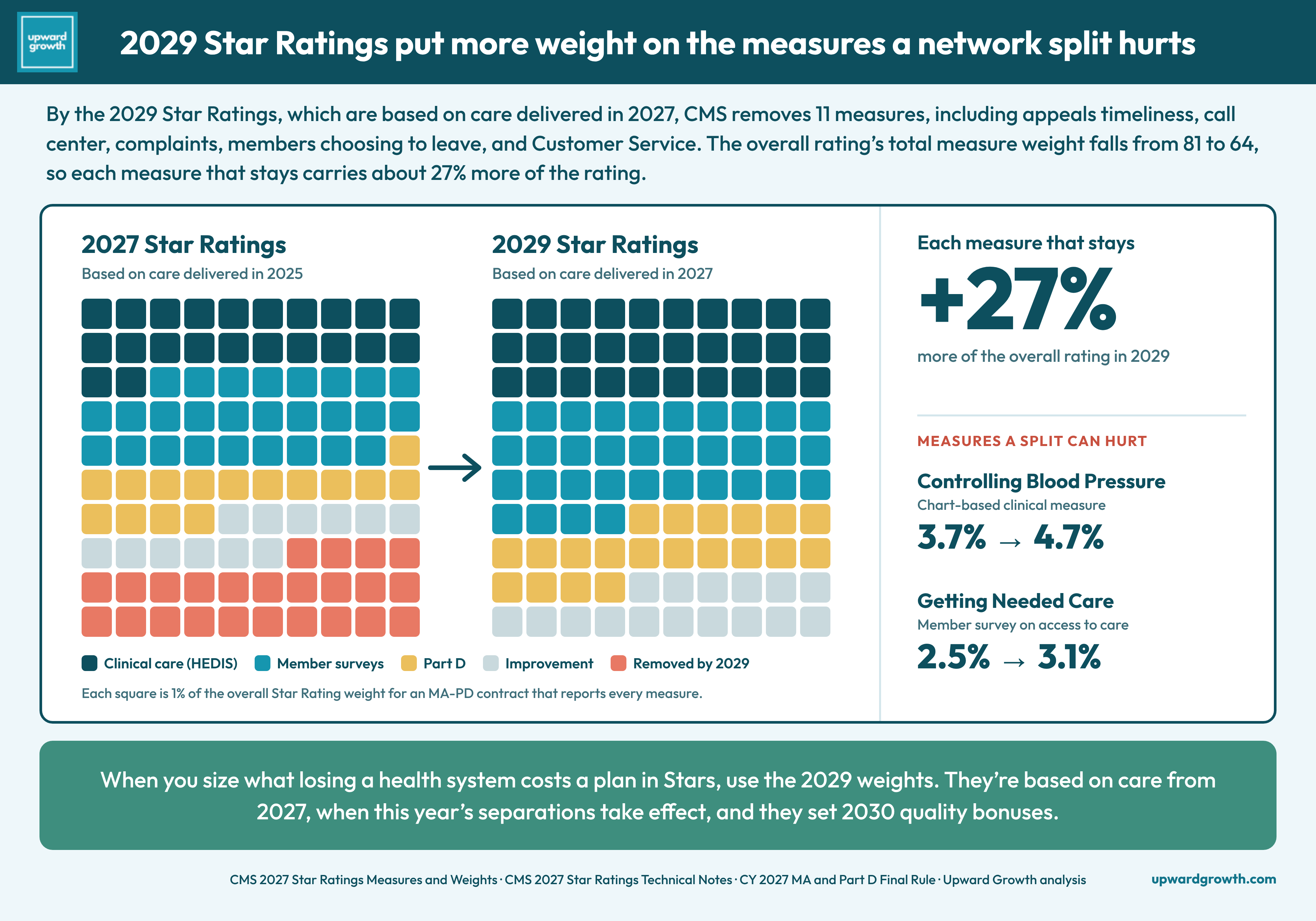
The CY2027 rule moves Star Ratings the same way, removing 11 measures that include appeals timeliness, call center, complaints, members choosing to leave, and Customer Service, with most removals taking effect in the 2029 Star Ratings. Those were largely measures a plan could improve on its own through its call centers, appeals staff, and member services, so removing them shifts relative weight toward clinical measures and member surveys, which depend on the care members get and how they experience it. With depression screening and a returning medication therapy management measure both entering the 2029 Star Ratings, the changes cut the overall rating’s total measure weight from 81 to 64 for a contract that reports every measure, so each remaining measure carries about 27% more weight in the rating.
Health plans also built their 2027 lineups around HMOs, giving them more control over cost and leaving members with fewer options when a large system exits. PPO bid IDs fell about 10% for 2027 while HMO bid IDs barely moved, and Elevance said it will keep emphasizing HMO plans and dual-eligible members. A lineup weighted toward HMOs means more members whose plan won’t cover a departed system’s routine care.
Measurement year 2026 Healthcare Effectiveness Data and Information Set (HEDIS) rates depend partly on medical records from a system that is no longer in the network. For measures scored from chart review, such as blood pressure control and blood sugar control for members with diabetes, a sampled member whose chart can’t be retrieved counts as not meeting the measure unless the plan finds the result elsewhere, and a former network partner has little reason to prioritize those requests. Both measures carry triple weight in the Star Ratings, so a small number of missing charts from one system can move those rates by a few percentage points and pull down the 2028 rating that sets 2029 quality bonuses.
The same plans asking providers for more documentation to adjudicate claims depend on that documentation to capture risk and close quality gaps.
Members whose system left start measurement year 2027 away from their usual point of care, so gap closure and risk capture for 2027 either happen somewhere else or don’t happen. Health plans can fill part of that gap with in-home assessments, video visits, and supplemental data, but in-home assessments already draw repeated federal scrutiny, and a new clinician starts with transferred records and a first visit rather than years of documented history.
When a health system leaves on January 1, the effects show up in 2027 and 2028 risk scores and in the 2028 and 2029 Star Ratings, which set quality bonuses for 2029 and 2030. For a contract near 4 stars, where the bonus is a 5% benchmark increase, one network decision can put two years of bonus payments at risk. How much a given plan feels depends on how many of the contract’s members used the system, how much of its local enrollment is in HMOs, and how much of its rating comes from measures scored by chart review. Where those overlap, a separation that saves money on unit cost can cost the plan in Star Ratings and risk scores for years.
What Plans and Health Systems Should Negotiate Beyond Rates
Because a separation costs both sides, many termination notices end in a new contract, sometimes after the old one has already lapsed. In 2027, that new contract should cover more than rates. If a plan’s risk scores and quality rates depend on a system’s visits and records, then chart access, data feeds, and documentation standards are part of what the system brings to the table and part of what the plan needs in writing.
Ascension Wisconsin’s contract with UnitedHealthcare lapsed on October 1, 2025, and the two reached a new agreement two weeks later, with claims from the gap paid at in-network rates. A quick settlement like that suggests neither side wanted to find out what a longer separation would cost, and CarolinaEast’s return to Blue Cross NC after six months points to a similar conclusion.
The next round of negotiations should put the encounter on the table directly. A system that understands how much a plan’s risk scores and Star Ratings depend on its records is in a position to ask for something in exchange for timely chart access, electronic data feeds, and cooperation with record requests after a contract ends. Health plans have something to offer in return, since the denial and documentation practices systems object to are largely within plans' control. Terms like these won’t replace the rate negotiation, but they give both sides something to trade when rates alone won’t close the gap, and they settle in advance what happens to the data if the relationship ends.
What to Watch Before 2028 Bids Are Due in June
The 2028 bids due the first Monday in June are where plans commit to their assumptions about next year’s membership, risk scores, and Star Ratings. Most of what will show how much this year’s separations cost arrives before then, giving plans and the companies that work with them a few months to adjust.
January membership in affected markets, and switching during the MA Open Enrollment Period through March 31, will show how many members followed their system. The 2028 Advance Notice, expected in late January or early February, will show whether CMS moves risk adjustment further toward the encounter. In Congress, the Medicare Advantage Prompt Pay Act would require MA plans to pay 95% of clean in-network claims within 14 days, which would reduce payment friction in these disputes if it moves. By the May 3 abstraction deadline, plans will know how many measurement year 2026 charts they couldn’t retrieve.
This argument would weaken if most of this year’s disputes settle with payers holding their rates, if contracts that lost large systems show no drag in risk scores, HEDIS, or member experience scores, or if plan-initiated terminations become the main pattern. In that last case, this becomes more a story about plans pruning networks for cost than about a relationship both sides need.
Final Thought
For years, a contract dispute between a health system and an MA plan mostly came down to rates and access. Those still drive the decision to separate, but in 2027 the cost reaches members who can’t easily follow their doctors and stays with the plan for years, from 2027 risk scores to 2030 quality bonuses, because CMS has tied more of what a plan earns to the visit. That’s how letting a system go can be sound margin work and expensive Stars work in the same year.
The visit, and the records behind it, now matter to both sides’ finances in a way they didn’t a few years ago. The full cost of this year’s separations won’t show up in Star Ratings until late 2027 or in bonus payments until 2029, well after the next round of contract talks begins, so the next renewal is the place to settle who gets the records, how quickly, and what happens to them if the relationship ends.
And if you’re working through what this means for your network decisions, your 2028 bid assumptions, or your go-to-market strategy, Upward Growth is a health plan market advisory firm that works with health tech vendors, investors, provider organizations, and management consultancies to build strategy around how health plans actually buy, operate, and make decisions. Contact us here.
Thanks for reading.
Here’s to upward growth,
Ryan Peterson
The frameworks in the weekly Upward Growth newsletter help health plans, health tech vendors, investors, provider organizations, and consultancies understand the health plan market as it continues to shift.
If your colleagues are in those conversations, they should be reading this too.
💰 Invest In Your Team with a Paid Subscription.
💡 Pro tip: Many subscribers expense Upward Growth through their company’s professional development, training, or learning budget. Here’s a one-minute email template to get your manager to approve expensing your subscription.
I’m only partway reading this but this is a banger