

Upward Growth is a health plan market advisory firm. Our weekly newsletter covers payor market strategy, regulatory shifts, and go-to-market insights for health tech vendors, investors, provider organizations, and consultancies competing in the health plan market.
🤝 Work with us on payor market strategy: Contact us
🟦 Connect with the author, Ryan Peterson, on LinkedIn.
🎧 Listen to the Upward Growth Podcast: Apple | Spotify
📰 Newsletter sponsorships: Learn More
Today’s Upward Growth newsletter is sponsored by Florence

Florence is a clinically validated, automated care management platform that uses ongoing, intelligent two-way SMS to support patients through the critical transition from hospital to home.
As your care team multiplier, Florence checks in after discharge, reinforces next steps, identifies barriers, and escalates patients who need additional support. In deployed programs, Florence reduced 30-day all-cause readmissions by 29%, with reductions of up to 56% for CHF and 70% in emergency COPD admissions.
Interested in seeing what Florence could do for your TOC population?
Want to reach health plan buyers, vendor executives, and investors? Contact Us
A few things to share this week:
We’re launching something new! The Upward Growth Debrief, a monthly live call for paid subscribers. I’ll kick off the call with 15 minutes on what’s actually shifting in the market right now, including the stuff that doesn’t make it into the written newsletter, then open it up for Q&A and dialogue. The first one is Friday, November 6 at 1pm ET / 10am PT. Upgrade here if you want in.
Article 2 of the RISE trilogy posted this week: Risk Adjustment Vendor Market Splits Around Specialty Depth. It builds on Article 1 on Plan-Side Risk Adjustment Vendor Evaluation Criteria and gets into how the vendor market is cleaving along specialty lines. Article 3 is still to come, on why the organizational separation between Risk Adjustment and Quality Improvement inside plans is structurally unsustainable, which is also the thread I’ll be moderating at the RISE Risk Adjustment Forum in Orlando on October 28. If you’ll be at the RA Forum, come find me.
A quick heads-up: a subscriber survey is coming to your inbox in the next couple of weeks. I want your honest feedback on what’s landing and what you’d want more of. Thanks in advance for helping me build an even better community here.
The 2027 MA Star Ratings came out October 8, and several threads from this release are worth pulling on. The CMS fact sheet math on 4+ star enrollment share. The dual-eligible dynamics inside Centene’s results. The HOS triple-weighting that showed up in the 2027 measure set and what it signals for 2028. The implications for 2028 bid season planning that is already underway. Any one of those is its own article, and some of them will probably show up in future weeks, or on the monthly Upward Growth Debrief for paid subscribers, where I can get into something without the length constraint of a Tuesday newsletter.
The thread I want to pull this week points at something structural. For the past 15 months, five of the biggest MA plans sat on earnings calls and in SEC filings and told the market, in near-identical language, how they’d fix their Stars problem. Humana called it contract diversification (actually, Elevance called it contract diversification a full year earlier). Aetna called it portfolio rationalization. UnitedHealth called it product repositioning. Centene called it dual-focused derisking. Different labels, but basically the same play. The 2027 release is the first scoreboard against those commitments. Humana produced the exact result its own public framing had modeled. The other four produced declines of 7 to 15 enrollment-weighted points from their 2026 baselines.
Part of the reason I am pulling this specific thread is that we track the quarterly earnings cycles from the five Nationals closely in this newsletter, including the past several Q1 and Q2 reads where I walked through what each plan was committing to and what the market was pricing in. The 2027 release is a natural checkpoint against the past 15 months of their commentary, and I wanted to see what the data actually showed.
Two notes before we go further. H-contracts are the individual Medicare Advantage contracts CMS assigns a Star Rating to, each identified by an H-number. A parent plan like Humana or Elevance operates many H-contracts under its corporate umbrella, and each one carries its own enrollment, its own rating, and its own financial consequences. For the enrollment weighting throughout, I used the CMS September enrollment file from the same year each ratings cycle was released, so the percentages reflect which members were in which contracts when each cycle took effect.
What makes this interesting is that it is the first cycle where the public scoreboard separated two things the plans had been describing as one thing. For 18 months, the margin environment required all five to exit unprofitable membership, concentrate the book in better-rated contracts and better-economic counties, and defend margin into the 2027 payment year. Those exits were defensible margin work, and they also happened to show up in Stars vocabulary because shedding low-rated contracts can lift the enrollment-weighted average by subtraction. The plans could tell both stories as one story, and the investor audience rewarded them for it. The contracts a plan kept required something the exits did not: measure-level investment at the H-contract on the heaviest-weighted CAHPS and HOS items, held across the three-year horizon those measures need to move. Humana was the only one of the five whose book forced that second kind of work, because H-contract H5216 sitting at 3.5 stars with roughly 45% of the company’s MA membership was existential and could not be exited away.
This points to the structural problem that awaits the four plans going into 2028. Every Q2 2026 guidance raise was defended on margin discipline rather than enrollment recovery, which seems to lock the industry into continued exits through 2027. Reversing course on the exits within twelve months would give back the story that justified the raise. Which means the four plans that produced Stars declines in 2027 have the least operational room to pivot to focused contract-level Stars work, because the margin commitments make it hard to add cost at exactly the moment the release says they most need to. The Q3 earnings calls over the next 60 days are the first live moment each CEO has to address this publicly.

How the Five Nationals Framed Their Stars Recovery in Public Disclosures
The five publicly-traded National MA plans (Humana, UnitedHealth, CVS/Aetna, Elevance, and Centene) converged on the same strategic play because they were absorbing the same hit. The 2025 Star Ratings cycle collapsed 4+ star enrollment share across the industry after CMS tightened cut points, applied the Tukey outlier method, and let the hold-harmless provision phase out. Humana’s version was the most dramatic, with H5216 dropping from 4.5 stars to 3.5 in a single cycle and taking roughly half the company’s MA book with it. The other four felt the same pressure in bid math, 2026 QBP exposure, and 2027 revenue planning. The response, across all five, was the same financial move described above, and the Stars vocabulary each plan reached for came from inside that move rather than alongside it.
Humana’s October 2, 2025 8-K named the play most clearly. The filing announced “an MA contract diversification strategy, beginning with the 2026 Annual Election Period beginning on October 15, 2025” and described a “fundamental shift” in the Stars program itself, grounded in strategic choices, data and analytics, and “an ‘always-on’ approach to Stars improvement.” The 8-K disclosed 1.2 million members in 4+ star plans for 2026, roughly 20% of the book, with an average Star rating of 3.61, and projected the 4+ share for 2027 would be “meaningfully higher than the approximately 20% noted above.” Humana also quantified the net Stars headwind for 2026 at approximately $3.5 billion on the Q4 2025 earnings call. The language was more pointed than any of the other four disclosures that followed, because Humana’s problem was more pointed: H5216 at 3.5 stars with roughly 45% of the book had to come back, or the margin story would not hold.
Elevance was first to use the exact “contract diversification” language, a full year before Humana, with CEO Gail Boudreaux introducing the phrase on the October 17, 2024 Q3 earnings call and the company committing several hundred million dollars of 2026 investment on the Q3 2025 call. Aetna reached for portfolio rationalization, spending 2024 trimming its MA footprint and then claiming in its October 2025 press release that “over 81%” of MA members were in 4+ star plans for 2026 and “over 63%” were in 4.5-star plans, with H5522 extending its 14-year streak at 4+. UnitedHealth landed on product repositioning, with the September 2025 8-K/A projecting approximately 78% of membership in 4+ star plans for Star Year 2026 and the Q3 2025 earnings call tying the projection to MA product exits covering roughly 1 to 1.4 million members. Centene framed it as dual-focused derisking, with six states exited and the Q3 2025 10-Q disclosing approximately 60% of MA membership at 3.5 stars or higher and approximately 20% in 4-star contracts.
The disclosures all use remarkably similar language because the plans were running remarkably similar strategies.
How the 2027 Numbers Reconciled Against Each Plan’s Public Projections
The industry headline from the CMS fact sheet on October 8 is that roughly 71% of MA-PD enrollees are in contracts rated 4 stars or higher, a modest uptick from the 2026 cycle. At the industry level, that reads flat-to-slightly-positive. At the parent level, it hides a 74-point Humana swing on one side and 7-to15-point declines across the other four on the other.
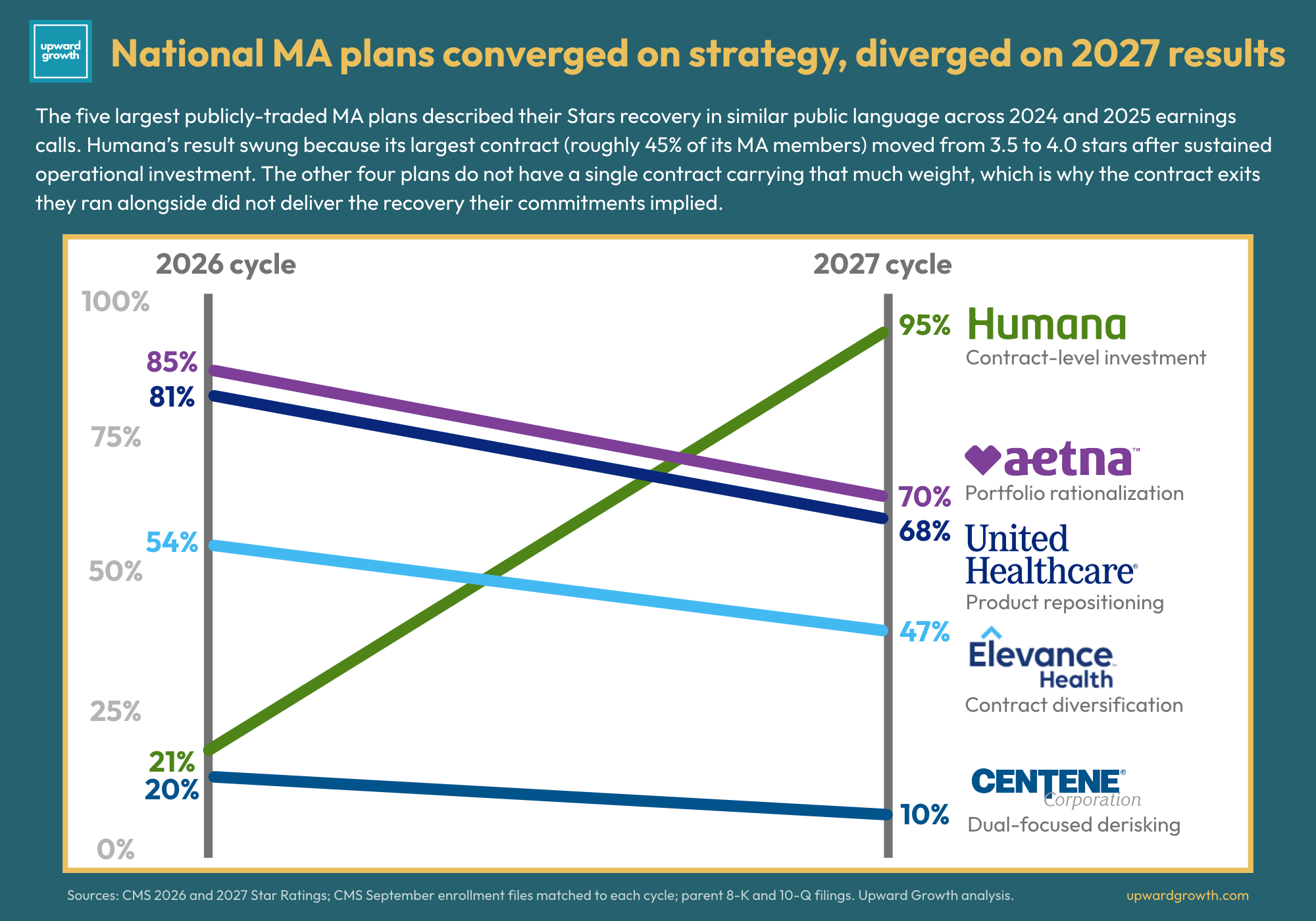
Humana’s Q4 2025 earnings call projected a Stars-normalized doubling of individual MA margin year over year for 2026, with the normalization math requiring the 4+ share to return to roughly its 2025 level. The 2027 release delivered it.
The disclosures use remarkably similar language because the plans were running remarkably similar strategies.
The decomposition is where the Humana story earns itself. The 8-K named two motions, one being steering members into better-rated contracts for the 2026 AEP, the other being the “always-on” operational investment in Stars. Ratings movement at constant enrollment accounts for roughly 73.5 of the 74 enrollment-weighted points. Member redistribution at constant ratings accounts for roughly 0.3 points. The operational Stars investment did essentially all of the work. Twelve Humana contracts crossed the 4+ threshold between the 2026 and 2027 ratings, and the single biggest driver was H5216, Humana’s largest contract at roughly 45% of its MA book, moving from 3.5 to 4.0 stars. H5216 alone carries roughly 12,000 county-plan offerings in the 2027 AEP, and the 12 Humana contracts that crossed the 4+ threshold account for the bulk of what Humana is putting in front of beneficiaries this cycle. Steering happened too, with members moving into H7617 (already at 4.5 stars) and Humana stopping broker commissions on roughly a third of its products to shape the 2026 AEP flow. The 0.3 points is the measure of how little that mattered against H5216’s size.
UnitedHealth’s drop from 81% to 68% is from a baseline the company itself described in September 2025 as “consistent with historical performance.” Aetna’s 85% to 70% is sharper, because the October 2025 press release was built around “strong fundamentals and unwavering commitment,” and a 15-point decline is harder to narrate against that language than against a hedged projection. H5522 held and anchors the Employer Group book, but the Individual MA book outside H5522 moved against the stated story.
Elevance’s 54% to 47% is the signal in the dataset that execution alone does not explain the dispersion. Elevance’s “contract diversification” language codified the phrase in SEC filings across 2025, committed several hundred million in 2026 Stars-aimed investment, and sued CMS twice over Star Ratings methodology (the first time in November 2024 over a rounding issue that cost a contract its 4-star rating, which the Texas court dismissed in August 2025, and the second time in July 2026 over the Clover-related recalculation and the roughly $115 million in 2027 QBP exposure Elevance tied to the dispute, with the emergency injunction denied in August 2026). Elevance walked its 2026 projection from 38% to approximately 55% across 2025 and landed at 54%, reconciling cleanly to its own disclosure. The 2027 cycle delivered 47%. Being first on the language, committing material investment, suing CMS twice, and still delivering a 7-point decline from the recovery is the pattern that makes the dispersion worth explaining.
Centene’s 20% to 10% rounds out the four, and the forward-looking footprint signals a deeper retreat than the earnings call language suggested. The CY 2027 Landscape file shows Centene cut its county-plan footprint by roughly 30% going into the 2027 AEP, dropping 11 contracts entirely with zero replacements, while the other four Nationals cut 2% to 5% of their footprint. For a plan whose stated approach is derisking toward lower-income seniors and whose leadership has publicly questioned whether Stars methodology risk-adjusts appropriately for complex low-income populations, the 2027 result and the forward footprint reinforce the ceiling problem Centene has been describing for most of the past year.

Margin Work and Stars Work Are Not the Same Operational Motion
Shedding low-rated contracts and exiting unprofitable counties does two things at once. It cuts the margin bleed, which is why every one of the Q2 2026 guidance raises was defended on protecting the raise rather than growing into it. And it lifts the enrollment-weighted Stars average by subtraction, because the contracts and counties being shed are concentrated in the lower-rated end of each plan’s book. The 2027 release separated what the plans had been telling as one story. Moving the underlying contracts the plan keeps required a different kind of work, focused at the H-contract level on the specific measures CMS is weighting heaviest, and sustained over the three-year horizon it takes for CAHPS and member experience measures to actually move. Four of the five were running the margin playbook as the primary motion and letting subtraction carry the Stars number. Humana was running both, because H5216’s size meant exits alone could not fix the problem.
Aetna said the margin story most directly. “Margins over membership,” which is how CFO Tom Cowhey framed it to investors in May 2024. The 160 counties Aetna exited going into 2026, the cuts to OTC allowances and transportation benefits, the H5522 protection posture, all of it was margin work. The Stars benefit was the subtraction effect from exiting the lowest-rated contracts and counties. Aetna’s bet was that the subtraction effect plus H5522 holding would carry the enrollment-weighted number. H5522 held, but the subtraction effect was not enough on its own.
UnitedHealth was running the same playbook with different vocabulary. The 109 counties UnitedHealth exited going into 2026 (later revised to roughly 225 across the full repositioning) were primarily PPO plans in rural areas where CMS funding cuts, utilization pressure, and the benchmark math made the economics unworkable. Bobby Hunter, who runs UnitedHealth’s government programs, framed it directly: “The combination of CMS funding cuts, rising healthcare costs and increased utilization have created headwinds that no organization can ignore.” The pivot from PPO to HMO was about network discipline and total cost of care. The 78% projection in the September 2025 8-K was positioning the cleaned-up remainder, with the Stars benefit coming from exiting the lowest-rated contracts rather than from operational investment at the H-contract level.
Elevance did the measure-level work on top of the margin exits. The several hundred million dollars committed on the Q3 2025 earnings call went into member experience, and the investment itself is not in dispute. The problem is that it was spread across many contracts without a single one carrying enough enrollment weight to swing the number by itself. Elevance’s book has no H5216; rather, it has a long distribution of mid-sized contracts, which means focused measure-level work has to show up across many contracts at once, on the measures CMS is weighting heaviest in the specific cycle being measured. The 2027 cycle tripled the weight on CAHPS and HOS measures that take roughly three years of sustained work to move half a star on. The Elevance investment was in the right category and probably too late in the cycle to show up in 2027. The lawsuits are the hedge for exactly that timeline. If the operational work does not close the gap fast enough, the methodology fight is the backup.
Centene’s book is a different problem (which is why I would not read Centene’s 20% to 10% as a strategic failure in the same category as the other three). Centene has been saying publicly for most of three years that the Stars methodology does not risk-adjust appropriately for dual-eligible and low-income populations, where the structural ceiling on CAHPS and member experience outcomes is lower regardless of operational work. Independent analysis of Star Ratings variation across contracts with high D-SNP and LIS enrollment supports that argument. Centene’s 2027 strategy of further simplifying the footprint and leaning into dual-eligible with Medicaid integration accepts the ceiling and tries to make the economics work inside it rather than fight it.
A quick sidebar before moving on. Alignment Healthcare is not a National plan, but the single-contract concentration variable showed up in reverse at Alignment in the same release, and the mirror image is worth naming. Alignment’s California HMO contract H3815 serves roughly 75% of the company’s health plan membership and dropped from 4.0 stars to 3.5 for 2027. ALHC shares fell more than 20% on the news. Alignment’s 8-K attributed the decline to higher industry cut points and declines in triple-weighted HOS and Part D measures, which is a plan independently naming the measure-exposure variable that showed up across the five Nationals in this cycle. Alignment is pursuing administrative appeals and filed suit in D.C. District Court on October 10, asking the court to vacate the 2027 ratings before the 2028 selling season, with the complaint claiming the decline costs Alignment more than $200 million in 2028 payments. The suit is separate from Alignment’s still-pending 2026 ratings suit, though it rests on the same argument about CMS changing methodology outside notice-and-comment rulemaking. The mirror image is the point: single-contract concentration can swing the full enrollment-weighted number in either direction, and 2027 produced both the upside case (Humana’s H5216 moving from 3.5 to 4.0) and the downside case (Alignment’s H3815 moving from 4.0 to 3.5) in the same release.
The structural constraint for 2028 is why these four plan-by-plan reads matter past this cycle. Every one of the five raised full-year 2026 guidance in Q2, and every raise was defended in terms of margin discipline rather than enrollment recovery, extending the 18-month reset the industry has been working through rather than signaling a pivot out of it. The four plans that produced declines face a harder funding question going into 2028 than they would in a normal cycle, because adding focused contract-level work to the P&L runs against the margin story the Q2 raise was built on. Humana already carries that cost in its base. The other four would be adding it fresh.
What Plan Finder Shows This Week and What the Q3 Calls Will Be Measured Against
The compounding effect of the 2027 release starts this week, not in 2028 bid season. The 2027 AEP opened October 15, and the dispersion is sharper in what plans are actually offering for 2027 coverage than in the enrollment-weighted scoreboard behind it.
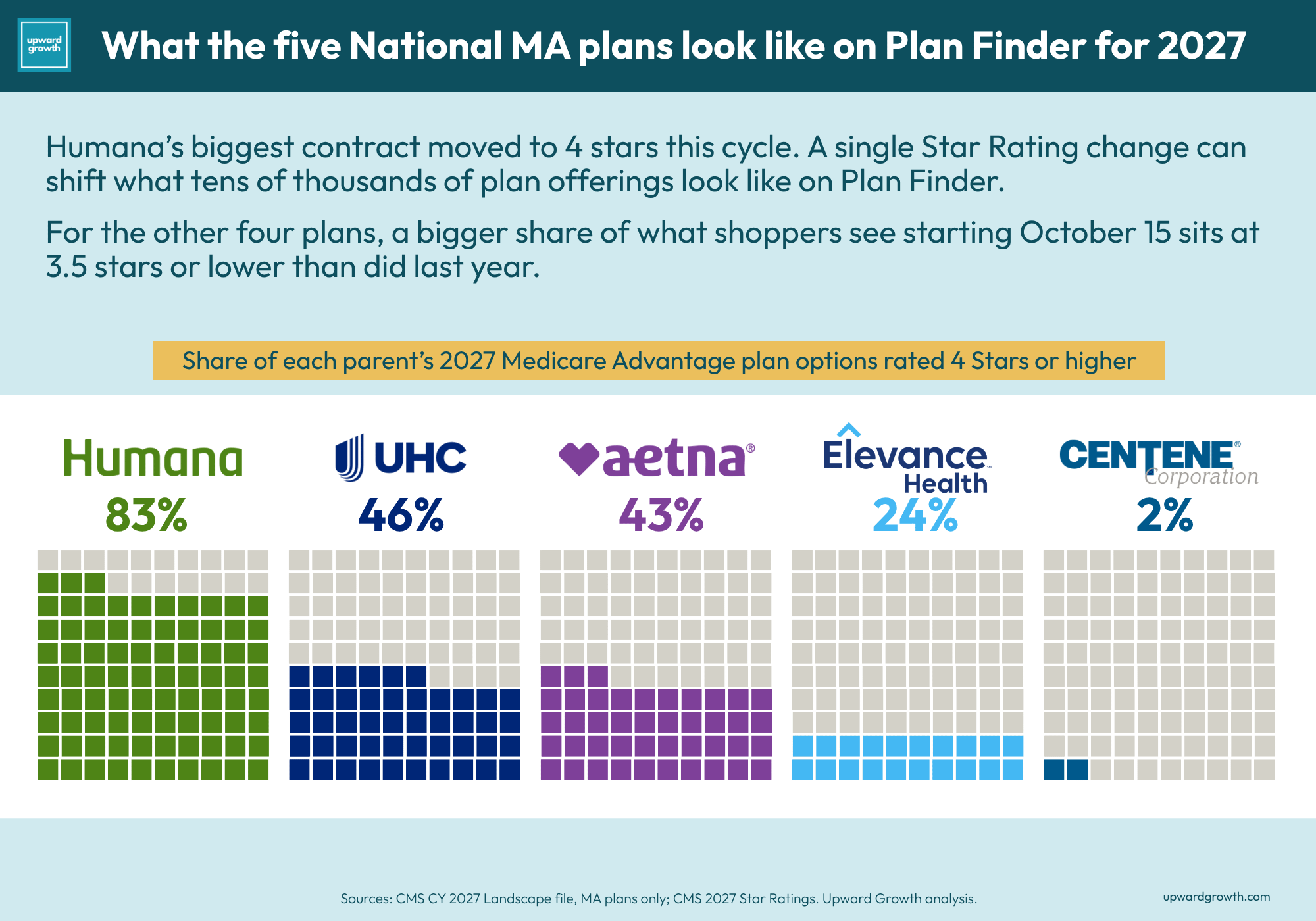
The star rating next to each plan is one of the strongest signals in the AEP shopping experience. The enrollment flows that come out of this cycle will compound the dispersion the 2027 ratings created, independent of what the 2028 QBP math eventually says.
The Q3 earnings calls over the next 60 days are where each CEO has to address the gap between the margin raise they committed to in July and the Stars result the October release delivered. The calls run from Humana on November 6 through Aetna in early December, and what each one says about the gap, measured against what each one said over the past 15 months, is the clearest 2028 positioning signal the market will get before bid season.
What to listen for on Humana’s call is how much the company leans into the “always-on” infrastructure as replicable across the portfolio versus how direct it is about H5216 being both the problem and the solution, and what the focus is now that the big contract is back at 4.0.
UNH’s 13-point decline sits against a September baseline the company itself called consistent with historical performance, which makes the county exits read as cost-driven work and the Stars decline read as a separate question about the contracts UNH kept. Aetna’s 15-point decline sits against stronger language from the October press release, with H5522 holding up the Employer Group book and the Individual MA book carrying the full decline. In both cases, the margin exits did not deliver the enrollment-weighted lift the subtraction math implied.
Elevance’s 7-point decline from the 2026 recovery is the harder one to narrate, because the operational investment and the lawsuits were both real. What the market will be listening for on that call is whether Elevance addresses the CAHPS and HOS weighting shift, the three-year horizon on member experience movement, and the Clover-related recalculation it is still litigating.
Centene’s Q3 call is a different kind of question entirely. The 20% to 10% result combined with the roughly 30% footprint cut and 11 dropped contracts going into the 2027 AEP makes it harder to defer whether to keep fighting the ceiling or build inside it. The 2027 strategy of simplifying the footprint and leaning into dual-eligible with Medicaid integration is directionally the second answer. Whether Centene leadership says that out loud or keeps hedging between the two is a story worth watching.
The CMS Technical Notes drop later this fall and will show which measures drove which movements for which contracts across all five. That is the independent check against whatever each CEO says on their Q3 call.
The 2027 release is also the last cycle measured against the environment the plans planned for. The specific provisions and the pattern behind them in the CY 2027 Final Rule reshape the measure set for 2028 and 2029 toward clinical outcomes and away from administrative process, which rewards focused operational Stars investment at the H-contract level even more than 2027 did. The guidance commitments the five made in Q2 will meet that reshaped measure set in the 2028 bid cycle. Whichever of the four declining plans finds a way to fund contract-level operational Stars work inside the margin commitments will have the cleanest 2028 story.
Thanks for reading.
Here’s to upward growth,
Ryan Peterson
The frameworks in the weekly Upward Growth newsletter help health plans, health tech vendors, investors, provider organizations, and consultancies understand the health plan market as it continues to shift.
If your colleagues are in those conversations, they should be reading this too.
💰 Invest In Your Team with a Paid Subscription.
💡 Pro tip: Many subscribers expense Upward Growth through their company’s professional development, training, or learning budget. Here’s a one-minute email template to get your manager to approve expensing your subscription.