

Upward Growth is a health plan market advisory firm. Our weekly newsletter covers payor market strategy, regulatory shifts, and go-to-market insights for health tech vendors, investors, provider organizations, and consultancies competing in the health plan market.
🤝 Work with us on payor market strategy: Contact us
🟦 Connect with the author, Ryan Peterson, on LinkedIn.
🎧 Listen to the Upward Growth Podcast: Apple | Spotify
📰 Newsletter sponsorships: Learn More
Today’s Upward Growth newsletter is sponsored by Invent Health
Last week we shared why we built Invent Health as the all-in-one payer intelligence platform. Now we want to make it simple for you. If you advise a health plan, sell into one, or run one, our team is here to help. Bring us the hardest problem on your list in risk adjustment, coding, encounter submissions, or quality. Our experts will work through it with you and show you how our platform handles it, the same way it does today for a top-20 Medicare Advantage plan. - Rohit Bhardwaj, Founder and CEO, Invent Health
Interested in sponsoring Upward Growth? Contact Us
A few quick updates before we get into this week’s Q3 earnings read:
Last Friday we held the first Upward Growth Debrief, and it was a great group! Thank you to those of you who joined. It was so good to connect live and hear directly from this community about what’s on your minds right now. The next Debrief is Friday, December 4 at 1pm ET / 10am PT, and paid subscribers will get the Zoom link by email a couple of days before. If you’ve been thinking about upgrading to a paid subscription, now is a good time to join us ahead of the December call.
Next week I’ll be at HLTH in Las Vegas, catching up with clients, friends, and hopefully a few readers I’ve only known by email so far. If you’ll be there, send me a note and let’s find time. And if your team is planning early 2027 launches and has been thinking about newsletter sponsorship, let’s talk.
Finally, the Upward Growth audience survey is open for two more weeks, through November 24. It takes about three minutes, and your answers will directly shape where the newsletter and podcast go next. If you haven’t had a chance yet, you can take it here.
The Q3 earnings calls put specific 2027 numbers behind this year’s margin discipline, and hitting them now depends on operating work more than on further exits. UnitedHealth opened the cycle on October 13 and Humana closed it on November 6. In between, CVS announced it’s splitting in two, Cigna defended its structure the next morning, and Molina was the only one of the eight public payers in this article that didn’t raise its 2026 outlook.
Each of those made its own headlines, but taken as a group, they describe a market that has decided what it will defend in 2027 and is now waiting on what it can’t control, starting with state Medicaid rates and the next Medicare risk adjustment decision.
The spring calls set the margin-over-membership tone, followed by the exits and raised guidance the second-quarter calls locked in.
The article starts with what the raises say about where 2027 margin has to come from, then covers why CVS and Cigna kept the insurer, the pharmacy benefit manager (PBM), and care delivery together, why Medicare Advantage (MA) growth is going to plans that can absorb the members others exit, how work requirements will decide whether Medicaid’s recovery holds, and why the Affordable Care Act (ACA) Marketplace is consolidating around specialists and Blues.
Those 2027 numbers are also what Q4 and Q1 spending decisions inside these plans will be measured against.
Q3 Raises Came From Shrinking, Which Leaves 2027 to Operations
Third-quarter earnings calls usually do two jobs, closing out the current year and starting to shape expectations for the next one. This cycle leaned hard on the second job, and the raises that headlined it came with an asterisk: several plans that raised their 2026 outlook did so with fewer members than a year ago.
That combination shows how 2026 earnings got rebuilt. UnitedHealth, Elevance, and Centene raised while carrying meaningfully smaller MA, Medicaid, or ACA enrollment, and CVS raised after Aetna walked away from the exchanges. Much of the recovery came from pruning, meaning exits from the counties, products, and members that weren’t paying for themselves, along with repricing and benefit cuts on what remained. That approach has a limit, because a plan can only walk away from an unprofitable book once.
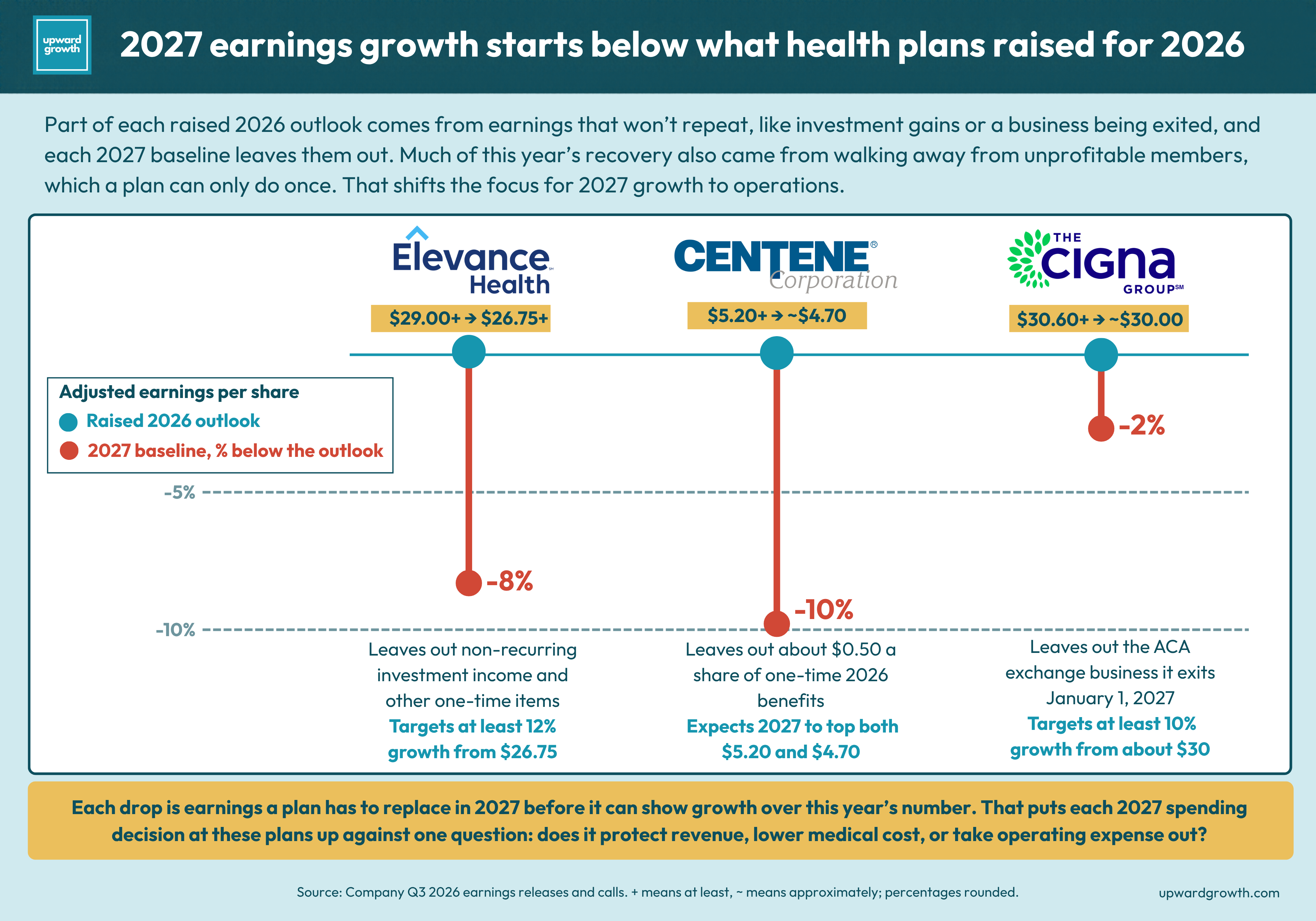
Their 2027 guidance reflects that limit. Elevance, Centene, and Cigna each told investors to measure 2027 growth from a lower baseline than the 2026 number they had just raised to, setting aside items like outsized investment income, one-time benefits, and, in Cigna’s case, the ACA business it leaves at year-end. Molina built its early 2027 outlook without assuming any improvement in its legacy Medicaid and Medicare cost ratios. When a CFO volunteers a lower jumping-off point, it signals that 2027 has to be earned through operations, meaning state rates that keep pace with cost trend, medical costs that land where they were priced, and lower operating expense.
Cost came up again and again on the calls. UnitedHealth tied its lower operating cost ratio to modernizing operations and streamlining administration, and Cigna gave the most detail on where its savings will come from, saying 20 to 30 percent of a new $3 billion productivity target will come from how it manages suppliers, partners, and vendors. After a year of shrinking back to margin, health plans need operations to carry 2027, and that changes what they’re willing to buy.
Inside plans where Compliance and Legal have picked up a bigger say over vendor decisions, Finance now has a public 2027 number to screen against too. A new contract has to either protect the 2027 figure the CFO just defended to investors or take cost out of the business. My guess is that spending that clearly does one of those moves faster through Q4 and Q1 than it has all year, with the rest pushed later into 2027.
Medicare revenue for 2027 is mostly locked, since the Centers for Medicare & Medicaid Services (CMS) finalized 2027 MA rates in April and held off on the risk adjustment model recalibration it had proposed. The calendar year (CY) 2028 Advance Notice, expected in late January or early February, will show whether that deferral holds for another year, and it arrives in the same weeks several of these plans give formal 2027 guidance. That makes it the earliest outside check on the commitments reaching past 2027, beginning with Humana’s 3 percent MA margin target for 2028.
CVS and Cigna used back-to-back days to show what they intend to own while they deliver on those numbers, and both arrived at the same answer.
Integrated Payers Are Keeping the Insurer, PBM, and Care Delivery Together
CVS announced its separation the morning of November 4, and Cigna reported the next morning. Side by side, those two days are one of the clearest signals this year about what the largest integrated payers think is worth owning: a health plan, a PBM, specialty pharmacy, and care delivery under one corporate roof, with the businesses outside that core being separated, exited, or reviewed.
In the CVS split, the core stays with CVS Health, while the retail drugstores, mail pharmacy, and walk-in clinics become a separate company in the first half of 2028. In effect, CVS is unwinding the retail-and-PBM combination that began with the 2007 Caremark merger, while the 2018 Aetna deal stays intact.
Cigna made its version of the argument a day later by leaving its structure alone. Its third-quarter growth came from its health plan and specialty pharmacy businesses, and when analysts raised state-level pressure on vertical integration, Cigna defended that setup rather than signaling any openness to change. That stance carries weight because Cigna has already sold or exited what didn’t fit, from the MA business that went to Health Care Service Corporation (HCSC) to the ACA exchange line it leaves at year-end, and now runs each business line through a portfolio test that weighs management focus, scale, standardization, and automation. CVS applied a version of that logic to a much larger asset and reached a similar answer.
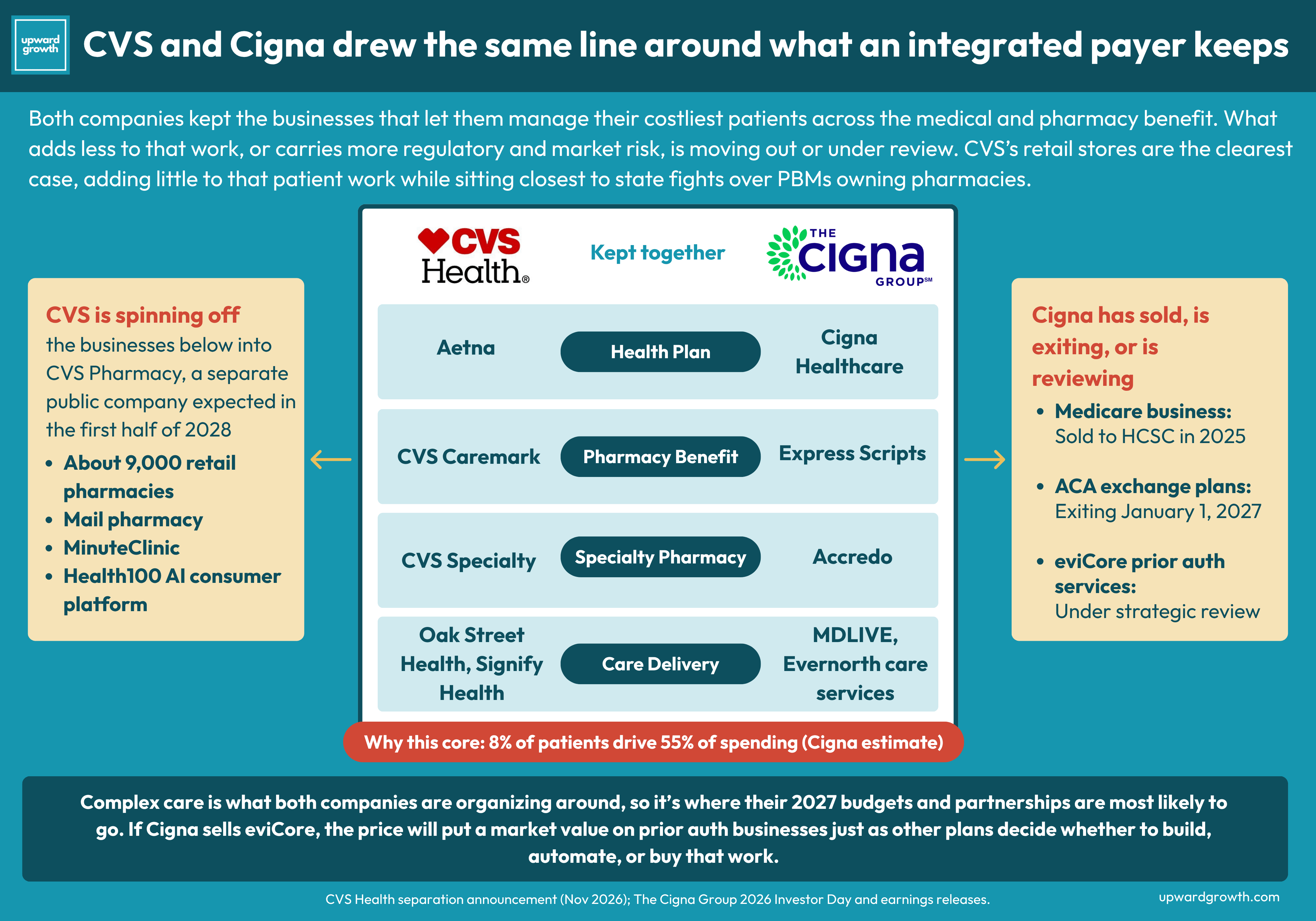
As best I can tell, both companies are keeping that core because of where cost is concentrating. Cigna estimates that 8 percent of patients now drive 55 percent of health care spending, and specialty drugs make up more than half of drug spend. A company that holds the medical benefit, the pharmacy benefit, and specialty pharmacy can follow and manage those high-cost patients across each of them, while a national drugstore chain adds little to that work and sits closest to the vertical integration challenges lawmakers have been raising, especially state fights over PBMs owning pharmacies. Separating retail keeps that combination intact and moves the most exposed business out.
Cigna’s eviCore review remains the one open item in that picture. The company hasn’t added anything since putting its utilization management (UM) and prior authorization business under review, and the review fits the pattern, because eviCore sells UM services to other health plans, a different business from managing Cigna’s own complex patients. Whenever a deal lands, the price becomes the reference point for how UM and prior auth assets get valued, right as plans decide how much of that work to automate, bring in-house, or keep buying.
CVS’s version of that model includes primary care and in-home health. Humana spent this year testing a related idea in Medicare Advantage, that a plan with strong Stars and care management operations can take on the members its competitors walked away from.
Medicare Advantage Growth Is Going to Plans That Can Absorb Exits
For the better part of two years, the message from the public payers on MA has been some version of margin over membership, and the 2027 plan lineup shows how seriously they meant it. Seniors will have fewer plans to choose from in 28 states, Centene cut nearly a third of its lineup, and UnitedHealth and Aetna each pulled standard plans from more than 100 counties. Humana went the other way, growing both individual MA and its dual eligible special needs plan (D-SNP) membership by roughly a quarter this year, with much of that coming from members its competitors let go.
For 2027, Humana says it priced its bids for margin first, retention second, and growth third, and trimmed plans where it wasn’t performing, yet it expects membership to rise again. Its bet is that a larger membership base can produce the 3 percent pre-tax MA margin it is targeting for 2028.
Humana’s Star Ratings recovery is what makes that bet plausible. Its largest contract, H5216, held about 45 percent of its MA members and nearly all of its group MA business when it fell from 4.5 stars to 3.5 two years ago, and it is back at 4 stars for 2027. Across the company, 95 percent of Humana’s MA members are now in plans rated 4 stars or higher, up from 20 percent for 2026. Clearing the bonus threshold on that contract restores quality bonus payments for a large share of Humana’s members in 2028, which gives it room to fund both richer benefits and better margins.
That leaves two approaches to MA on the record. UnitedHealth, Elevance, Centene, and Aetna are rebuilding margin by contracting, exiting unprofitable counties and products and bidding 2028 against a smaller footprint. Humana is rebuilding it by absorbing displaced members and relying on its Stars and care management work to make them profitable. Each is defensible, and they lead to very different 2028 bids.
HCSC shows how hard absorbing can be when the scale arrives at once. It bought Cigna’s Medicare business in a $3.3 billion deal that closed in March 2025, nearly quadrupling its MA membership, and for 2027 it is cutting its MA footprint from 948 counties to 478, with the deepest cuts in its own Blue Cross Blue Shield states (Texas alone goes from 229 counties to 47).
My read is that the difference comes down to what a plan brings to the members it takes on. Humana folded its growth into a Stars and care management operation it had spent two years rebuilding, and the 2027 ratings show that work paying off. HCSC took on Cigna’s members as a largely separate operation from its Blues plans, at least as of earlier this year. That’s a thesis rather than a proven claim. HCSC has had the Cigna business for nearly two years, while Humana’s absorbed members arrived in January, so 2027 is the year Humana’s version gets tested at this scale.
The risk in Humana’s strategy lives in the members that drove its growth. More D-SNP members and new chronic condition special needs plans (C-SNPs) push more of its membership into dual-adjacent populations, where an HHS Office of Inspector General (OIG) review of D-SNP risk adjustment practices is due in 2027 and the risk model recalibration CMS deferred could return for 2028. The compound pressure building around dual-adjacent SNP growth applies to whoever does the growing, and Humana is also pricing 2027 for higher medical and Part D cost trend than this year.
Medicaid plans face their own version of a shifting membership, except that the state sets the rate and, beginning in January, federal work requirements change who qualifies to stay enrolled.
Medicaid Rates Are Catching Up to Trend as Work Requirements Shift Acuity
Across the Medicaid-heavy public plans, the Q3 message was consistent: state rates are finally catching up to cost trend, and 2026 looks like the bottom. What decides whether that recovery shows up in 2027 is narrower: states pricing the change in who stays enrolled once federal work requirements begin in January.
The rate numbers back that up. Molina said it is “likely observing the beginning of the turn in Medicaid margins”, with 2026 rates expected to average about 4.5 percent and its known January renewals closer to 7 percent. UnitedHealth called 2026 its trough year and expects Medicaid margins back to target by the end of 2028, Elevance said Medicaid ran ahead of its outlook on recent rate actions, and Centene held its composite rate near 5 percent with Medicaid on track for the year.
Those rates now have to absorb a change Medicaid plans have never priced at national scale. Under the One Big Beautiful Bill Act (OBBBA), expansion adults ages 19 to 64 have to show 80 hours a month of work, school, job training, or community service to stay covered beginning January 1 unless they qualify for an exemption, and states have to recheck their eligibility every six months instead of once a year. The Congressional Budget Office projected about 5.3 million fewer people covered over the next decade from the work requirement alone. For health plans, that’s a new hurdle between the rate a state sets and the members that rate is meant to pay for.
After a year of shrinking back to margin, health plans need operations to carry 2027, and that changes what they’re willing to buy.
Plans pricing for work requirements expect the members who fall off to skew healthier, losing coverage through paperwork and verification friction, while sicker members, who are more likely to qualify for an exemption or to fight for their coverage, stay on. Nebraska’s first six months under work requirements offer an early look at how that plays out. Enrollment shrinks while costs rise per member, so a 2027 rate that covers trend but misses that shift still pushes a plan’s medical loss ratio the wrong way.
Molina and Centene are coming at that uncertainty from opposite ends. Molina is planning for it in its own outlook, assuming a 6 percent Medicaid membership decline and higher acuity in its 2027 cost trend without counting on any margin improvement, while Centene is pressing states to price it directly, with a few states in its July rate cohort already accounting for the shift and others in active discussions. Plans concentrated in expansion states will need to do both, building the shift into their own forecasts while pushing their states to recognize it in rates.
The rules themselves are also in motion. CMS’s June interim final rule narrowed who counts as medically frail, and 24 attorneys general and two governors sued to block those provisions. Whatever the court decides will reshape who gets exempted, and with it the acuity of who remains, which is exactly what state actuaries are trying to price right now.
So the Medicaid recovery built into the Q3 commitments needs 2027 rates that cover acuity as well as trend. The early read suggests most states are covering trend, which makes acuity the place where 2027 Medicaid results are likely to split. My guess is the shortfalls show up first in Q2 2027 results at plans concentrated in expansion states, right as those state actuaries begin building 2028 rates.
The ACA Marketplace Is Consolidating Around Specialists and Blues
While Medicaid’s membership is being reshaped by policy, the ACA Marketplace is being reshaped by which payers choose to stay. The moves of the last eighteen months add up to a fairly direct statement about who the individual market belongs to now. Aetna left for 2026, Cigna leaves for 2027, UnitedHealth has shrunk its exchange business, and Molina is cutting its footprint roughly in half, while Centene, Oscar, and Elevance are holding or growing. The national payers with large PBM and employer businesses are pulling back hardest, and the plans holding on are the ones whose core business is the Marketplace or who are anchored in a home state.
A lot of that comes down to what the risk pool has become. Without the enhanced premium tax credits, the people still paying premiums skew sicker, and benchmark silver premiums are up an average of 42 percent since 2025. Pricing that pool well means pricing for something that shifts from year to year, and a company with large employer, Medicare, or PBM businesses has less reason to live with that volatility than a Marketplace specialist, or a Blue whose home state isn’t optional.
I wrote about the split between plans that priced 2027 for a pool that keeps getting sicker and plans that priced for it to stabilize, and Q3 left that split intact. Centene, which priced for continued selection, has returned its Marketplace business to profitability and is holding nearly its full footprint, while Molina, which priced closer to stabilization, is shrinking to the states it believes it can price and saved its turnaround language on the Q3 call for Medicaid. When a plan chooses which business to be optimistic about out loud, that choice tells you where its leadership sees a path to profit.
Oscar is the strongest evidence of where the market is heading. In the same year Aetna and Cigna walked away, a company focused solely on the individual market is on track for the strongest financial year in its history, grew membership by more than a quarter, and expects to take more share in 2027. This year suggests the Marketplace now rewards operators whose pricing, technology, and member experience were designed specifically for this market, as competitors with other priorities step back.
Blues plans fill out the rest of that picture. Elevance raised its expectations for individual ACA membership this year, and a Blue anchored in its home state often absorbs displaced members because leaving its primary market isn’t an option the way it is for a national payer. I’d expect the 2027 Marketplace in most states to look like the local Blue plus one or two specialist operators, with fewer integrated nationals in the mix.
That shape matters beyond the exchanges. Fewer payers competing for individual members means fewer choices in thinner counties, and the plans that stay set pricing and networks with less competitive pressure. It also narrows the buyers for ACA-focused services and technology to a small group of operators, which favors anyone who understands how those few plans price and operate.
November’s election adds a variable without settling it. Democrats won both chambers on November 3, picking up seven Senate seats, which moves restoring the enhanced premium tax credits up the agenda. The new Congress isn’t seated until January, most legislation needs 60 Senate votes, and the President keeps his veto. I’d keep restoration out of the base case for 2028 assumptions and treat it as upside, especially since the selection already baked into the pool doesn’t reverse on its own.
Open enrollment is the first look at how that consolidation holds up, as more than 350,000 Cigna members across 11 states choose new coverage, with December 15 the deadline for plans that begin January 1. Where those members land, and whether they keep paying premiums, shapes how the consolidated market prices 2028. If a meaningful share go uninsured instead, the conversation turns to coverage gaps in counties where competitors have already thinned out. February effectuation data, set against the roughly 86 percent of 2026 enrollees who paid their first premium, will show which way it broke.

Final Thought
The public payers spent 2026 rebuilding margin mostly by getting smaller, and the Q3 calls showed how little room that approach has left. What shrinking rebuilt now has to be held through operations: running the insurer, PBM, and care delivery as one business, turning absorbed members into profitable ones, getting state rates to cover acuity, and pricing a smaller, sicker ACA pool correctly.
Some of that resolves quickly. The CY 2028 Advance Notice and the Q4 calls land within weeks of each other early next year, with February effectuation data right behind them. The rest plays out over a longer horizon, through Medicaid results in mid-2027, the OIG’s D-SNP review, the eviCore outcome, and a CVS separation that runs into 2028.
If you’re working through what this means for your positioning, your messaging, or your go-to-market strategy, Upward Growth is a health plan market advisory firm that works with health tech vendors, investors, provider organizations, and management consultancies to build strategy around how health plans actually buy, operate, and make decisions. Contact us here.
Thanks for reading.
Here’s to upward growth,
Ryan Peterson
The frameworks in the weekly Upward Growth newsletter help health plans, health tech vendors, investors, provider organizations, and consultancies understand the health plan market as it continues to shift.
If your colleagues are in those conversations, they should be reading this too.
💰 Invest In Your Team with a Paid Subscription.
💡 Pro tip: Many subscribers expense Upward Growth through their company’s professional development, training, or learning budget. Here’s a one-minute email template to get your manager to approve expensing your subscription.