

Upward Growth is a health plan market advisory firm. Our weekly newsletter covers payor market strategy, regulatory shifts, and go-to-market insights for health tech vendors, investors, provider organizations, and consultancies competing in the health plan market.
🤝 Work with us on payor market strategy: Contact us
🟦 Connect with the author, Ryan Peterson, on LinkedIn.
🎧 Listen to the Upward Growth Podcast: Apple | Spotify
📰 Newsletter sponsorships: Learn More
Today’s Upward Growth newsletter is sponsored by Kbrax

Kbrax: Integrated Care Platform for Health Plans
25 years of experience deploying care coordination at scale for the nation’s largest payers. Kbrax helps health plans reduce readmissions, close care gaps, and drive measurable cost savings by integrating physical and behavioral health into one platform. From risk stratification to automated care journeys to member engagement via mobile app, it’s the care navigation infrastructure your clinical teams actually need. Serving Medicaid, Medicare Advantage, and commercial plans.
Interested in sponsoring Upward Growth? Contact Us
Some updates from me before we get into this week’s newsletter:
First, I'll be speaking later this month at UiPath Fusion (Sept 22-25) in Las Vegas. Fusion is UiPath's flagship annual event, and its programming includes a dedicated healthcare and payer track, including a full session just for Blues plans. If you're planning on being there, come say hello!
Also, this week we hit 6,500 weekly subscribers, and I don't take a single one of you for granted. One easy way to help the newsletter keep growing: forward this piece to a colleague, or share it on LinkedIn with a note about what landed. That kind of word-of-mouth is how this thing keeps building.
Provider-Sponsored Plans (PSPs) are deciding line by line whether owning the delivery system alongside the health plan is a revenue asset or a cost center. That principle explains many of the moves these plans have made over the last 18 months, whether that meant doubling down on Medicare Advantage (MA) and direct-to-employer, walking away from Individual Marketplace and Medicaid managed care, or experimenting with cross-system partnerships and Risant-style aggregation.
You can trace the pattern through the last 18 months of announcements. SelectHealth extended its MA product into Colorado through a partnership with UCHealth. BSWHP is exiting Medicaid managed care and the Individual Marketplace, while PacificSource is pulling out of the ACA market across Oregon, Idaho, Washington, and Montana, and fully leaving Montana across every line of business. Kaiser's Risant Health continues to hold Geisinger and Cone Health, with plans to add more systems. Each of these plans is asking itself: given how our plan actually operates, is this line of business worth keeping?
The market shock producing these decisions is the compound pressure hitting the ACA and MA payment environment right now: Enhanced Premium Tax Credits (EPTCs) expired at the end of 2025, Cost Sharing Reduction payment mechanics have been in and out of court through the summer, and the MA payment reset has forced every carrier to reprice against tighter margins. Last week's newsletter walked through how health plans priced 2027 ACA rates against a CSR rule the court has since paused, and how Q2 earnings made the bet harder to defend. PSPs are running against that same pressure. But when the provider system owns the plan, the repricing environment forces a second decision beyond how to price the line: whether the line is worth keeping at all, given what integration is actually worth there.
The article works through why the pattern is happening, what the selection logic predicts about the next round of moves, and where your own market read has to sharpen to match how these plans are actually deciding.
If you're watching PSP moves in your pipeline, your portfolio, or your competitive market, this frame lets you read them before the next filing hits. It also changes how you read the members those exiting plans are leaving behind, because the plans that inherit them are working through a different calculation than the national payers are.
Why the Same Market Shock Reads Differently Across Provider-Sponsored Plans
The intro sketched three directions: doubling down, walking away, and experimenting. Each one runs against the same selection logic inside a specific set of lines, and working through them one direction at a time makes that logic visible and the pattern predictive.
The most visible direction right now is the doubling down, because it is happening in MA at the same time that the biggest national payers are contracting in the same markets. SelectHealth’s partnership with UCHealth launched its Colorado MA product for 2024, and got sharper this plan year when UCHealth chose to leave Cigna and Devoted MA networks and stay with SelectHealth. That narrowed the market’s MA access to UCHealth providers into the SelectHealth partnership. BSWHP is holding its MA and employer group business as the two lines where the integrated model earns its keep, while pulling back everywhere else. Multiple regional PSPs are expanding MA into adjacent counties within their existing provider footprint, while UnitedHealthcare, Humana, and Aetna are exiting them.
The walking away trend is showing up in the lines where that same integrated model runs at a loss. BSWHP is exiting Medicaid managed care and the Individual Marketplace; PacificSource is leaving Montana entirely and pulling out of the ACA market across three more states; and Providence Health Plan is shuttering most of its insurance business beginning in 2027, affecting 440,000 members predominantly in Oregon. These are largely line-of-business selection decisions, not failures. Each plan looked at which lines its operating model actually gets paid for and made the call accordingly. The mechanism that separates the lines that pay from the lines that do not is what the next section works through.
The experimenting direction is a smaller number of plans working on structural approaches to a constraint that doubling down eventually runs into: how to scale MA beyond the geography of a single provider network. Two structural approaches are showing up right now: cross-system partnerships between PSPs and peer systems, and holding-company aggregation of multiple integrated systems under a shared parent.
The through-line across all three directions is the same selection principle, and it predicts more than the moves that have already happened, because it also predicts which plans move next.
The clearest way to see why the current MA payment environment is producing this pattern is to compare what is happening at the national payers in the same market. UnitedHealthcare, Humana, and Aetna are collectively exiting more than 580 counties for 2026, while Kaiser now ranks as the fourth-largest MA parent at roughly 6% of national enrollment and was one of only two large insurers to grow MA enrollment year-over-year. In the same market where the biggest national payers are contracting, PSPs are pushing further into MA. That contrast shows the current payment environment is rewarding the two operating models differently. The doubling down is playing out in the lines where PSPs’ operating model actually earns its keep.
What Owning the Delivery System Is Worth in MA and Direct-to-Employer
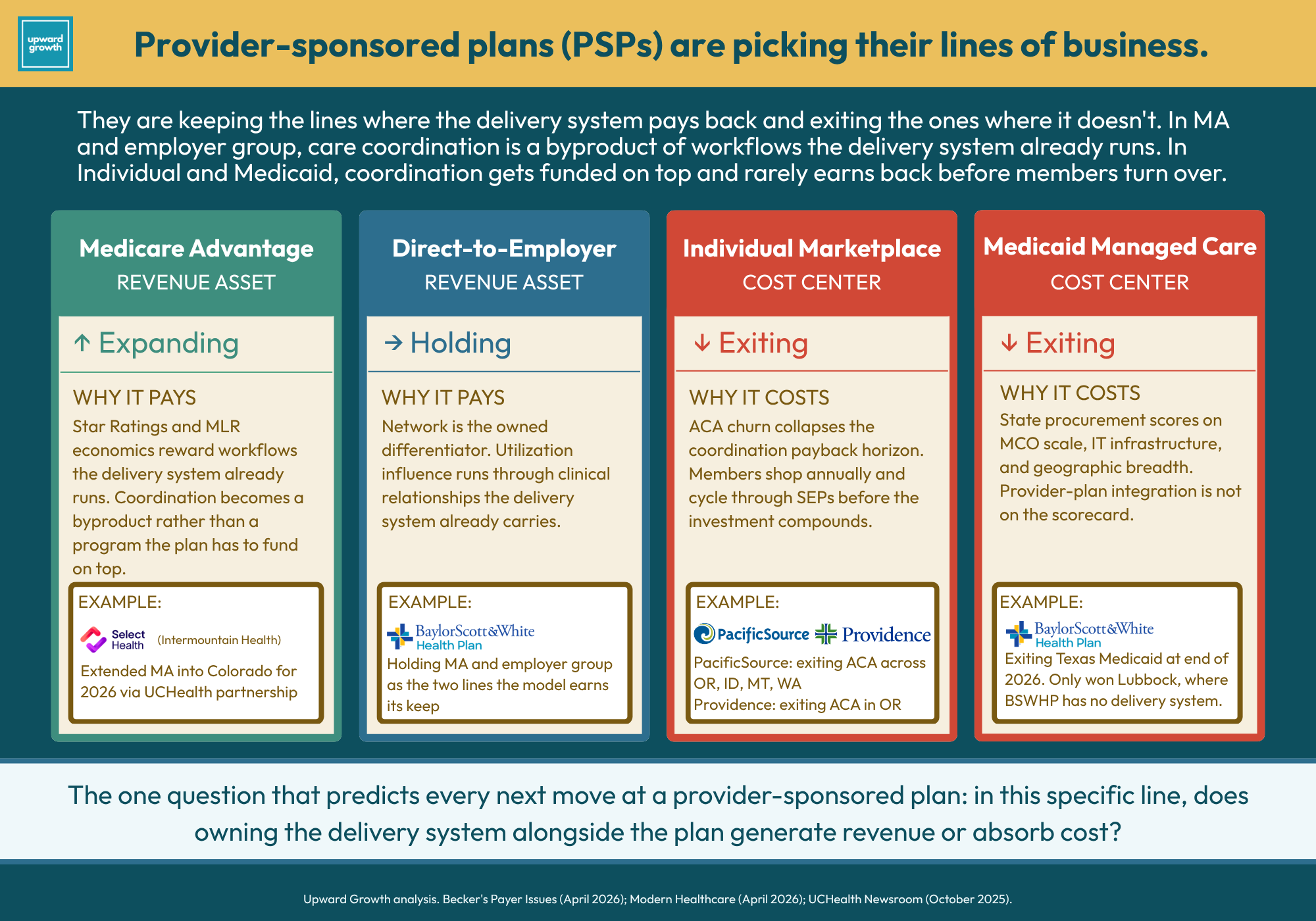
PSPs have several operational levers they do not have to build from scratch to compete in MA, because those levers already run inside the delivery system. The clinical workflows that drive Star Ratings performance are already staffed and running, and so is the chronic care infrastructure that keeps Medical Loss Ratio (MLR) manageable. Care coordination follows from how the plan and the system already operate together, rather than being a program the plan has to fund on top. So when a PSP invests a dollar in coordination for its MA members, the delivery system captures much of that value back through its own P&L. Whether any given PSP fully realizes those levers is a separate question, but the cost of pulling them is structurally lower than at a plan that carries risk without the delivery system.
Direct-to-employer rewards the same operating model, for reasons that overlap with MA. Network depth is a differentiator that costs a PSP nothing to demonstrate, because the network is the delivery system the plan already owns. Care navigation is a joint product of the plan and the system rather than a bolted-on utilization management gate. When the plan wants to influence utilization, it can route decisions through the clinical relationships the delivery system already carries rather than through a prior authorization process that antagonizes the network and the member at once. And employer buyers evaluating a PSP are seeking an operating model that trades administrative friction for clinical alignment, which is exactly the trade self-insured employers with disability and productivity costs are looking to make right now.
For plans doubling down on MA, this is not theoretical. SelectHealth CEO Rob Hitchcock named the mechanism plainly: “To be successful in Medicare Advantage, you’ve got to have a strong clinical partner. For us at Select Health, we have a strong clinical partner in Intermountain Health, and I think that’s critical. Without a strong clinical partner, Medicare Advantage is only going to get harder.” Hitchcock was talking about Intermountain, which owns SelectHealth outright and gives it that alignment by construction. The UCHealth partnership in Colorado is the same mechanism, extended into a market where SelectHealth had to build the partnership rather than inherit it. A PSP's MA viability lives or dies on clinical alignment, whether that alignment comes through corporate structure or through a deliberately built partnership.
Benefit design tells the same story from another angle. PSPs run a different playbook than nationals or Blues, varying more from plan to plan on core benefits and including them at slightly lower rates in individual plans. Inside SNPs, they carry lower overall benefit inclusion, while nationals and Blues more consistently offer OTC allowance, health-related meals, and transportation. That pattern makes sense once you see that PSPs often already capture the value of care coordination through their delivery system, so their benefit design does not have to substitute for utilization management or member engagement the way it has to at plans without that alignment.
Finally, a PSP entering an MA market is competing on a different unit of value than a national payer entering the same market. The cost to acquire a member is lower because the delivery system is already there. Retention runs off different levers because the tools that keep a member healthy sit inside the same organization that carries the risk. And the growth constraint runs into provider network geography rather than into acquisition economics, which is why the current MA payment environment is rewarding the integrated operating model right now, while the plans that carry MA risk without the delivery infrastructure to earn back on it are the ones contracting.

Why Integration Turns Into a Cost Center in Marketplace and Medicaid
The lines of business PSPs are exiting share a feature that flips the value of integration. The two lines driving most of the exits are Individual Marketplace and Medicaid managed care, and each one fails to reward integration for its own reason. The same operating model that gets rewarded in MA and employer group runs at a loss in both.
Individual Marketplace is the clearer of the two. Coordination investments in identifying rising-risk members, closing chronic care gaps, and building relationships between members and the delivery system take multiple years of member continuity to earn back. ACA marketplace churn does not give the plan that long. Members shop across plans annually, switch during Special Enrollment Periods (SEPs), and cycle in and out of Medicaid based on redetermination timing. A PSP that invests in coordination for a Marketplace member often funds someone whose next annual enrollment lands them at a competitor.
Medicaid produces the same result through a different mechanism. State Medicaid procurement selects on criteria that reward administrative capacity, MCO scale, IT infrastructure, and network breadth across the specific geographies the state defines. Those criteria do not select for provider-plan integration in the markets where the state has the most Medicaid members to place. A PSP whose delivery system runs in Dallas and Central Texas cannot win a procurement where the state's scoring rubric prioritizes coverage in West Texas markets the plan does not serve. That is exactly what happened to BSWHP: when Texas concluded its latest Medicaid procurement, BSWHP was awarded only a limited contract in Lubbock, a market where the health system does not operate hospitals. CEO Pete McCanna reinforced the point in a separate interview, describing how high turnover in marketplace and Medicaid populations makes those lines structurally harder for BSWHP than MA and employer group. The procurement did not reward what BSWHP does best where it does it, and the members it would have served would have churned out before the coordination investment paid back.
The exits following the same logic are already stacking up. PacificSource is pulling out of the ACA market across all four of its states and leaving Montana entirely, and had anchored the Oregon marketplace alongside Providence until both left it within the last two years. Every one of these exits is a plan reading the same math on the same two lines and reaching the same conclusion.
The pattern of PSP moves in the last 18 months keeps coming back to one question: does integration itself pay? Once a plan has decided which lines it wants to keep, the next problem is what happens when its growth ambitions run into the geographic limits of its own provider network.

How PSPs Are Scaling MA Beyond Their Own Provider Network
For PSPs doubling down, scale is the next problem to solve. A PSP's MA growth ambitions eventually exceed the geography its own provider network covers. The plan can price, design benefits, and file for expansion into new counties, but if the delivery system does not operate hospitals there, none of the operating advantages that made MA work in the home market come with it.
The SelectHealth-UCHealth partnership is one approach. It launched SelectHealth’s MA and individual products in Colorado for 2024, into markets where SelectHealth’s parent Intermountain Health does not operate hospitals but UCHealth does. Neither party gave up corporate independence. The two organizations share clinical operations without sharing a corporate structure, which is the specific alignment PSPs depend on to make MA work. And once the partnership was in place, the clinical partner had room to concentrate its MA network exposure into it, which is what happened this plan year when UCHealth exited Cigna and Devoted while staying with SelectHealth.
Kaiser’s Risant Health takes a broader approach to the same constraint. Risant holds Geisinger, added in March 2024, and Cone Health, added in December 2024, under a shared parent that preserves each system’s local operating identity while pooling infrastructure, capital, and operating discipline across them. The parent gives them scale advantages no single-system PSP can build alone, from technology platforms to capital access to shared clinical operations. Risant’s stated intent is to add four or five more systems over the coming years. The model is trying to prove that a group of integrated systems can share back-office scale without giving up the local clinical alignment that makes each one profitable.
The pattern of PSP moves in the last 18 months keeps coming back to one question: does integration itself pay?
Both approaches start from the same premise: the integrated operating model is worth preserving, and the way to scale it is not to give up what makes it work locally. A cross-system partnership solves the geography problem for one line in one market; an aggregation holding company solves it across multiple systems and multiple lines at once. Both are betting that integration wins against the national payer operating model when you extend it, and that the problem worth solving is how to extend it further.
This kind of scaling can look a lot like the health plan consolidation happening elsewhere in the market, but it is a different move entirely. Blues plans have been consolidating from within under financial pressure, and other regional plans are being absorbed into larger national footprints. Both of those consolidations are driven by losses and infrastructure gaps a bigger parent can close. Cross-system partnerships and Risant-style aggregation are the reverse: line-of-business scaling driven by the growth ambitions of an operating model that is already profitable where it operates. A PSP that reads its cross-system move as consolidation, or lets it be read that way from outside, will misjudge how far and how fast the integrated model can be extended.
And getting that read right is where the selection logic starts to matter for anyone building their own view of the PSP market.
How to Read PSP Moves Before They Land
The selection logic changes how any read on a PSP has to work. Take an MA expansion into an adjacent county: a national payer prices that move against per-life economics, but at a PSP it is a bet that integration will pay off in that specific market. The same double read applies on the exit side. A Medicaid exit that looks like a plan giving up on a population is more often a procurement read against a state that scored on criteria the PSP couldn't fully address. And when you get to cross-system partnerships, what would trigger M&A speculation at a national plan is more likely just scale infrastructure for a line the PSP already earns on. Read any of these against the wrong framework, and you miss what the move is actually saying.
The clearest test of this is putting two PSPs that look similar side by side. BSWHP and PacificSource show up as roughly comparable accounts on any of the usual sorts of size, geography, membership category. But BSWHP is walking away from Medicaid managed care while PacificSource is holding it, because each plan's calculation on where its delivery system pays back is running against its own local conditions. That difference doesn't show up in any standard segmentation, but it predicts everything about how each plan will move next.
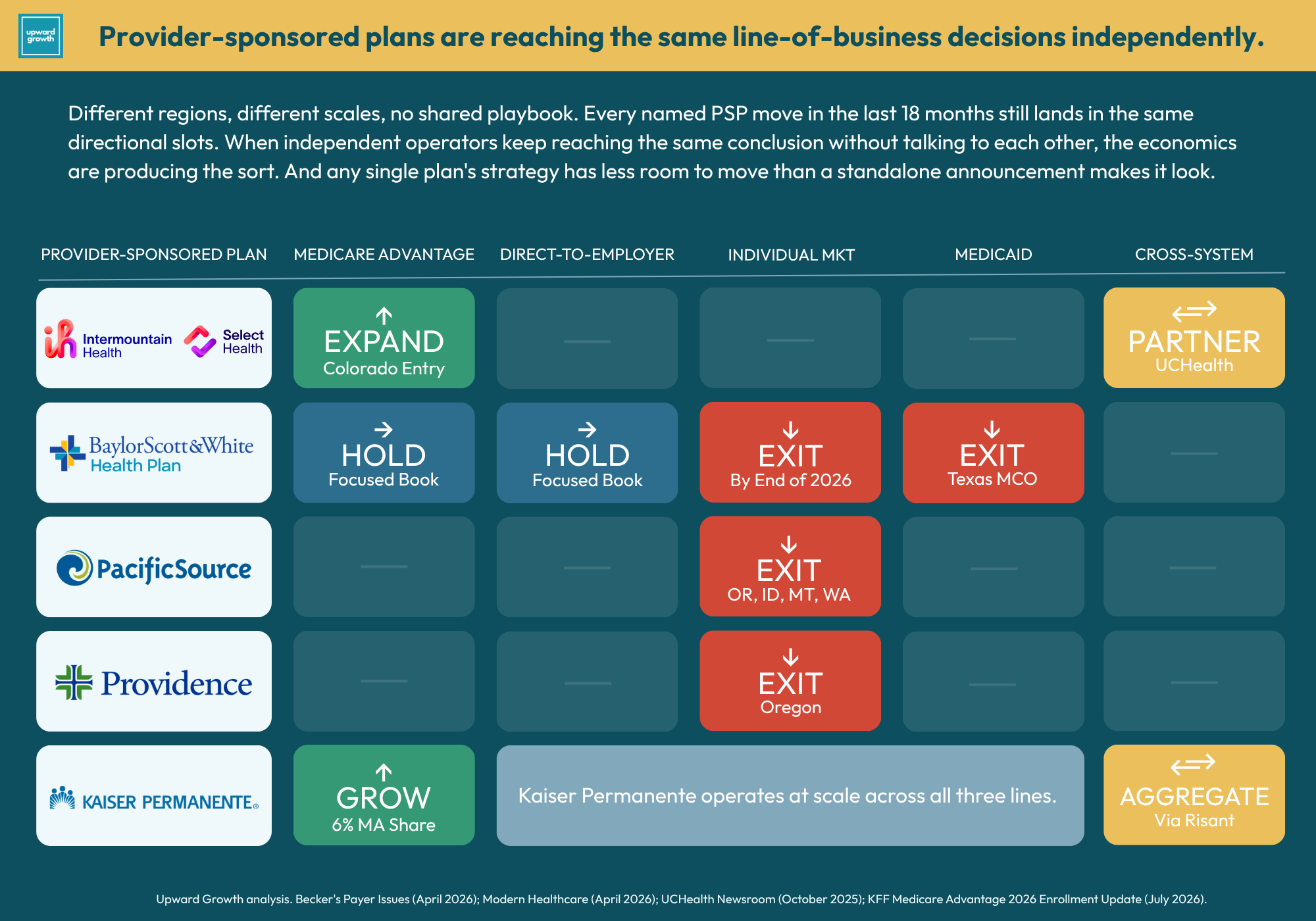
When BSWHP CEO Pete McCanna talks about turnover in marketplace and Medicaid populations, he is naming why lines fail his plan's operating model. And when SelectHealth CEO Rob Hitchcock names a strong clinical partner as inseparable from MA success, he is naming why lines succeed. Both are describing the mechanism their plan runs each line against, and both are doing it out loud six to twelve months ahead of the filings, exits, and expansions it will show up in.
Not every PSP has moved publicly yet, but the ones that haven't are running the same math their peers already ran. Watch for it in three places specifically: MA product filings that extend into new geographies, Medicaid contract non-renewals inside the next twelve months, and joint venture announcements without acquisition language. It also shows up in CFO commentary on earnings calls, where the internal read on each line's economics tends to surface first.
Read every PSP announcement as a plan telling you where integration pays in its book, and the pattern stops looking like scattered news.
Final Thought
Medicare Advantage AEP opens October 15. Q3 earnings from ACA-exposed payors and hospitals will grade what year one without Enhanced Premium Tax Credits (EPTCs) actually cost. Any PSP corporate restructuring, MA product filing, or Medicaid contract non-renewal that lands inside that window is running against the same selection logic, and it should be read that way.
This frame does not go away with the next payment update. It gets sharper as MA payment reforms mature and state Medicaid procurement keeps selecting for MCO scale over provider-plan integration.
If any of what’s above touches how you’re reading provider-sponsored plan moves in your pipeline, your portfolio, or your strategy, Upward Growth is a health plan market advisory firm that works with health tech vendors, investors, provider organizations, and management consultancies to build strategy around how health plans actually buy, operate, and make decisions. Contact us here.
Thanks for reading.
Here’s to upward growth,
Ryan Peterson
The frameworks in the weekly Upward Growth newsletter help health plans, health tech vendors, investors, provider organizations, and consultancies understand the health plan market as it continues to shift.
If your colleagues are in those conversations, they should be reading this too.
💰 Invest In Your Team with a Paid Subscription.
💡 Pro tip: Many subscribers expense Upward Growth through their company’s professional development, training, or learning budget. Here’s a one-minute email template to get your manager to approve expensing your subscription.