

Upward Growth is a health plan market advisory firm. Our weekly newsletter covers payor market strategy, regulatory shifts, and go-to-market insights for health tech vendors, investors, provider organizations, and consultancies competing in the health plan market.
🤝 Work with us on payor market strategy: Contact us
🟦 Connect with the author, Ryan Peterson, on LinkedIn.
🎧 Listen to the Upward Growth Podcast: Apple | Spotify
📰 Newsletter sponsorships: Learn More
Today’s Upward Growth newsletter is sponsored by Florence

Florence is a clinically validated, automated care management platform that uses ongoing, intelligent two-way SMS to help health plans find and re-engage patients, close priority care gaps, and improve HEDIS performance without adding to care-team workload.
And she can operate at scale: Florence has reached 50,000 patients in four weeks and actively managed a Medicaid population of 300,000+ without increasing staffing, augmenting care teams to focus their time where it matters most. In deployed programs, Florence increased Annual Wellness Visit show rates by 17.7% and prenatal visits by 325%. Want to see what Florence could do for your population? Let’s chat!
Interested in sponsoring Upward Growth? Contact Us

A few things to share this week:
Risk adjustment is the thread I keep coming back to. A few weeks ago I wrote about whether MA may be stabilizing, and Health Payer Specialist picked it up in a story on how the risk adjustment changes could leave Centene and Molina behind. That same shift is the thesis of a three-part series I’m doing with RISE. Article 1 dropped last week on the plan-side buying criteria that no longer fit under the new environment. Article 2 will discuss how the RA changes will affect vendors. And Article 3 will cover the organizational separation between Risk Adjustment and Quality Improvement inside plans and why the environment CMS built makes that separation structurally unsustainable. Keep an eye out for Articles 2 and 3 in the coming weeks!
Speaking of RA and QI, I’ll be moderating a panel at the RISE Risk Adjustment Forum in Orlando on October 28. We’ll be working through why the organizational line between risk adjustment and quality is harder to defend under the new rules, and what that means for how plans need to think about their operating model going forward. If you’re going to be at RA Forum, come find me.
Finally, a few newsletter sponsorship slots are open for November and December. Connect here if you want to reach health plan buyers, vendor executives, and investors.
Insurers filed their 2027 Medicare Advantage bids along four distinct operating paths, and the Landscape file CMS posted last week makes those paths directly comparable at the company level. The Big Six publicly traded insurers split in half on how they chose to prune. Fifteen regional and provider-sponsored plans filed formal enrollment caps that none of the Big Six touched. And Devoted stands alone as a counter-cyclical growth operator nobody else is really attempting. The 2027 rate math gave every insurer the same gap to close, and the file is the first place those different choices sit next to each other at the company level.
The CMS Landscape data shows total MA-PD General Enrollment plans down 155, or 4.6%, with cuts split roughly evenly between $0 premium and premium plans. Plan-level average Maximum Out-of-Pocket (MOOP) is up 9.4%. Plan-level average Part D deductible is up 30%. Roughly one in six MA members will land in a plan that won’t continue in their county next year.
What the aggregate numbers can’t show is which insurer chose which path and why. The choices locked in during August and September are now the ones each company has to defend through Q3 earnings, 2027 Star Ratings (dropping any day), and the CY 2028 Advance Notice in January. The peers worth benchmarking against for 2027 are the ones that chose the same operating path, and the next several months will show which paths held up.
What Every Insurer Had to Absorb Before Building 2027 Bids
Every insurer that filed in September built its bid against the same CY 2027 rate math. CMS finalized the Rate Announcement at a 2.48% net average and roughly $13 billion in additional MA payments, and the rate still fell short of what plans needed to absorb underlying medical cost trend, Version 28 of the CMS-HCC risk adjustment model (V28) now at full weight, and Star Ratings volatility that pulled Quality Bonus Payment (QBP) dollars out of several large books. Nearly 70% of MA plan leaders surveyed in January expected leaner 2027 benefit packages than 2026, a notable jump from the prior year’s survey, fielded across 35 plans before most insurers locked their bids. Plan leaders had the forecast by spring, and the file shows which insurers acted on it and how.
Since Q1 earnings, I’ve been writing that margin-over-membership was the dominant 2027 bid driver across the Big Six, and the file is the first measurable test of what each insurer actually did with that framing. The margin story was the one earnings calls covered, and the market-shape layer is the one the Landscape file now makes visible. Those decisions are now locked in, and each insurer has to defend them through the next several quarters of earnings and bid cycles.

The Big Six Nationals Diverged on How to Cut 2027 MA Plans
The Big Six publicly traded insurers (UnitedHealth, Elevance, CVS/Aetna, Humana, Centene, and Molina) drove most of the aggregate plan-count change in the file, and the group broke along two directional patterns on how it chose to cut, with HCSC and Molina running separate stories covered later in the section. Humana and Centene cleared the low-Star tail of the retained book. UnitedHealth, CVS, and Elevance ran geographic-portfolio pruning that didn’t correlate with Star rating. Both groups worked the same rate math. Both matched the direction each insurer previewed on Q2 earnings calls.
Humana and Centene are where Star-preservation discipline becomes visible. Humana filed 72 exits against roughly 50 new plans for a net reduction of 22, with 78% of those exits rated 3.5 stars or below. That matches what the company told investors on its Q2 call about the majority of its 2027 exits involving plans rated 3.5 stars or below for the 2027 bonus year. Centene cut 57 plans net, from 157 to 100, with 82% of its 66 exits in the same low-Star range. In both cases, the pruning cleared the plans that were dragging QBP arithmetic and protected the Star math on the retained book. What makes the Star-preservation strategy actually workable is value-based care (VBC) infrastructure. Humana’s Q2 commentary framed the pruning approach around VBC alignment, with the majority of its individual MA members already in value-based arrangements, and that infrastructure is what lets the retained book run tighter clinical operations against 2028 Star measurement. Clearing the low-Star tail only pays off if the retained book can actually improve on its clinical measures, which is what both insurers have spent the last several cycles investing against.
UnitedHealth, CVS, and Elevance moved differently. UnitedHealth filed 77 exits and 35 adds for a net of 42, consistent with a wider scope than the preliminary 34-county filing that surfaced in broker channels earlier this year. CVS filed 87 exits against roughly 65 adds for a net of 22. Elevance filed 25 exits and 19 adds for a net of 6. The exit distributions skew the opposite direction, with 31%, 34%, and 38% respectively at or below 3.5 stars (see graphic below). To me, that pattern reads as network and economic cleanup rather than Star protection, with the trade-off landing between retained geography and retained enrollment.
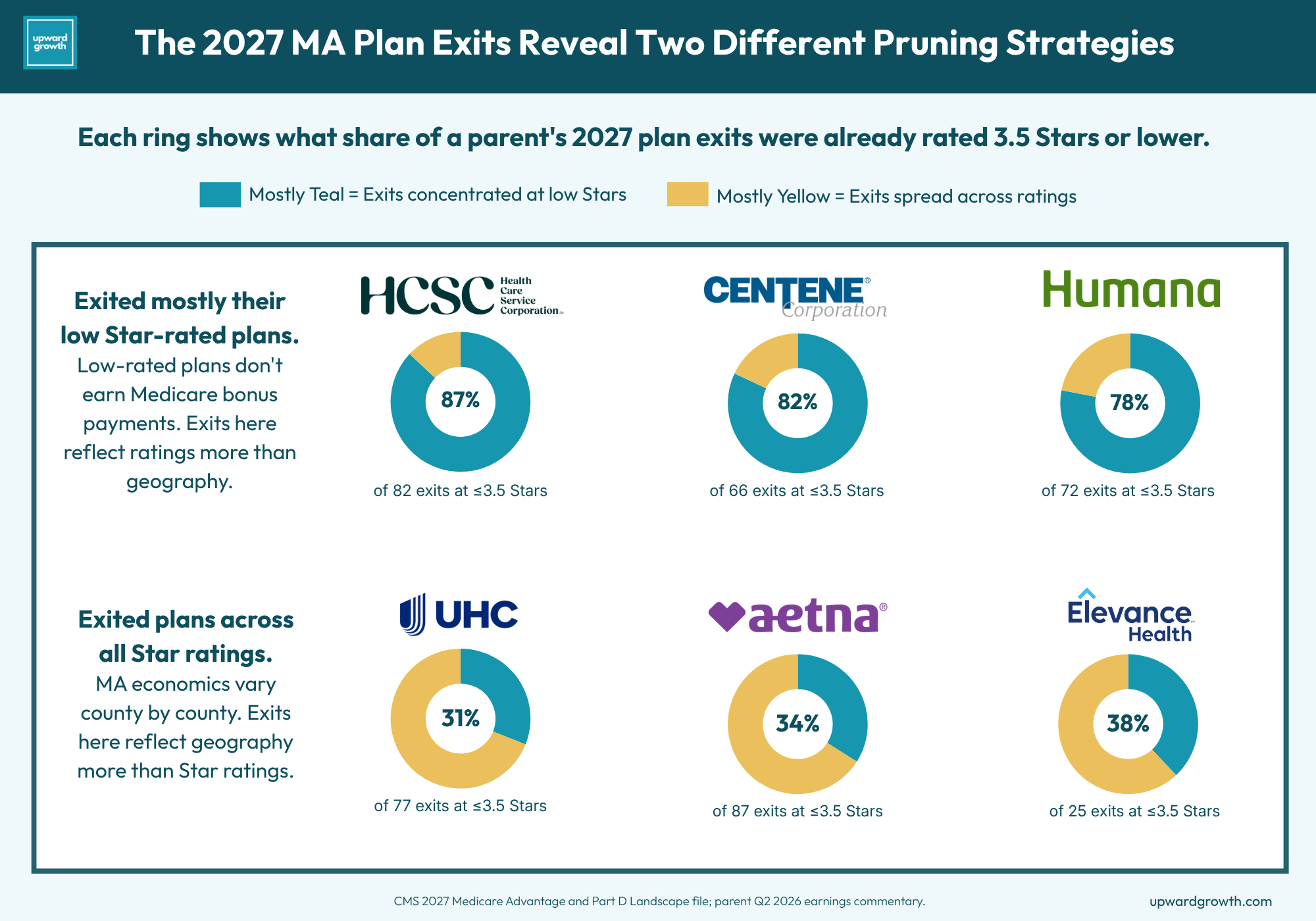
The two groups are also betting differently on what 2028 will reward. Humana and Centene are wagering that cleaner Star distributions in their retained books will translate to QBP preservation when the 2028 Star Ratings arrive. Meanwhile, UnitedHealth, CVS, and Elevance are wagering that network economics drive 2027 margin recovery more than Star distribution does, and that outcomes in their mixed-rating books won’t move the ratings math enough to warrant preemptive pruning. The wagers also reflect different capital-allocation pictures at each insurer. For Humana and Centene, operating investment can concentrate on a smaller retained footprint. The three geographic-portfolio pruners have the diversified line-of-business revenue on their enterprise balance sheets to absorb MA margin pressure the regionals can't. The wagers are testable. The first resolution comes when the 2027 Star Ratings publish in the next couple of weeks and reset the starting line for every retained book. CMS previewed draft 2027 cutpoints in September that raised thresholds on many of the measures, which means some of the pruning decisions in the file will look prescient within two weeks, and some will look premature.
The motives behind each cluster are worth holding loosely. Both patterns are also consistent with simple margin discipline, where the Star correlation at Humana and Centene could be the arithmetic of QBP running through Medical Loss Ratio (MLR) math on plans that happened to be low-rated rather than a deliberate Star-preservation move. A less generous read is that both camps are partly unwinding footprint that got overbuilt during the growth years. Either way, the file settles what each insurer chose but not why, and the Q3 earnings calls will say more about the why than the file can.
HCSC is a different story from either Big Six cluster. Technically a Blues mutual rather than a publicly traded national, HCSC became national in MA scope through the Cigna acquisition that closed in early 2025, and the file shows the company retracing most of that footprint. HCSC’s MA-PD GE county-plan combinations dropped from 3,416 to 1,324, a 61% reduction, with unique counties served falling from 699 to 345. That is the largest geographic retreat of any single insurer in the file. In parallel, HCSC told brokers it is withdrawing entirely from Connecticut, New York, and the District of Columbia, cutting its HealthSpring footprint from 580 counties to 450, and exiting 11 additional unspecified markets. HCSC’s underwriting loss last year ran $4.57 billion, with the Cigna acquisition cited as a contributor. The read is less about Star preservation or geographic cleanup and more about an insurer retrenching from markets it acquired last year, which aligns with the broader Blues consolidation dynamic reshaping where Blues capital flows as mid-sized Blues organizations get pulled toward larger affiliations partly because the operating math of acquired growth hasn’t been working.
Meanwhile, it's a different story at Molina. The 2027 move reads less like a pruning strategy and more like line-of-business reallocation. Molina is scaling back MA at a time when the One Big Beautiful Bill Act (OBBBA) has reshaped the Medicaid environment where the company carries most of its enterprise exposure. The MA footprint reduction is enterprise capital flowing to Medicaid, not operating discipline within MA, and that's the distinction worth holding onto when the Q3 call lands.
Why Regional and Provider-Sponsored Insurers Capped 2027 Enrollment Instead of Exiting
Fifteen regional and provider-sponsored insurers ran a 2027 strategy none of the Big Six pulled. They stayed in their markets, and they told CMS, in writing, how much enrollment they would accept. The 2027 file is the first time CMS surfaced the lever as a formal data column. 65 plans across those insurers filed capped enrollment capacity totaling 592,050 members, concentrated in 350 counties across 11 states. Wisconsin, Nebraska, North Carolina, Michigan, Maryland, Massachusetts, Minnesota, and Maine lead the capped footprint. The profile of who filed is specific: regional non-profits, provider-sponsored plans tied to health systems, and smaller Blues affiliates.
These insurers aren’t trying to grow into the counties nationals are vacating. They’re picking the geographies where they already know the operating economics and setting the terms before the Annual Enrollment Period opens. Regional and provider-sponsored plans have had this lever for years through network capacity constraints, broker commission structures, and plan design. 2027 is just the first year CMS is making it visible as a data point.
A regional insurer files an enrollment cap because MA losses can't be cross-subsidized anywhere else in the enterprise. A national doesn't need to cap because the losses sit next to commercial, PBM, and Medicaid revenue.
The capped capacity is a small share of the regional MA base. This is a visible operating signal, not a dominant market-share story. There’s no prior-year baseline to measure change against, so read the signal against its own structural logic rather than a trend line.
Why the Big Six aren’t on the list is worth unpacking. Regional plans and provider-sponsored entrants face harder trade-offs than diversified nationals in the 2027 rate environment, specifically because they lack the risk infrastructure and geographic footprints that let larger insurers spread MA margin pressure elsewhere in the enterprise. The cap filing is the operating artifact of that constraint. For a regional insurer, filing one is defensible as margin discipline and often a survival move, because MA losses can't be cross-subsidized with commercial, PBM, or services revenue. A publicly traded national doing the same thing would face immediate questions from capital markets about why it isn't growing, and the nationals don't need to anyway. Their diversified line-of-business portfolios absorb MA losses that regionals can't. What lets nationals prune aggressively is what keeps them off the regional cap list.
Devoted Drove Most of 2027 C-SNP Growth and the D-SNP Composition Shifted
Growth in the 2027 file lives in the SNP numbers, and the aggregate “MA shrinks for 2027” framing only holds if SNPs are excluded. Total SNP plan count grew by 169, or 9.4%, which is larger than the entire General Enrollment contraction of 155. Including SNPs, MA plan availability is roughly flat for 2027. The SNP mix is where several of the Big Six and Devoted placed their growth bets.
The composition inside the SNP growth tells the sharper story. C-SNPs added 192 plans, a 34% jump. D-SNPs shrank by 30, or 2.8%. I-SNPs added 7. The tilt toward C-SNPs isn’t new. KFF enrollment data from 2026 already showed C-SNPs doing most of the SNP growth work, with chronic-condition plans growing 45% year over year against D-SNPs at 5.7%. 2027 extends that pattern at the plan-count level, and the file shows which operator ran hardest at the opportunity.
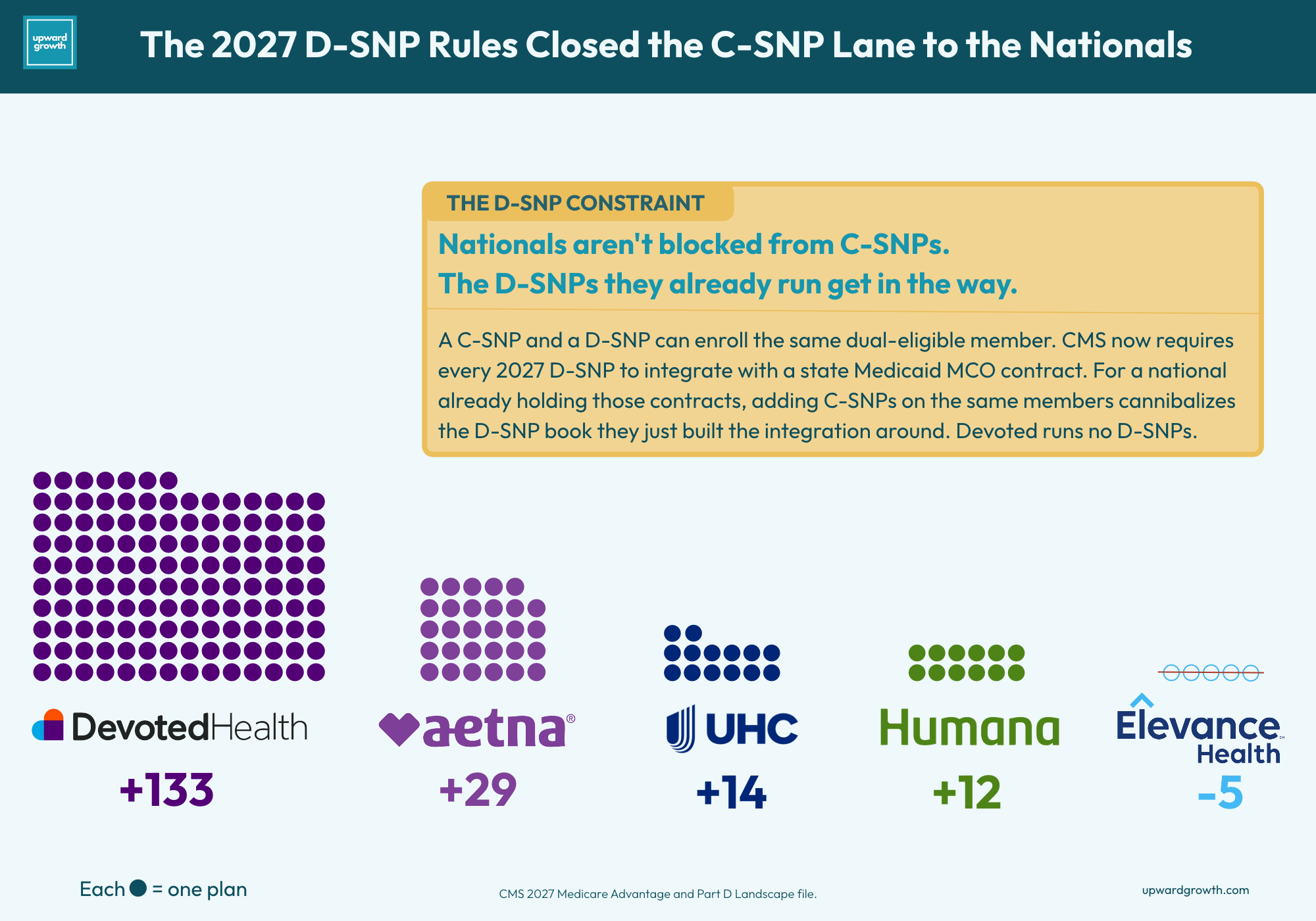
Devoted ran hardest. Devoted alone added 133 C-SNPs, moving from 122 to 255 and accounting for 69% of market-wide net C-SNP growth. The rest spreads thinly across Aetna (+29), UnitedHealth (+14), and Humana (+12), with Elevance cutting C-SNPs by 5 (see image below). On the broader growth side, Devoted expanded county-plan combinations by 82%, from 2,852 to 5,204, and grew unique counties served from 683 to 847. The company closed a $1.18 billion financing round in early October tied directly to the 2027 expansion. As of September, Devoted held 538,000 members, with five new state entries scheduled for 2027. “C-SNPs are the growth story” is correct in aggregate but misleading in isolation. The right read: Devoted ran a specific concentrated bet on dual-eligible-adjacent populations, and no other operator in the file is attempting growth at that scale.
Why Devoted and not everyone else? C-SNP growth is concentrated in a condition category (Cardiovascular Disorders, Chronic Heart Failure, and Diabetes) that grew from 481 to 662 plans market-wide, and that category heavily overlaps the dual-eligible population. For an insurer that doesn't operate a state Medicaid MCO, C-SNPs are a way to grow dual-eligible revenue without facing the cannibalization trap the 2027 D-SNP integration rules created. The trap only applies to insurers that own both ends: the D-SNP and the Medicaid MCO it integrates with. Devoted owns the D-SNP side but not the MCO side, which is why most of its D-SNPs sit at Coordination Only and the C-SNP lane stays open on the same dual-eligible populations. Devoted Medical, the physician-aligned clinical arm, gives it the documentation and care-management infrastructure most carriers chasing dual-eligible growth don't have.
Operating-model pressure from risk-adjustment methodology forced the D-SNP composition shift. CMS tightened D-SNP integration requirements for 2027, giving plans a choice between aligning with a state Medicaid MCO contract or accepting narrower enrollment pathways. The file shows the result as a collapse of the middle integration tier. Coordination Only D-SNPs grew by 32, Highly Integrated Dual Eligible SNPs (HIDE) dropped by 68, and Fully Integrated Dual Eligible SNPs (FIDE) grew by just 6. Plans without the state MCO relationships needed to reach FIDE fell back to Coordination Only. The handful of plans with genuine MCO alignment pushed through to FIDE instead.
2027 Benefit Repricing Hit MOOP, Part D Deductible, and PPO Economics
The benefit math in the file shows a specific operating choice. Insurers preserved the number members shop on and repriced the numbers members feel after they enroll. PPO products took the hit on both sides.
Plan-level average consolidated premium is up 8.5%, though the median is still $0. MOOP is up 9.4%, and Part D deductible is up 30%. Brokers lead with premium when they pitch a plan, but MOOP and the deductible are what members encounter when they actually use it. The 2027 rate math had to land somewhere, and insurers put it in the numbers members feel later. That lines up with September broker commentary that Humana and UnitedHealthcare were likely to cut benefits the most for 2027.
The product-type cuts tell the same story. HMO plans finished essentially flat at a net plus eleven, HMO-POS plans dropped 29, and PPO plans dropped 130. PPO is where the net exits concentrated, a pattern visible in the 2027 plan cuts broadly. On the member cost side, PPO MOOP grew more than HMO MOOP, up $642 on average versus $523. PPO members got hit twice: by the product exits, and by higher cost-sharing on the PPO products that remain.
PPO took the hit because of how its economics work when rate margins tighten. Because PPOs carry broader networks and more out-of-network utilization risk, they're the hardest MA product to run profitably in a tight-rate year. Insurers either exit PPO products (as UnitedHealth did with most of its 2027 exits) or reprice PPO member cost exposure to hold margin. The 2027 file shows insurers doing both, with the mix of exits versus repricing varying by insurer.
What insurers kept in their bid math matters more than what they cut. The categories insurers preserved are the ones carrying weight for 2027 performance: behavioral health engagement, chronic care management, and care coordination. The new Depression Screening and Follow-Up measure (2027 measurement year, 2029 Star Ratings) is part of why behavioral health held in several books. When nearly everything else got repriced, and a category didn't, the finance team concluded that category would protect 2027 margin or defend 2028 Stars.
That already-settled priority list is what Q4 vendor conversations and 2028 bid planning now run against.
How 2027 Insurer Decisions Shape the 2028 Bid Cycle
What insurers are buying this quarter is already shaped by the operating choice each one made for 2027. Whether you sit on the plan side, sell into plans, hold portfolio exposure, or advise the insurers themselves, those operating choices sort plans into distinct Q4 budget conversations.
Star-preservation insurers are spending into the retained book. The budget priorities are 2028 Star defense, risk adjustment accuracy under the new chart review rules, and member retention in the counties that stayed. Humana telegraphed this on its Q2 call, framing the 2027 bid approach around clinical excellence and operating efficiency on the plans it kept. The geographic-portfolio pruners are in a different Q4 conversation entirely. Their priorities are network stabilization, member reassignment inside the retained footprint, and the operational cost of executing the exits themselves. Devoted and the smaller counter-cyclical operators are in a scale year, with budget tilted toward member engagement, onboarding, and risk adjustment capability on populations they haven’t held before. The regionals that filed capped capacity are working the unit economics inside those caps, which favors categories that reduce medical cost per member over categories that add new ones.
The file doesn't show what HCSC, Elevance, UnitedHealth, and CVS are doing with capital across their non-MA books. The MA choice visible in the file is one piece of a broader allocation decision across commercial, Medicaid, PBM, services, and provider assets, and some of the MA pruning you see may be capital moving elsewhere within the enterprise entirely.
Roughly 5.5 million members whose plans don't continue in their county next year become their own 2028 setup. If a meaningful share end up redistributed across other MA plans rather than returning to Original Medicare, the insurers absorbing them inherit a cohort that tends to skew older, more medically complex, and less broker-engaged than voluntary enrollees. That cohort also fares worse on member sentiment measures, which matters more now that the 2027 Star Ratings tripled the weight of patient experience and complaints measures. An insurer that priced its 2027 bid for a healthier new cohort than it actually gets turns its 2028 margin story into a risk-mix story and its 2029 Star story into a patient-experience story.
The compound shocks pattern that's run through MA, Medicaid, ACA, and employer coverage this year sets the frame for how insurers approach the CY 2028 Advance Notice in January 2027. By late Q1 2027, the picture clarifies in several directions: pruners will know whether cleaner 2027 margins hold, non-pruners will know whether patience was the right call, and counter-cyclical bidders will know whether the cohorts they absorbed came in profitable. The 2027 operating choice sets up the 2028 operating choice, and insurers that benchmark against the right peer group this quarter go into the January Advance Notice with the clearest view.
Final Thought
The 2027 Landscape file is the first time 2026 operating discipline becomes measurable at the operator level. Four different playbooks ran against the same rate math, and the file finally lines them up in one view. The right benchmark is the peer group that made the same operating choice, not the peer group at the same enrollment size.
2027 Star Ratings are the first live test, and they drop any day. Every pruning decision in the file was built against 2026 Star Ratings, and the 2027 Stars publish into a market where the operating choices are already locked. CMS previewed draft 2027 cutpoints in September that raised thresholds on many measures, resetting the starting line for every retained book heading into 2028 bid planning. ANOC letters landed October 1, Plan Finder went live the same day, and Q3 earnings start mid-October. By month-end, every major insurer’s filing is visible, 2027 Stars have reset the 2028 QBP starting line, and Q3 earnings commentary has shown how each operating choice is being defended publicly.
If you’re working through what the 2027 operating-model mix means for your plan, your portfolio, or your vendor positioning, Upward Growth is a health plan market advisory firm that works with health tech vendors, investors, provider organizations, and management consultancies to build strategy around how health plans actually buy, operate, and make decisions.
Thanks for reading.
Here’s to upward growth,
Ryan Peterson
The frameworks in the weekly Upward Growth newsletter help health plans, health tech vendors, investors, provider organizations, and consultancies understand the health plan market as it continues to shift.
If your colleagues are in those conversations, they should be reading this too.
💰 Invest In Your Team with a Paid Subscription.
💡 Pro tip: Many subscribers expense Upward Growth through their company’s professional development, training, or learning budget. Here’s a one-minute email template to get your manager to approve expensing your subscription.