

Upward Growth is a health plan market advisory firm. Our weekly newsletter covers payor market strategy, regulatory shifts, and go-to-market insights for health tech vendors, investors, provider organizations, and consultancies competing in the health plan market.
🤝 Work with us on payor market strategy: Contact us
🟦 Connect with the author, Ryan Peterson, on LinkedIn.
🎧 Listen to the Upward Growth Podcast: Apple | Spotify
📰 Newsletter sponsorships: Learn More
This week’s newsletter is presented in partnership with RISE

The CY 2027 risk adjustment rules are set. Now comes the operational work.
CMS’ finalized exclusion of unlinked chart review diagnoses is just one of the changes risk adjustment leaders must operationalize before January. The 27th Risk Adjustment Forum, October 27–29 in Orlando, is built around what comes next: identifying missed revenue, strengthening payment integrity, and preparing for greater audit scrutiny. If you’re responsible for accurate, compliant risk adjustment – and the revenue tied to it – this is your agenda.
Interested in sponsoring Upward Growth? Contact Us
A few updates from me before we get into it:
Sponsorships are booked through late October, with November and December moving fast. Our readership is ~7,000 health plan and health tech executives, investors, and consultancies. If getting in front of that audience fits what you’re doing, reach out here. And a big thanks to our current sponsors for backing our work.
Next week I’m in Vegas for UiPath Fusion (Sept 22-25). I’m speaking Wednesday 9/23 as part of the healthcare and payer track. If you’re going to be there, come say hi.
One observation while writing this article: since CMS finalized chart review exclusion in April, the volume of “our AI helps with risk adjustment” messages I’ve seen has probably quadrupled, from new entrants and legacy players alike. Health plan buyers can tell the difference between vendors that have actually built for encounter-level coding, delegated risk enablement, and RADV readiness, and those still selling into the retrospective book with new marketing on top. That difference will matter far more in CY 2027 buying cycles than it did in CY 2026.
Some Medicare Advantage plans are absorbing the current CMS cycle with almost no impact on their risk adjustment revenue. Most are absorbing it hard. Which side of that split a plan sits on comes down to operating model decisions made years before V28, the April chart review exclusion, or Risk Adjustment Data Validation (RADV) audits at all-contract scale showed up. Together, those three CMS actions are compressing the risk adjustment factor (RAF) revenue line unevenly across the industry, and that unevenness shapes what a plan’s 2027 revenue guidance actually means, what its delegated risk deal pattern will look like over the next four quarters, and what its CY 2028 bid economics can carry.
The enterprise margin stabilization read on Medicare Advantage really doesn’t capture any of this, because uneven compression doesn’t show up in an industry average. Instead, it shows up inside each plan’s operating model or in coding workflow decisions made (or not made) over the last decade. And the industry-average number does not tell you what any specific plan will do next. That answer lives inside each plan’s operating model, one plan at a time.

V28, Chart Review Exclusion, and RADV Are Compounding
The retrospective risk adjustment model most MA plans have run for a decade has a specific structure, and the current CMS cycle is putting pressure on three points of it. The primary care encounter captures whatever the PCP documents at the visit. Whatever the PCP does not capture gets picked up later through chart review, sweeps, and retrospective analytics. CMS pays the plan on the full picture, which is what the visit captured plus what the plan recovered afterward. Every part of that chain has been under pressure for years. What is different about the last twelve months is that three CMS actions landed on three different parts of the chain at once, and reading each of them separately misses what happens when they interact.
V28 lowered the payment for the higher-RAF conditions that made V24 economics work. It retired hundreds of diagnosis codes, tightened others, and recalibrated the model around tighter documentation standards. The V24 cushion plans had been leaning on since 2024 finished phasing out on January 1. What is left is a coding model that pays less for the same visit than V24 did, and pays disproportionately less for the conditions the sweep economy was built around. The industry-average read on this is straight revenue compression, which it is. What the average read misses is that plans running heavy retrospective books on the deprioritized conditions absorb more of the V28 cut, and plans that were already coding tighter at the visit absorb less.
Chart review exclusion closes the retrospective channel for what the encounter did not code. In April, CMS finalized the exclusion of unlinked chart review diagnoses from CY 2027 risk adjustment payments, cutting roughly $7 billion in RAF payments across the MA book. (A narrow exception preserves unlinked reviews for beneficiaries switching MA plans, but it does not change the overall picture.) A Brookings analysis called out the workaround plans were most likely to try, noting that insurers “may often convert unlinked reviews to linked ones by inducing providers to report the diagnoses on encounter records,” with regulators calling it arbitrage recapture. Either way, diagnoses that used to get picked up in chart review now either land at the visit or don't get paid on. Plans whose visits were already catching those diagnoses are less exposed. Plans running heavy retrospective books absorb the full hit.
Retrospective risk adjustment worked for a decade because the economics worked. CMS has spent the last twelve months changing the rules underneath.
RADV expansion turns audit into a running problem instead of a lottery. CMS took audits from roughly 60 contracts a year to all 550 eligible contracts annually, pressed ahead after a September 2025 federal court ruling vacated the extrapolation methodology, and appealed to the Fifth Circuit. Whichever way the appeal lands, every MA plan is now facing audit exposure that used to hit roughly one contract in ten. Plans that were coding at the visit have less to worry about, because the code on the claim is the code the physician wrote in the note. Plans running heavy retrospective addition have more to worry about, because the gap between what the visit captured and what the plan submitted is exactly what CMS is reviewing.
The three actions don't sit on separate lines of the same P&L. V28 lowers what the visit is worth, which changes what the sweep team goes after retrospectively. Whatever the sweep team does recover falls under the chart review exclusion, because most of those diagnoses were unlinked to begin with. Whatever survives both then walks into RADV, which is reviewing more contracts, more often, against tighter standards than the retrospective book was ever built to meet. A plan cannot fix its V28 exposure without changing what it submits, cannot change what it submits without inviting more RADV scrutiny, and cannot avoid RADV scrutiny without giving up recovery it needs to cover the V28 cut. The three actions land together, and the sequencing that would have absorbed them across two or three bid cycles does not clear inside CY 2027.
Retrospective risk adjustment worked for a decade because the economics worked. CMS has spent the last twelve months changing the rules underneath. The political case behind the three actions has been building for years and is not going away. MedPAC put the payment differential between MA and traditional Medicare in front of Congress this spring at $76 billion for 2026, and Commissioner Tamara Konetzka called V28 a "very blunt tool." The commission is not saying CMS overreached. The commission is saying CMS is directionally right and not done. That leaves room for the CY 2028 cycle to keep moving in the same direction without political cost, and the aggregate revenue number analysts are watching across the industry is the wrong frame for what happens next. The compression is landing on individual plan operating models, and those operating models were built years ago.
Which Health Plans Are Absorbing V28, Chart Review Exclusion, and RADV Cleanly
A small number of MA plans code the RAF at the visit. Most catch it afterward through chart review, sweeps, and retrospective analytics. That difference determines how much V28, chart review exclusion, and RADV land on a given plan's revenue line. The plans coding at the visit sit largely outside all three. Health plans that catch it afterward sit inside all three simultaneously.
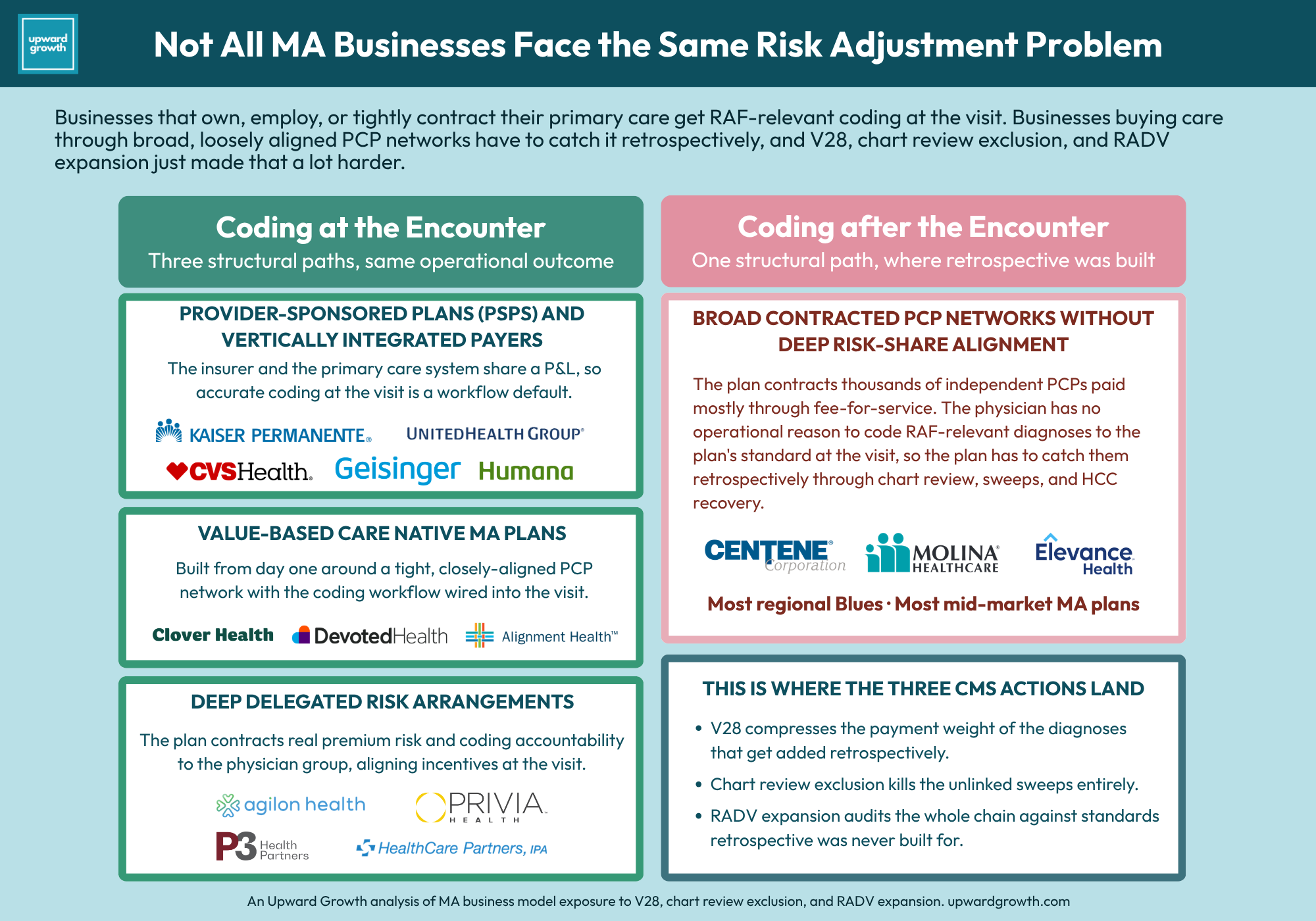
Kaiser Permanente sits on the first side of the line because the primary care physician and the plan share a balance sheet. The doctor has no reason to leave a diagnosis uncoded, and the plan has no reason to reconstruct one afterward. Geisinger, Intermountain SelectHealth, UPMC Health Plan, Highmark with Allegheny Health Network, and Johns Hopkins Health Plans sit in the same position. The value-based care case for provider-sponsored plans has been made for years. What the current cycle adds is a specific RAF revenue advantage on top of everything PSHPs already had going for them.
UnitedHealth’s Optum-served MA lives sit on the same side of the line without the health system architecture. UnitedHealth spent the last fifteen years putting primary care under a payer P&L through owned and tightly aligned physician assets, and those Optum-served lives now code at intensities closer to Kaiser than to a typical network payer. CVS built the same architecture at smaller scale through Oak Street Health, Humana through CenterWell, and Elevance is assembling a variant through Carelon Health. Owning the primary care means the visit and the coding are one workflow instead of two, and the same setup that produces cleaner RAF also produces cleaner Stars and better MLR.
Devoted Health, Alignment Healthcare, and Clover Health (with its Home Care Physician model) got to the same side of the line a different way. They built the payer, the network, and the tech stack as one operation from day one, without owning provider assets the way Kaiser and Optum do. What they own is the contracts and the systems that keep the visit and the coding on one workflow inside a network built for it.
The fourth version of the same setup is what most of the mid-market and regional payers are working toward right now. A plan that contracts with an IPA, an MSO, or a physician group that takes real premium risk and coding accountability written into the deal puts that provider in the same operating position as Kaiser’s owned doctor. The plan does not own the paycheck, but the contract lines up the doctor’s revenue with the plan’s. The depth of the arrangement determines how much of the property gets delivered, and light delegation arrangements common through 2024 delivered relatively little. Q4 2026 is largely about moving those lighter deals into deeper ones on terms that transfer real coding accountability with the risk-share.
None of that setup was cheap or fast to build. Kaiser has been running its integrated primary care model for more than seventy years, and its position on MA coding intensity is the compounding result of a delivery system that predates CMS’s payment methodology by decades. UnitedHealth spent the last fifteen years and multiple ten-figure acquisitions putting Optum’s primary care footprint together (DaVita Medical Group, Reliant, Kelsey-Seybold, Atrius, Crystal Run, and adjacent assets in urgent care, ambulatory surgery, and home health). CVS paid roughly $10.6 billion for Oak Street Health in 2023 and took a $5.7 billion goodwill impairment on its Health Care Delivery unit in Q3 2025, and is closing 16 Oak Street clinics and slowing new openings. Humana has invested for years in CenterWell without producing an Optum-scale asset. Devoted raised roughly $2.6 billion across multiple rounds to reach where it is today. The payoff on all of it was uncertain under V24, because retrospective recovery closed most of the gap between the traditional plan and the vertically integrated one. Most plans looked at the capital commitment, the execution risk, and the V24 math, and made the right call for the last decade: keep running the retrospective book, invest incrementally in workflow.
The current cycle makes that whole investment look smart in hindsight and urgent going forward. The gap between the two sides of the line existed under V24. It just did not show up on the RAF revenue line the way it does now. KFF’s July analysis showing about six percentage points of industry-wide coding intensity compression since 2022 reads across the industry as uniform pressure. It is not uniform. It is landing harder on plans coding after the visit than on plans coding at it, and that gap widens with every year the current cycle continues. Grouping plans by ownership category (PSHP, vertically integrated, VBC-native, delegated) is a useful shortcut, but ownership doesn't tell you where the coding actually lands. A tightly delegated IPA can deliver the setup, and a provider-sponsored plan without operational integration often cannot. What matters is where the coding lands, and MA is now sorting on that in a way it did not have to under V24.
Buying Primary Care, Deepening Delegated Risk, or Managing Compression
For every plan without the encounter-coding setup already built, the current cycle turns a strategic call the industry could kick down the road under V24 into a Q4 2026 decision. What that decision looks like depends on the plan's capital position, its existing network, and how much MA book it wants to keep running.
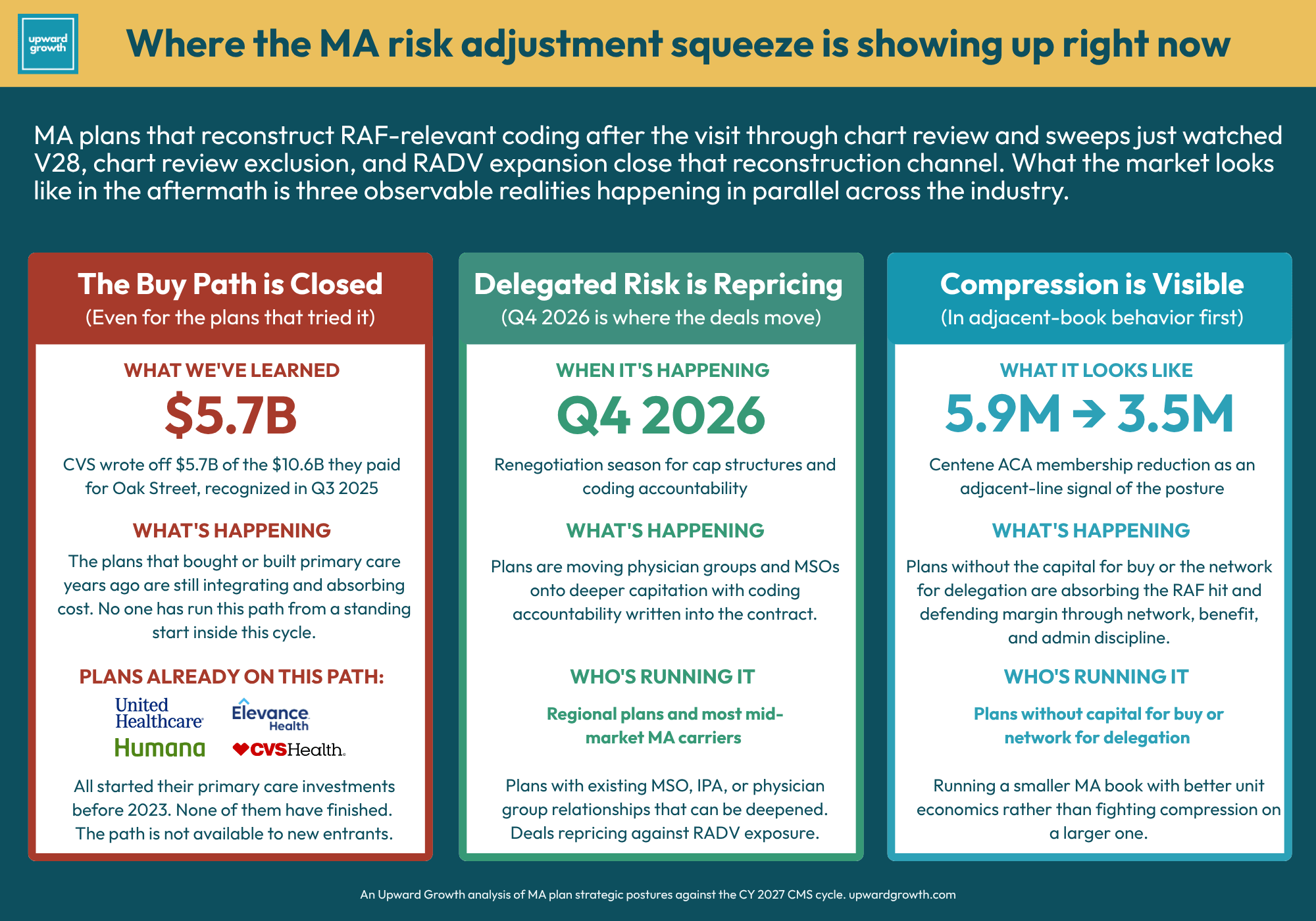
Buying primary care assets is a ten-figure bet with multi-year execution risk. CVS is running that bet visibly right now with Oak Street, Humana with CenterWell, and Elevance with Carelon Health, each one at a different scale and time horizon, and none of them without integration cost and margin drag along the way. The path only clears at that scale, because owning primary care means carrying the revenue, the operating cost, the integration cost, and years of P&L drag before the payer side sees the benefit. UnitedHealth had fifteen years to build Optum. Nobody has that runway inside this cycle, and the capital required takes Centene, Molina, and every mid-market and regional plan out of contention. The buy path is really only available to the four largest publicly traded MA plans, and even those four are still working through integration years after they started.
Much of the industry is moving toward deeper delegated risk, and Q4 2026 is running the busiest renegotiation quarter in years. Cap structures, upside share percentages, coding accountability language, and RADV recoupment allocation are all in play because CY 2027 economics are locking in on both sides of every deal. The trade: the plan gives up some upside on RAF revenue, and the provider takes coding responsibility at the visit and absorbs a defined share of RADV exposure. The provider takes on real premium risk and gets the analytics, tooling, and revenue upside that come with it. The deals closing now move providers from light delegation on shared-savings metrics to full professional-services risk, with coding accountability written into the contract and RADV exposure shared under a defined formula. The plan loses some upside and walks away with an operating model that clears CMS review and produces defensible RAF into CY 2028. Under V24, plans kept most of the RAF upside because the retrospective book was still doing enough work to justify it. Under the current cycle, plans are giving up some of that upside to lock in providers who can code cleanly at the visit, and both sides understand what the trade actually gets them. Most of the operational change in MA over the next year is happening inside these deals.
Managed compression is the third path, and the honest posture for plans that cannot access the other two inside this cycle. The plan takes the RAF hit and defends margin elsewhere through some combination of network narrowing, benefit design discipline, and admin cost containment, running a smaller MA book with better unit economics rather than a larger one bleeding margin. The math is direct. The encounter-coding setup cannot be built, bought, or contracted into within twelve to twenty-four months. Running a broad network on a retrospective model in this environment erodes margins in a way no plan can afford to absorb. Centene's Marketplace book dropped from 5.9 million members to 3.5 million between Q2 2025 and Q2 2026, and CEO Sarah London emphasized stability on the earnings call. That is managed compression in practice, on their Marketplace book. Whether Centene runs the same play on MA will show up in Q3. Molina is signaling the same posture per CEO Joseph Zubretsky’s Q2 commentary on acuity mispricing and constrained options. Molina cannot afford the buy path and did not build the network for the delegated risk path at the scale CY 2027 requires. Public commentary from plans running managed compression tends to lead with network optimization and disciplined growth rather than call it what it is. The posture clearly surfaces when you read Q3 and Q4 language against actual network and benefit design decisions.
Taken together, the three paths sort the industry unevenly. The buy path is available to four of the largest publicly traded MA plans. The delegated risk path is where most of the mid-market and regional segment is running, and where the operational change over the next four quarters will concentrate. Managed compression is the honest read for plans without capital for the buy path or network flexibility for delegated risk, and how far that group extends across the industry will become clearer as Q3 and Q4 commentary either confirms or complicates the path each team is on.
The Signals to Watch Before CY 2028 Bids Close
Four signals between now and the CY 2028 bid deadline will show which path each plan is really on, and reading them plan by plan against the encounter-coding line is where the analytical work of the next four quarters actually gets done.
Delegated risk deal announcements are the largest of the four. Between now and Q1 2027, the pattern shows which plans are executing at operational scale and which are running one or two market pilots while their earnings commentary talks about something else. Trade press covers major IPA and MSO deals with reasonable consistency, and the operational tells are visible in the announcements even when deal size is not disclosed. A plan expanding an existing delegated arrangement into new geographies, adding coding accountability to a light-delegation deal, or announcing a first full-risk deal with a large physician group is running the delegated risk path. A plan calling itself primary-care-focused in Q3 with no deal activity to match is likely running managed compression alongside the primary care talk, and reading the two together in October is worth more than reading them apart after the CY 2028 bid closes.
The Fifth Circuit ruling on the RADV extrapolation appeal is the near-term wild card. CMS filed its notice of appeal in November 2025, and if extrapolation returns, the math on delegated risk cap structures shifts, because the deals plans are negotiating right now were priced against paused extrapolation. Plans that locked deals before the ruling face repricing conversations with providers whose audit exposure just changed in a single court decision. Plans that held off gain leverage they did not have at the start of the quarter. The deals closing between now and the ruling with contract language anticipating both outcomes will set the reference terms for every renegotiation that follows.
October's Star Ratings release for CY 2027 tests the same operating property from a different side. The CY 2027 rule removed 11 administrative measures and put more weight on clinical outcomes and member experience. If provider-sponsored plans hold or extend their historical Star advantage under the new methodology, the same encounter-level workflow that produces cleaner RAF is producing cleaner member experience. If provider-sponsored plans compress toward the national average, the encounter-coding read needs recalibration and delegated risk becomes the only remaining defense for plans without an owned provider asset. Either outcome changes what is worth doing in CY 2028 planning. If the operating property holds up, providers that can deliver the workflow can charge more in the delegated risk deals still being written. If it does not hold up as cleanly, the buy path becomes more attractive for plans that can afford it and managed compression stops looking like a bridge posture.
The CY 2028 Advance Notice at the end of January is the last signal in the window and the most consequential. CMS will telegraph where payment accuracy pressure heads next. If it includes further chart review restrictions, a higher coding pattern adjustment, or explicit language on encounter data quality (all of which would extend the direction the CY 2027 final rule established), the direction the current cycle established compounds, and delegated risk becomes the only serious response for plans without an owned provider asset. If CMS softens on any of those, delegated risk deal economics move against providers, and managed compression becomes more attractive at the margin. Every plan negotiating cap structures right now would need to reopen the deal. The Advance Notice arrives with roughly nine months to the CY 2028 bid deadline, which is not enough time to change paths on the strength of what CMS publishes, but it is plenty of time to change the terms on which the current path runs.
Each of these signals is a headline on its own. All four, read together and against the path a health plan is already on, form the framework for the next four quarters. The delegated risk deal pattern and the appellate calendar move on the same timeline. The Star Ratings release in October and the Advance Notice at the end of January calibrate whether the direction holds or the terms reprice.
Final Thought
The current cycle has done more than compress the RAF revenue line. It has sorted Medicare Advantage into two groups, defined by a setup most plans did not build under V24 because retrospective recovery closed the gap. Kaiser, Optum-served MA lives, Devoted, and tightly delegated IPA arrangements running deep coding accountability all share the same operating property, regardless of ownership: coding lands at the visit, not after it. Everyone else is running one of three postures on CY 2028. The delegated risk deal pattern, the Fifth Circuit ruling, the October Star Ratings release, and the CY 2028 Advance Notice will separate the plans executing a posture from the plans wearing one.
The industry-average number tells you nothing about what any specific plan will do, because the compression is not landing at the industry level. It is landing on individual operating models built on specific coding decisions plans made a decade ago. Reading the market plan by plan against those decisions is the analysis the aggregate cannot do, and the next four quarters will show which plans were operating on the right side of that line a year before anyone else noticed.
If any of this touches your CY 2028 planning, your product roadmap, or your investment thesis, Upward Growth is a health plan market advisory firm that works with health tech vendors, investors, provider organizations, and management consultancies on strategy that starts from how health plans actually buy, operate, and make decisions. Contact us here.
Thanks for reading.
Here’s to upward growth,
Ryan Peterson
The frameworks in the weekly Upward Growth newsletter help health plans, health tech vendors, investors, provider organizations, and consultancies understand the health plan market as it continues to shift.
If your colleagues are in those conversations, they should be reading this too.
💰 Invest In Your Team with a Paid Subscription.
💡 Pro tip: Many subscribers expense Upward Growth through their company’s professional development, training, or learning budget. Here’s a one-minute email template to get your manager to approve expensing your subscription.
Solid piece and actionable insights. Always a good read. Looking back, current state and forward advisory. Covers all bases.