

Upward Growth is a health plan market advisory firm. Our weekly newsletter covers payor market strategy, regulatory shifts, and go-to-market insights for health tech vendors, investors, provider organizations, and consultancies competing in the health plan market.
🤝 Work with us on payor market strategy: Contact us
🟦 Connect with the author, Ryan Peterson, on LinkedIn.
🎧 Listen to the Upward Growth Podcast: Apple | Spotify
📰 Newsletter sponsorships: Learn More
Today’s Upward Growth newsletter is sponsored by HOMELINK

A high-performing network doesn’t have to mean high costs.
Too many ancillary care networks add complexity and cost. HOMELINK was built to reduce both. We bring together a directly contracted national network, Medicare compliance, and 100% of claims reviewed for accuracy and alignment before they reach your desk. As an employee-owned partner, we’re built to take accountability at every step, helping health plans manage spend by keeping care responsible, coordinated, and member-centered.
Interested in sponsoring Upward Growth? Learn more
🎁 Unlocked: This post includes the full deep dive. Most Tuesday articles start with a free section and then continue behind the paywall. Today’s post is left completely open so you can read the entire edition.
Paid subscribers get the full deep dive every week, plus playbooks, case breakdowns, and the ability to reply with their own questions.
Almost a year ago to the day, I published an article titled Medicare Advantage’s Reset: What Vendors Need to Get Right. The argument was that what looked like an MA collapse was a (more) familiar reset cycle. Plans pruning unprofitable contracts. Pricing and risk models realigning. Plans re-entering stronger once the math worked again. That framework mostly held up.
What twelve months of new evidence clarified is that the reset is reshaping the market into something bigger than the 2015-16 cycle I was matching against. I have watched it play out across the year and have published articles of my findings such as: Q1 2026 Payor Earnings Just Decided What CY 2027 Will Look Like and Early 2026 Hit Medicare Advantage, Medicaid, ACA, and Employer Coverage. Health Plans Are Absorbing It All at Once. Today's article pulls those threads together, and what is emerging is different enough from the 2015-16 pattern that the 2027 vendor and buyer questions need a different answer than enterprise financial analysis is producing.
Meanwhile, sell-side analysts have coalesced around a stabilization read on Medicare Advantage (MA) over the past two quarters. Articles such as Bank of America’s “When, Not If” framing on managed care margin recovery provide analysts with fair-value revisions on Humana and CVS, with commentary anticipating margin normalization by 2027 to 2028. That work answers the enterprise margin question credibly, and investors making stock decisions off those reports get a defensible read.
However, selling into these plans, investing in vendors that do, or partnering with them as a provider requires a different analysis. That analysis needs to dig into what MA product lines health plans are funding in 2027, which counties look like exit risk, and which supplemental benefit categories are being cut. It also needs to know what Star tier a specific buyer sits in and whether that shapes their appetite for new vendor spend inside the CY 2027 bid window. Rarely does that level of detail make its way into the enterprise margin analysis, and it cannot be extracted from it either.
What the Stabilization Story Misses
Three shifts have compounded on your buyer’s decisions over the past twelve months.
One is the SNP rotation. Chronic Condition SNPs (C-SNPs) are driving more of the growth than Dual-Eligible SNPs (D-SNPs), which changes how vendors and investors should read the 85 percent number KFF published. Two is Star Ratings as the plan-side operational trigger for 2027 exits, with the rating methodology itself now being rewritten by four plans in federal court, extending a pattern that started with prior-cycle lawsuits. Three is a hard January 2027 Centers for Medicare & Medicaid Services (CMS) deadline on supplemental benefit verification that gives plans a regulatory pretext to accelerate the vendor cuts they were already planning, funneling the remaining spend onto the small set of vendors who can meet the standard.
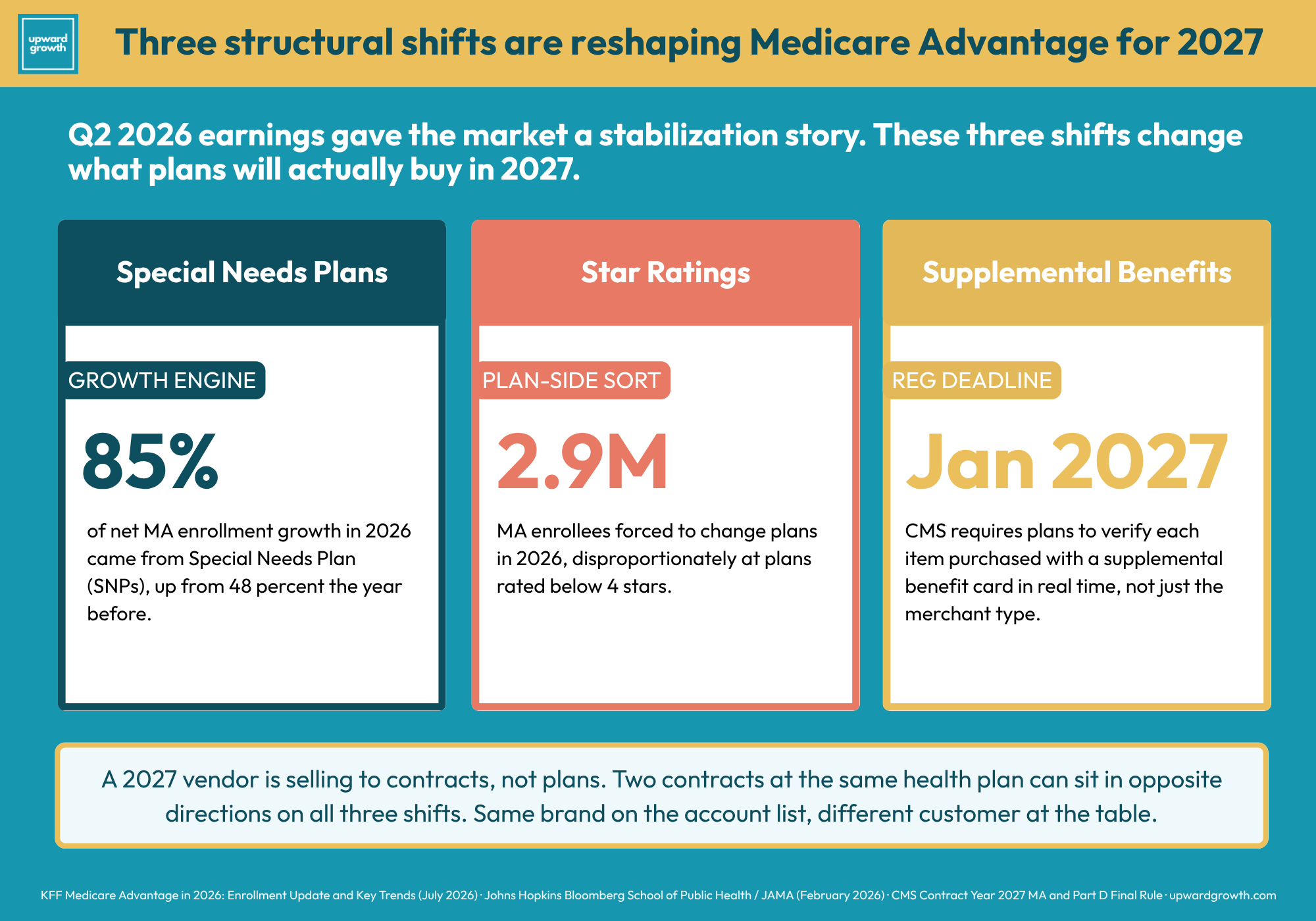
Each of those shifts changes what a plan actually buys, cuts, or defends heading into 2027. Enterprise financial analysis captures none of them, because none of them show up in a margin walk. They show up in enrollment files, in courtrooms, and in verification requirements.
Shift One: The SNP Growth Story Is a C-SNP Story
The 2026 MA growth headline was flat to modestly positive. Underneath it, plans executed a specific rotation that reshapes buying priorities across every major buyer heading into 2027.
KFF's latest enrollment analysis found Special Needs Plans (SNPs) accounted for 85 percent of net Medicare Advantage enrollment growth in 2026. General MA (the individually available bucket, not group and not SNP) posted slower growth in 2026 than in any year between 2007 and 2025. Both numbers came straight out of the CMS enrollment file, so they are hard data points, not analyst reads.
The composition inside that 85 percent is where the buying decisions get made. C-SNPs are the actual growth engine, not D-SNPs, even though D-SNPs make up 78 percent of the SNP enrollment base. C-SNPs added roughly 500,000 net new members in 2025 to 2026, compared with D-SNPs adding roughly 344,000. C-SNPs grew 45 percent year over year while D-SNPs grew 5.7 percent, an 8x gap in growth rate despite C-SNPs starting from a much smaller base. The 2024 to 2025 flow ran the same way (C-SNPs added 476,000, D-SNPs added 159,000). Chronic-condition plans are the fastest-growing product in Medicare Advantage right now, and it is not close.
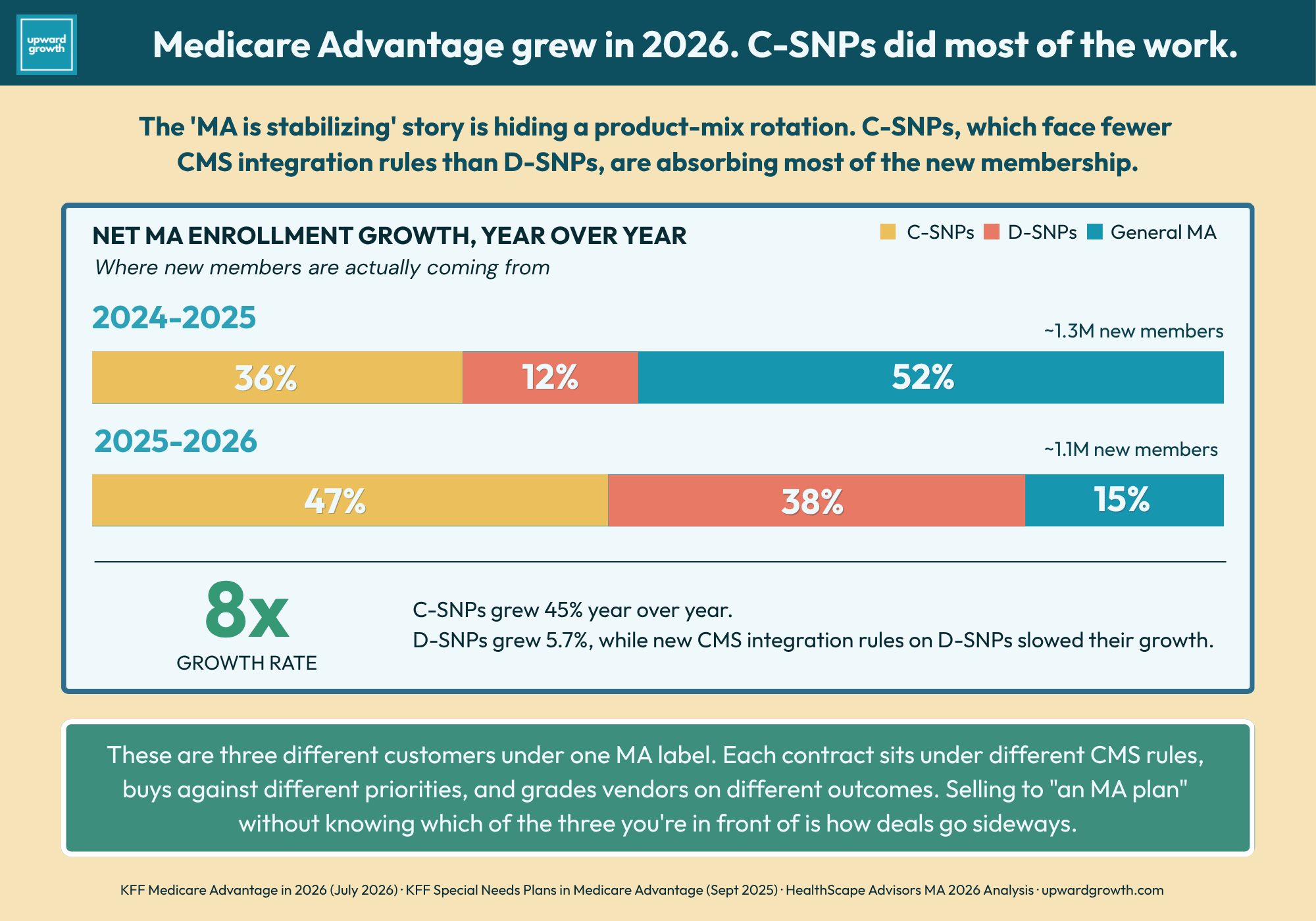
For a vendor who thought they were pursuing “the duals market,” that composition gap matters. The addressable population is not the one you sized against, and the plan-side buyer for chronic-condition programs is a different account than the buyer for state Medicaid integration.
The reason sits on the CMS side. New D-SNP integration requirements around state Medicaid coordination take hold in 2027, and plans spent 2025 and 2026 on operational readiness. That work slowed D-SNP enrollment throughput in the exact window it should have surged. C-SNPs do not carry the same integration requirement, so growth routed there instead. D-SNP throughput will recover once integration is in production; C-SNP will keep growing on its own economics.
Plan by plan, C-SNP enrollment numbers show where growth landed inside SNPs, and the pattern is coordinated across the peer set. Humana grew C-SNP enrollment 53 percent year over year, UnitedHealthcare grew 38 percent, Elevance grew 12 percent, Aetna grew 26x off a small starting base, and Devoted grew 17x. Compare that to what the same plans are saying on earnings calls. Centene has told the market 2027 will focus on "dual-eligible populations." Humana's Q1 2026 language framed D-SNP intake as the higher-value pipeline. The public commentary sits with duals; the enrollment file is loading up on C-SNPs. But it’s important to dig into the enrollment data, and not only rely on the press release.
Chronic-condition plans are the fastest-growing product in Medicare Advantage right now, and it is not close.
You can argue that the “MA plan” buyer category is disaggregating into three product lines. A general MA book (shrinking pool with tighter vendor spend). A D-SNP book (growing pool, budget flowing into state Medicaid integration and duals-specific care management). And a C-SNP book (fastest-growing pool, budget flowing into condition-specific care programs, chronic care management infrastructure, and disease-state specialty vendors). And most major plans have all three, with different budgets and priorities within each. A vendor pitch that treats MA as monolithic, or that treats the SNP piece as a single duals story, will forecast 2027 pipeline off aggregate trend lines no plan is operating against, so take the time to segment your book by which of the three lines you actually serve.
The second shift is how plans decided which contracts to cut and hold, and what is now happening to the tool they used to make those calls.
Shift Two: The Star Ratings Program Is Breaking Down
The Star Ratings program has settled into an annual pattern over the past two rating cycles. Plans invest tens of millions in Star improvement programs, CMS publishes the ratings each October, some downgraded plans sue, courts partially agree, and CMS ends up partially recalculating for some contracts while appealing for others. What ends up funding Quality Bonus Payments (QBPs) diverges from what CMS originally published. The 2027 cycle is the largest version of that sequence to date. The QBP program, which ties billions of dollars to those ratings, is showing signs of a systemic problem unlikely to survive to 2028 as it stands today.
Prior rating cycles have already produced this exact pattern. In 2024, Elevance and SCAN Health Plan won Stars lawsuits that prompted CMS to recalculate ratings for 60 plans and issue roughly $1.4 billion in additional Quality Bonus Payments. UnitedHealthcare followed with its own suit in October 2024 and won a court-ordered recalculation the following month. I wrote about the initial Clover v. HHS filing in June 2026 and discussed it on the Upward Growth podcast, framing it as a signal for broader pressure on the QBP program. If you want week-by-week detail on how each ruling and CMS response is playing out, Jenn Kerfoot at DUOS has been publishing a fantastic and thorough deep-dive series on the Clover ruling and CMS’s shifting positions. What matters here is not each individual case but the pattern. Plans have figured out that litigating a Star Rating downgrade is often cheaper than absorbing the QBP hit, and CMS is now spending significant resources defending a methodology whose flaws multiple federal courts have already ruled on.
Meanwhile, Johns Hopkins Bloomberg School of Public Health researchers, publishing in JAMA in February 2026, found that 2.9 million Medicare Advantage enrollees were forced to change plans in 2026, roughly 10 percent of MA enrollees in a single year. Plans rated below four stars were disproportionately affected. Only about 67 percent of MA enrollees now sit in 4+ star plans, down from roughly 80 percent earlier in the decade. Humana said on Q2 2026 earnings that 2027 exit decisions skewed to contracts rated 3.5 stars or lower. Plans are using Star Ratings to make consequential exit decisions, and then some of the same plans are suing over the same Star Ratings after the fact.
🎙️ Episode 5 of the Upward Growth Podcast is the audio companion to this article. It walks through the three shifts as one compounding pattern rather than three separate reads, and translates the market shape distinction into the segmentation and account risk work the CY 2027 bid window is actually being modeled against.
The last time the market saw this pattern was 2014-15, when Stars similarly triggered a wave of contract exits. What is different now is the scale. Roughly 10 percent of MA enrollees getting forced out in a single cycle is triple the ~3 percent hit that landed in 2014-15, and it is happening to plans that have already absorbed two consecutive rate cycles of pressure while absorbing compounding pressure across every other line of business at the same time.
For the current cycle, briefly: Clover filed in November 2025 and won a partial ruling from a Georgia federal court in May 2026 that adjusted its largest contract from 3.5 to 4.5 stars. In June, CMS agreed to voluntarily recalculate 2027 QBPs for certain contracts but retained 10 of 20 contested measures for others. In July, SCAN Health Plan, Alignment Healthcare, and Elevance filed their own suits, each arguing CMS violated the Administrative Procedure Act (APA) by treating similarly situated plans differently. Combined disputed QBP dollars are $290 million (Elevance $115M, SCAN $125M, Alignment $50M). On July 21, CMS filed a notice of appeal on the Clover ruling to the 11th Circuit Court of Appeals.
For the plan-side buyer, that means Stars is a moving number, and CMS's hold-harmless approach to the current recalculations means it moves in only one direction. Clover won and its 2026 rating moved from 3.5 to 4.5. CMS then voluntarily recalculated for other plans using a reduced measure set, though per analyst commentary the effect on average ratings for non-plaintiff plans was modest.
SCAN, Elevance, and Alignment are now in court arguing CMS should have applied the Clover methodology to their contracts too. If any of them wins, or CMS concedes further ground while defending the Clover appeal, additional plans could see ratings move up. The competitive picture shifts even without downgrades: plans that gain QBP dollars have more to redeploy into benefit design and member acquisition, while their competitors, whose ratings did not move, face a widening gap on the same lines. Any account risk model that treated a plan's Star tier as a fixed input six months ago is working from an out-of-date snapshot.
Where all of this lands is a QBP program that will not look the same in 2028 as it does today. Stars as a measurement system is not stable enough right now to run the operational and financial decisions that CMS has built on top of it, and every additional lawsuit strengthens the case for a rewrite. Whether the 2028 version is a modest methodology revision or a wholesale overhaul depends on the 11th Circuit ruling and how CMS responds.
That takes us to the third shift, on supplemental benefits, where a hard January 2027 regulatory deadline will consolidate a whole vendor category onto a handful of compliant platforms.

Shift Three: Supplemental Benefits Are Now a Member Selection Tool
Supplemental benefits used to be the growth lever. Plans loaded flex cards, Over-The-Counter (OTC) allowances, and food and grocery cards to win Annual Enrollment Period share. Plans are not trying to grow membership the same way anymore, so the benefit stacking has slowed too.
What plans are doing with benefit design heading into CY 2027 is doing two things at once. The obvious one is saving money. Reduced benefit spending protects margin under tight rate assumptions. The less-obvious one shows up in the county-level filings but not on the earnings calls: plans are shaping which members they attract and which they don’t. Cut general-population supplemental benefits and keep SNP-specific care management benefits, and you become less attractive to a marginal general MA shopper and more attractive to the D-SNP and C-SNP populations you actually want to grow into. Benefit cuts are member-shaping decisions, not just cost decisions.
The category-level pullback data already shows it. KFF’s 2026 MA spotlight found OTC benefits available in 66 percent of 2026 MA plans, down from 73 percent in 2025. Meal benefits, transportation, and fitness all posted declines, while dental has held steady. The trend has been building for two years, and it is accelerating into CY 2027.
Effective January 1, 2027, supplemental benefit spending routed through flex cards, OTC allowances, and food and grocery cards has to be verified in real time at point-of-sale, per the CY 2027 Final Rule we unpacked when it dropped, with each transaction tied to an eligible plan-covered item. Vendors serving these categories have to prove SOC 2 data-security compliance, CMS-grade verification infrastructure, and real-time integration with plan claims systems. Plans that were already trimming will use the deadline as the reason to consolidate remaining spend onto the smaller set of platform vendors that meet the standard. Everyone else gets squeezed out of accounts they have held for years.
For a vendor in the supplemental benefit category, that creates three legitimate paths and one bad option:
1. Platform-winner status: gaining accounts as competitors fail the verification standard and get dropped.
2. Partner-under-a-platform-winner: your product runs as an underlying feature inside a compliant platform (revenue continuity, less brand equity).
3. Category exit: harvest cash on the current book and redeploy capital elsewhere ahead of the CY 2027 bid submissions.
The wrong move is waiting to see how the market sorts out. The plan-side decision on who they consolidate onto is being modeled right now alongside CY 2027 bid economics.
And frankly, even if you do not sell into supplemental benefits, this still changes how you sell. Plans are using benefit design as a member-shaping tool now, not just a cost lever, and every product they buy from you gets evaluated on the same lens: does this help attract the members we want (SNP populations, high-risk-adjustment members, targeted geographies) or does it help retain members we are not trying to keep? Your framing on new products and renewals has to speak to that lens too.
That's why the sell-side stabilization story from the financial press keeps getting stretched past what it was built to answer.
Enterprise Stabilization Is Not Market Shape Analysis
Two distinct analytical questions get conflated in the MA market right now, and separating them matters for what you do next.
The enterprise margin question. Whether plans hit their 2028 margin targets, and whether the stock is defensible at current valuations. Sell-side analysts answer this credibly. Historical MA cycles do recover, discipline returns, and target margins come back. The 2014-15 reset is the base case, and enterprise analysts are right to reference it. The Johns Hopkins researcher who ran the disenrollment analysis framed the 2026 pullbacks in a follow-up AJMC interview as “necessary market corrections intended to address historical government overpayments,” which is directionally consistent with the sell-side stabilization view. Both reads are compatible and largely correct.
The market-shape question. What plans will actually be buying in 2027, in what categories, at what Star tiers, in what geographies? That is a different analytical problem, and the 2014-15 comparison as the base case does not carry over cleanly.
Five structural differences make the market-shape analysis distinct. Forced disenrollment in 2026 runs roughly three times the scale of the 2014-15 cycle. The Inflation Reduction Act (IRA) rewrote Part D economics after 2022. Chart review exclusion under the tighter 2027 rate parameters reshaped risk adjustment revenue across every plan for CY 2027. Coordinated cross-plan rotation into SNPs (heavier on C-SNPs than public commentary implies) is a 2025-2026 phenomenon with no real parallel in the earlier reset. And the supplemental benefit platform consolidation runs on a hard January 2027 deadline that no prior cycle had to accommodate either. Plans crystallized their responses to those forces during the Q1 2026 earnings cycle. All five of these differences are material to current health plan buying decisions, and none were really present the last time this market ran a reset cycle.
Enterprise stabilization and market re-shaping are both true; they just answer different questions. Planning your market strategy off enterprise stabilization alone, though, is like planning a real estate purchase off a stock analyst’s read on the housing market. Right domain, but wrong analysis.
What the Three Shifts Add Up To
The three shifts are hitting the same buyer at the same time, and plans are having to allocate against all three inside the same CY 2027 bid cycle. Reading them in isolation is where the market-shape analysis breaks down, because on the plan-side P&L they do not sit in isolation. They compound.
A plan’s Star tier shapes its C-SNP appetite, since plaintiff plans with QBP upside will fund the C-SNP push harder than bystanders who are still absorbing the recalculation exposure. That same Star position drives the pace of supplemental benefit consolidation, because plans under the tightest budget pressure will lean hardest on the January 2027 verification deadline as the reason to cut vendors they were already trimming. And the C-SNP push itself determines what actually stays in the supplemental benefit portfolio, since SNP-specific care benefits will get protected inside the cuts while general-population benefits are the first to go. Each shift is a variable in the other two, and none of them can be understood cleanly without the other two in view.
The work between now and end of Q3 is to build a read on where each plan in your book, portfolio, or advisory relationships sits across all three shifts together, holding the product-line mix, the Star-plus-litigation posture, and the supplemental benefit standard as one connected picture rather than three separate reads. That is the market-shape analysis argued for earlier in this piece, and it is what turns the three shifts from three data points into an actionable answer to what plans will be buying in 2027.
Final Thought
Late in September, the CMS Landscape file drops. That is the next real data point that either confirms or complicates the three shifts.
Three signals to watch for inside the file. How much of the announced exits and county-level contractions translate to actual plan withdrawals, or whether plans held more footprint than earnings-call commentary implied. Whether the D-SNP and C-SNP plan-count expansion matches the growth commentary, which is the real test of whether the SNP rotation is landing at the filing level or is being oversold. And which supplemental benefit categories move which direction, and how the cuts distribute across plans.
Whichever way the file lands, the underlying point really doesn’t change. Enterprise stabilization and market-shape analysis are answering different problems, and anyone planning CY 2027 exposure off enterprise financial analysis alone will forecast against a market that does not exist. So read the shifts, segment against MA product line and Star-plus-litigation exposure, and settle your supplemental benefit position before the CY 2027 bid window closes. Everything else follows from that.
Finally, ff any of the three shifts touch your CY 2027 planning (repositioning a product for the C-SNP rotation, resetting account risk models against Star litigation exposure, making a stay-or-exit call in supplemental benefits), Upward Growth is a health plan market advisory firm built for exactly this kind of question. We work with health tech vendors, investors, provider organizations, and management consultancies on strategy that starts from how health plans actually buy, operate, and make decisions. Get in touch.
Thanks for reading.
Here’s to upward growth,
Ryan Peterson
The frameworks in the weekly Upward Growth newsletter help health tech sales and marketing teams navigate payor conversations as the market continues to shift.
If your colleagues are in those conversations, they should be reading this too.
💰 Invest In Your Team with a Paid Subscription.
💡 Pro tip: Many subscribers expense Upward Growth through their company’s professional development, training, or learning budget. Here’s a one-minute email template to get your manager to approve expensing your subscription.