

Upward Growth is a health plan market advisory firm. Our weekly newsletter covers payor market strategy, regulatory shifts, and go-to-market insights for health tech vendors, investors, provider organizations, and consultancies competing in the health plan market.
🤝 Work with us on payor market strategy: Contact us
🟦 Connect with the author, Ryan Peterson, on LinkedIn.
🎧 Listen to the Upward Growth Podcast: Apple | Spotify
📰 Newsletter sponsorships: Learn More
Today’s Upward Growth newsletter is sponsored by Invent Health

At Invent Health, we built the all-in-one payer intelligence platform because the health plan leaders we work with want fewer vendors doing more of the work. Risk Analytics, Coder Workbench, Encounter Submissions, and Quality Analytics share one view of every member, so every team at the plan works from the same information. We serve Medicare Advantage, Medicaid, and ACA plans. If you work with health plans, we’d like to show you what we’ve built. - Rohit Bhardwaj, Founder and CEO, Invent Health
Interested in sponsoring Upward Growth? Contact Us
The Upward Growth audience survey launches today, and your answers will directly shape where the newsletter and podcast go over the next few months. It takes three minutes, is anonymous unless you share your email at the end, and is open through November 24. If you’ve gotten value from Upward Growth, tell us what matters most to you: Take the survey here.
A friendly reminder that the Upward Growth Debrief is this Friday, November 6 at 1pm ET / 10am PT. It’s the monthly live call for paid subscribers. I’ll open with fifteen minutes on what’s shifting in the market right now, including what doesn’t fit into the written newsletter, then we'll do Q&A and dialogue. Paid subscribers, watch your inbox for an email a couple of days before the call with the Zoom link and details. If you’ve been thinking about upgrading, come join us.
Finally, I’ll be at the HLTH conference in Las Vegas November 15 to 18, catching up with clients, friends, and a few of you I’ve only ever talked to over email. If you’ll be in Vegas that week, send me a note and let’s find a time to meet.
The 2027 Medicare Advantage (MA) Landscape File is telling two stories at once. The dominant one is retrenchment. The 2027 Landscape file read on operating discipline across the Nationals walked through the picture: Humana trimmed its individual MA footprint by 57 counties, Centene cut nearly a third of its lineup from 303 plans to 210, Health Care Service Corporation (HCSC) halved its county presence from 948 to 450 following its 2025 Cigna Medicare acquisition, and Molina exited individual MA entirely to redeploy toward Medicaid. Average Maximum Out of Pocket (MOOP) climbed around 9 percent market-wide, supplemental benefit availability dropped across food, Over-the-Counter (OTC), transportation, and fitness, and fifteen insurers set enrollment caps on 65 plans in eleven states. These are the moves plans make when managing to margin above all else.
The second story is the opposite. Chronic Condition Special Needs Plan (C-SNP) enrollment grew faster than any other product line in Medicare Advantage for 2027. The compounding pressure behind that growth is where I would focus plan leadership's attention right now.
Special Needs Plans (SNPs) grew 9.4 percent in plan count for 2027. C-SNPs grew faster than everything else in that umbrella, adding 192 plans for a 34 percent jump. Devoted Health alone added 133 of them, taking its count from 122 to 255 in a single year and entering five new states. That one company accounted for 69 percent of all net C-SNP growth in the market.
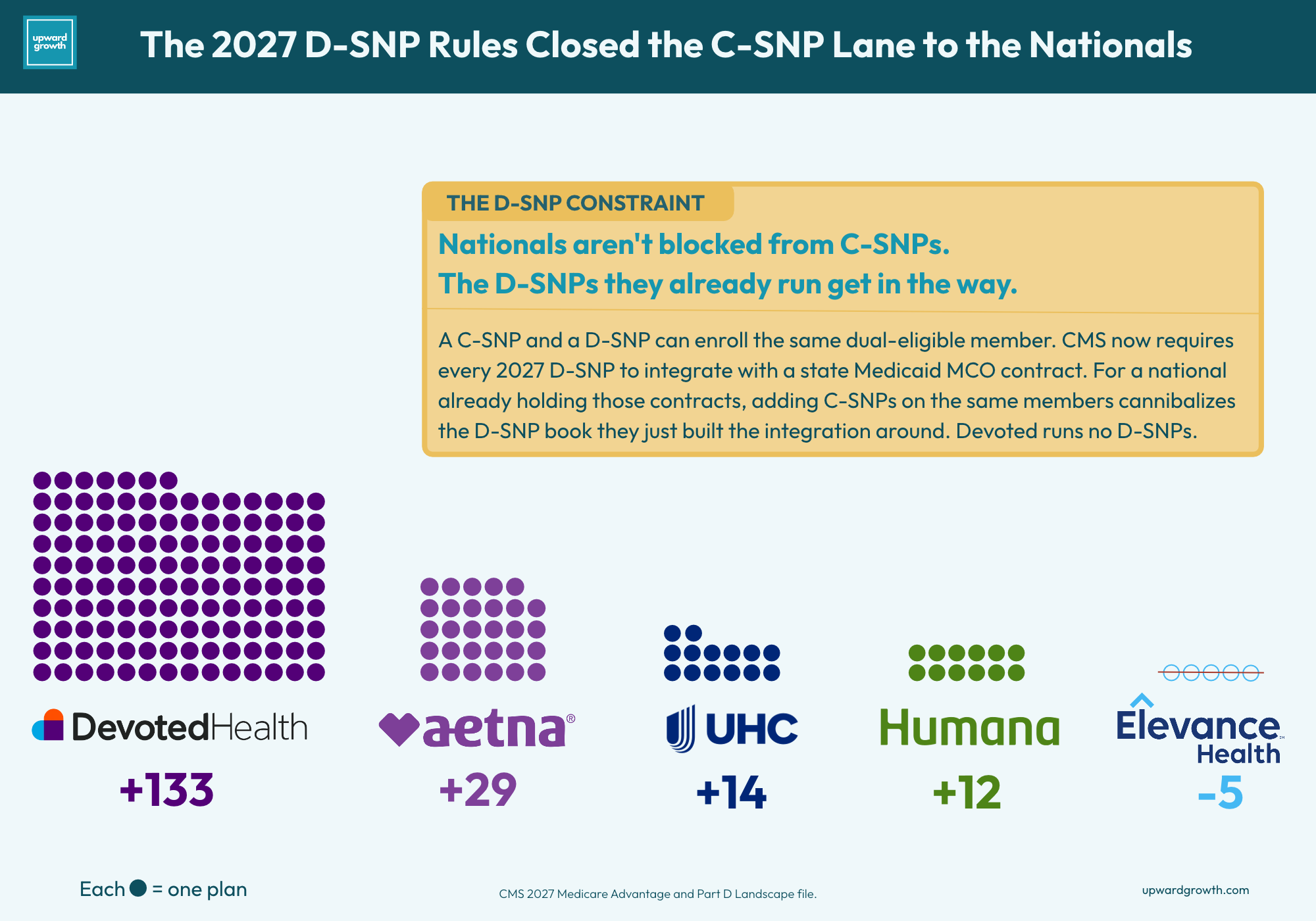
The surface growth is striking, and yet what sits underneath those numbers is more concentrated and more specific than the headline suggests. Dual Eligible Special Needs Plan (D-SNP) composition shifted inside the same window, with Coordination Only plans up 32, Highly Integrated Dual Eligible (HIDE) SNPs down 68, and Fully Integrated Dual Eligible (FIDE) SNPs up six.
Where C-SNP Growth Is Concentrated and Who Is Watching
C-SNPs can target any of a long list of chronic conditions CMS allows, but in practice the market has clustered around three. Cardiovascular disease, chronic heart failure, and diabetes together account for roughly 95 percent of C-SNP enrollment nationally. The 2026 cycle saw C-SNP plan counts jump from 376 to 548 and enrollment grow 49 percent (an additional 500,000 members), with 207 of the roughly 215 new C-SNPs falling in that same clinical grouping. Between 2026 and 2027, plans built around those three conditions grew market-wide from 481 to 662.
These conditions do not fall evenly across the Medicare population. They cluster heavily in the same socioeconomic cohort that qualifies for both Medicare and Medicaid. In practice, C-SNP growth is pulling in beneficiaries who look dual-eligible by every measure except Medicaid status, which would route them into D-SNPs. That is the dual-adjacent population I keep returning to, and it is the engine driving the growth story's momentum.
Attention around this pattern has been building for over a year, and it has come from more than CMS. The Medicare Payment Advisory Commission (MedPAC), the Department of Health and Human Services Office of Inspector General (HHS OIG), and the National Association of Medicaid Directors (NAMD) have all weighed in, as have independent policy researchers and the industry coalitions whose own member plans are growing C-SNPs.
C-SNP Economics Under V28 and the Verification Rules
The cost of running a C-SNP in 2027 is higher than it was in 2026, and the revenue available to offset it is tighter. The pressures on both sides are market-wide, but they bite harder in the dual-adjacent cohort these plans are growing into than in a conventional MA book. The faster the growth in that cohort, the sharper the compression on both sides.
Start with the verification mechanics. CMS rules require independent verification of the qualifying condition through the enrollee’s treating physician before enrollment can take effect. Neither a diagnosis on a previously submitted claim nor a verification carried over from the prior plan clears that bar. The verification cycle runs on every new member every time, and the administrative load scales nonlinearly with plan growth.
The burden lands hardest in the dual-adjacent population. These members churn across coverage status at a higher rate than other MA beneficiaries, with less continuous provider relationships and more geographic movement. Verification cycles that work in a cleaner Medicare-only commercial-provider market break down faster in a population with higher churn and thinner continuity of care. Growing C-SNP plan counts 34 percent in a single cycle is a demanding lift under any conditions. Doing it in a higher-churn dual-adjacent cohort, while verifying every new enrollee through a treating physician, pushes the cost per new member materially higher.
Risk adjustment adds a second pressure. V28 reached full weight in 2026, and chart review exclusion was codified alongside it, closing off a meaningful lane of retrospective risk capture MA plans across the market relied on. These are both market-wide pressures, but they land harder in dual-adjacent populations than in the broader MA book. Complex multi-condition members are exactly where V28 reweighting reduced coefficients most, and chart review exclusion removes a source of capture that complex members disproportionately contributed to under the prior rule set. The combination compresses revenue per member in the same cohort C-SNP growth is drawing in.
Actuarial advisory to C-SNP operators has already flagged the claims-to-revenue timing mismatch inherent to prospective risk adjustment for C-SNPs, a dynamic V28 and the chart review exclusion sharpen rather than relieve. The same advisory tells plans to actively monitor CMS policy on dual enrollment in C-SNPs. That is the kind of language actuaries use when they want plans to carry policy risk in their forward bid modeling without saying the words policy risk directly to C-SNP sponsors.
C-SNP growth is pulling in beneficiaries who look dual-eligible by every measure except the Medicaid status that would route them into D-SNPs.
Inside C-SNP enrollment, dual concentration shapes the economics. Higher-dual plans carry more coordination load, more supplemental benefit utilization, more provider mix complexity, and more exposure to state Medicaid environment shifts, while lower-dual plans sit closer to a conventional MA book with a chronic-condition filter. Both are growing, but growth is weighted toward the high-dual end of the distribution, where operating economics are tightest.
Some of that federal attention is already visible on the operating side. The HHS OIG workplan OEI-03-25-00210 is actively evaluating D-SNP risk adjustment payments tied to diagnoses reported only on Health Risk Assessments (HRAs) and chart reviews with no other records of service in MA or Medicaid data. The scope is formally D-SNPs, not C-SNPs. But the practices under evaluation (HRA-sourced diagnoses, chart-review-sourced diagnoses, thin corroborating service records) are not practices that stop at the formal D-SNP line. The workplan is scheduled for completion in 2027. Any findings will reach the C-SNP conversation whether or not scope formally extends.
That is where the operating pressure meets the federal attention stacking around C-SNPs. The verification economics, the V28 and chart review exclusion effects, and the OIG workplan are all tightening around the dual-adjacent population C-SNPs are growing into.

What CMS, MedPAC, and OIG Are Saying About C-SNPs
The regulatory signals around C-SNPs do not all carry equal weight. Ranking them matters for separating what is in motion from what is still being hinted at. The primary signals come from CMS itself, MedPAC, and HHS OIG, with NAMD, academic research, and industry commentary as supporting voices. It’s this industry collective that continues to catch my attention.
CMS wrote in a Request for Information on C-SNPs and I-SNPs with high dual concentrations that C-SNP enrollment growth “could be an intentional approach by MA organizations to circumvent” federal and state D-SNP integration requirements. That phrasing is unusually direct inside an RFI. The RFI itself, published in late November 2025 as part of the Contract Year 2027 Proposed Rule, asked whether to apply a State Medicaid Agency Contract (SMAC) requirement to C-SNPs and Institutional Special Needs Plans (I-SNPs) at high dual concentrations, and whether to extend the D-SNP look-alike contracting limitations to C-SNPs. Whether the Final Rule acted on either lever is a separate question; CMS's formal language carries weight on its own.
The April 2026 Final Rule deferred both C-SNP RFI levers to future rulemaking. On D-SNP integration itself, however, the Rule did act. The “substantially similar” network requirement gave way to a 120-day continuity-of-care transition period for passive enrollment. New exceptions to §422.514(h) policy allow D-SNPs to continue enrolling full-benefit duals in HIDE SNPs or Coordination Only D-SNPs where those members sit in Medicaid fee-for-service, plus a US Territory exemption. Both relax existing integration standards. One tightening sat alongside them: CMS finalized immediate termination authority for D-SNPs that lose their SMAC. On balance, the Final Rule reads as deregulatory on dual integration broadly, with specific tightening preserved around SMAC loss.
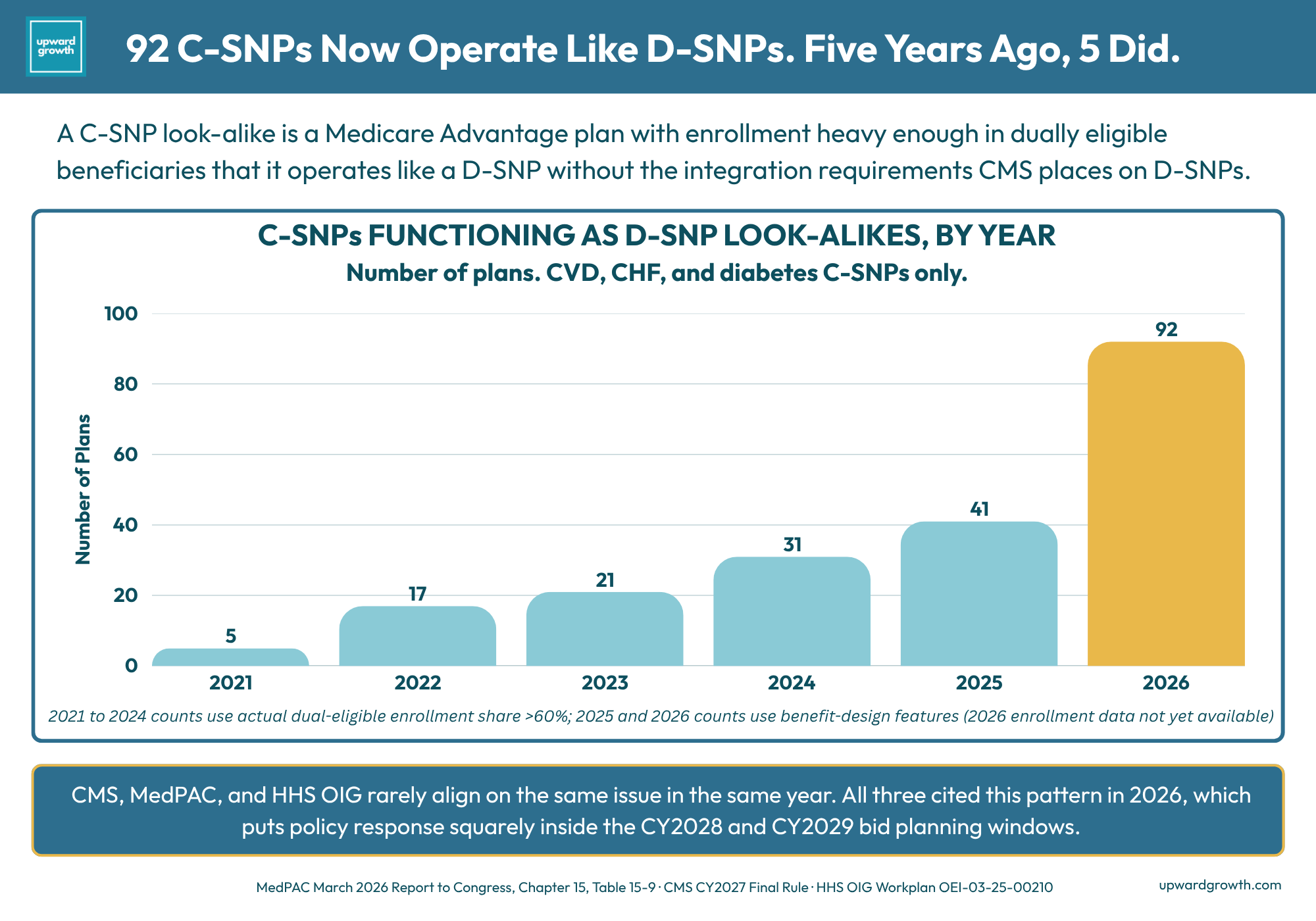
Where CMS asked, MedPAC answered. The March 2026 Report to Congress devoted a full chapter to C-SNPs functioning as D-SNP look-alikes, counting 92 such plans in 2026 against five in 2021 and roughly 100,000 additional members across the period. MedPAC concluded that policymakers “may want to consider applying the current limits on look-alike plans to C-SNPs.” For a MedPAC conclusion, that is as close to a direct recommendation as the Commission usually gets.
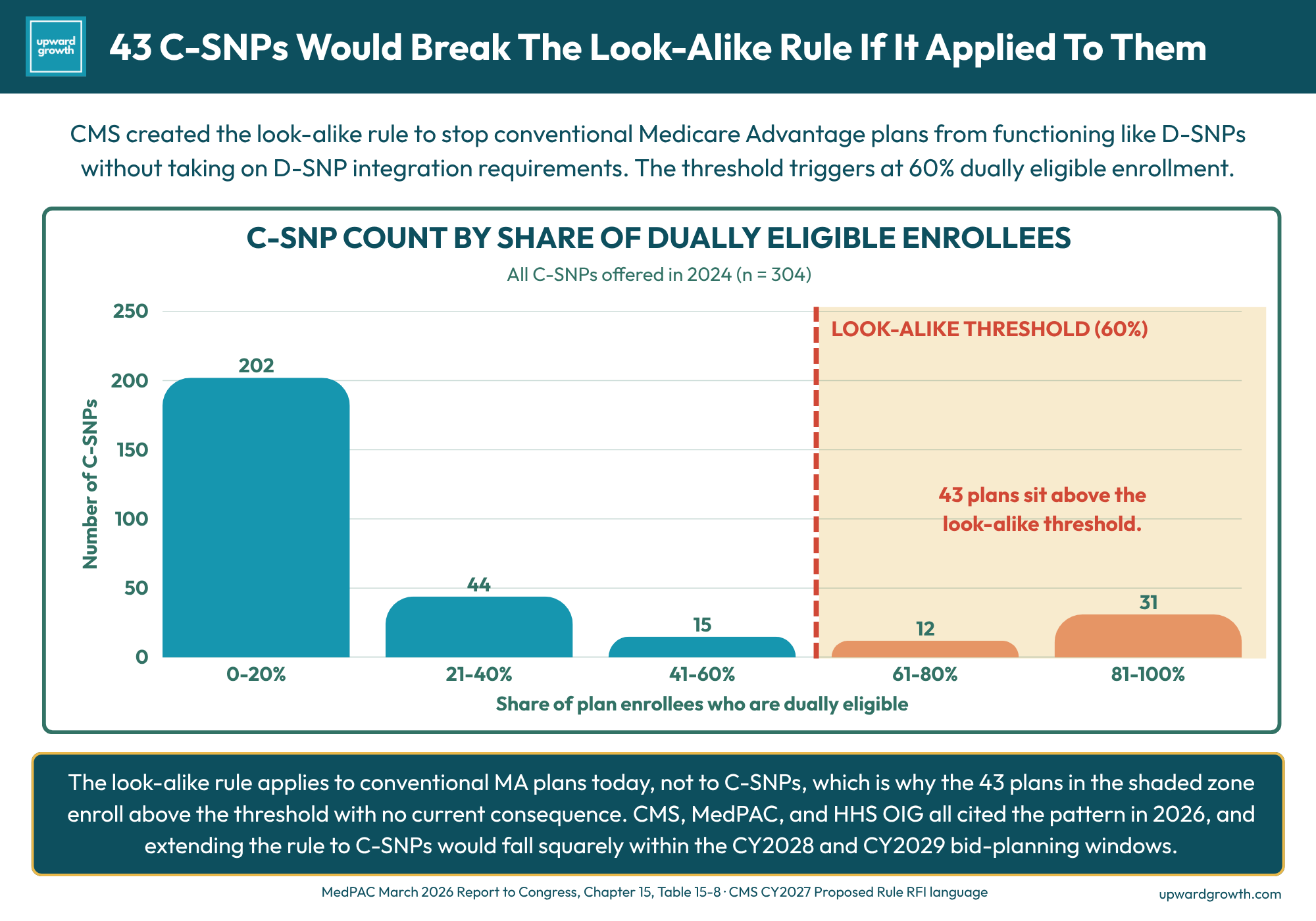
Academic research reaches the same conclusion from a different angle. The D-SNP look-alike threshold sits at 60 percent dual enrollment for 2026 and beyond, and 43 C-SNPs would already clear that threshold if the rule applied to them, based on 2024 enrollment data. When CMS tightened the D-SNP look-alike termination policy in 2023, dual enrollment did not shift into integrated plans, but it did rise in C-SNPs in affected counties. That is exactly the behavior CMS is watching for now. A public comment letter from academic researchers formalized the same concern in the 2027 rulemaking file.
Timing is what keeps HHS OIG in the primary tier alongside CMS and MedPAC. The D-SNP risk adjustment workplan completes in 2027, putting findings in play exactly as plans finalize 2028 bid work and start 2029 planning.
State Medicaid directors publicly backed CMS’s direction. In a comment letter on the CY 2027 Proposed Rule filed in late January 2026, NAMD supported CMS exploring look-alike safeguards for C-SNPs and encouraged the agency to monitor C-SNP and I-SNP participation to prevent circumvention of D-SNP integration requirements.
Finally, I found this industry positioning in the comment file rather intriguing. The Dual Eligible Coalition pushed back on a blanket SMAC requirement for all C-SNPs. In the same letter, the coalition recommended CMS develop an appropriate look-alike threshold for C-SNPs with a phase-out plan. An industry group representing dual-eligible-serving plans endorsing a look-alike threshold with a transition plan is a different kind of statement than straight opposition. The Health Care Transformation Task Force (HCTTF) similarly supported CMS exploring look-alike safeguards for C-SNPs. When both industry and delivery system reform coalitions endorse the direction, even in bounded form, the regulatory conversation may just shift from whether to how.
Of course, all of this needs grounding against the administration’s deregulatory posture on MA. CMS deferred the two C-SNP action levers from the CY 2027 RFI in the Final Rule, a near-term signal that the agency is not racing to act. But the October 16, 2026 press release announcing the first CY 2028 Proposed Rule noted that CMS plans to release another proposed rule with “policy and technical changes for Parts C and D later this fall.” That second rule is where C-SNP integration policy would land if CMS acts in this cycle, as deferral in the Final Rule is not the same as indefinite deferral.
Modeling Compound C-SNP Exposure for the 2028 Bid Cycle
The operating side and the federal side are the same underlying bet moving at different speeds. Treating them as independent risks pointed at C-SNPs understates what their convergence does to 2028 bid math.
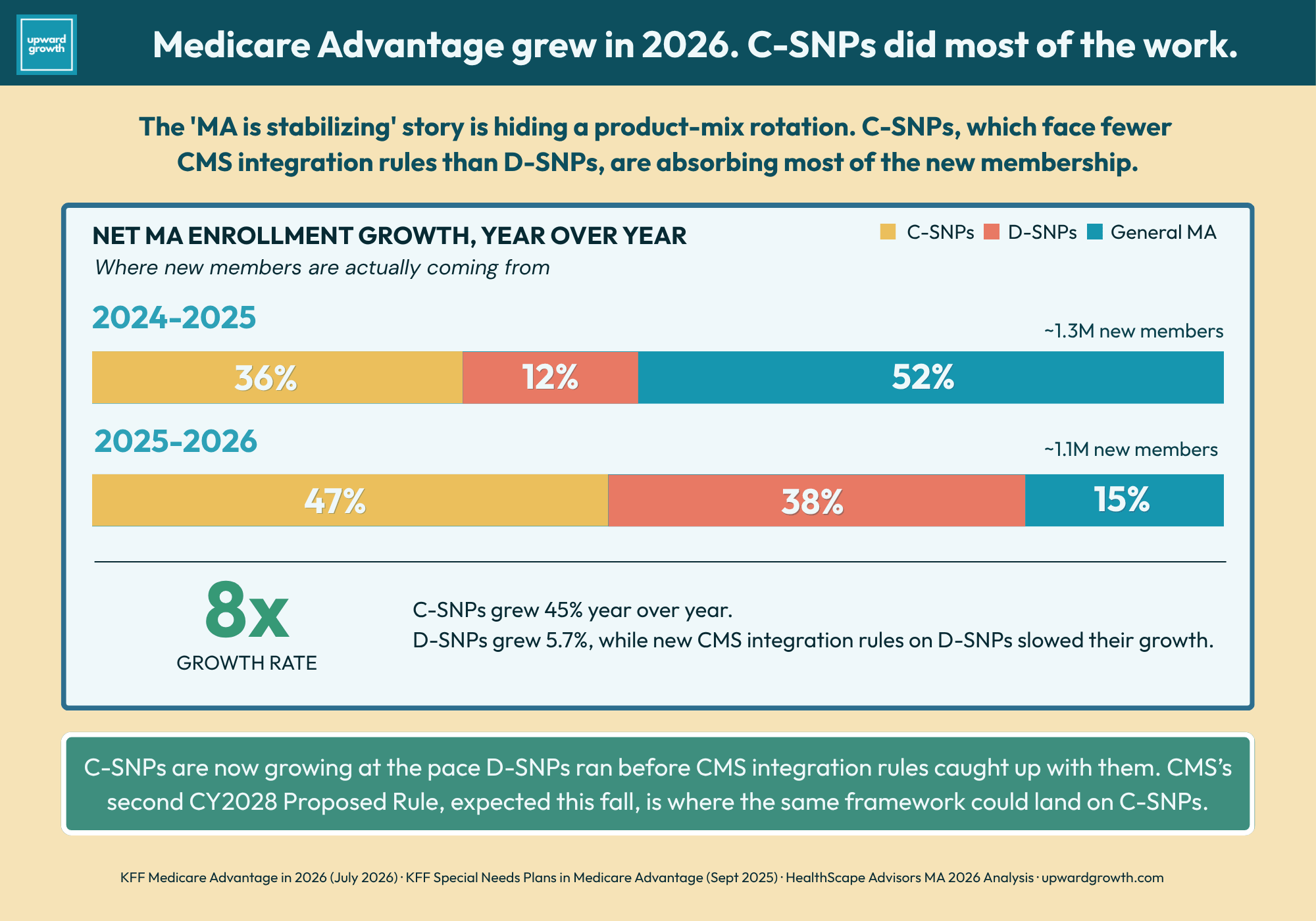
On the operating side, the pressure is already live. V28, chart review exclusion, verification economics at scale, and higher churn in dual-adjacent populations are compressing revenue and raising cost per member precisely where C-SNP growth is landing. Those forces act in 2027 regardless of what CMS does in the fall rulemaking cycle.
On the federal side, the trajectory is probabilistic and plays out over a longer horizon that still reaches into the 2028 bid cycle. CMS has flagged the pattern, MedPAC has recommended action, OIG findings on parallel D-SNP practices land in 2027, and industry has lined up alongside. The posture is deregulatory, but the specific action levers remain on the table, and the fall 2026 Proposed Rule is where they could appear.
And this is where plan bid math gets interesting. I wrote about SNP composition rotation as one of the shifts reshaping MA buyer behavior, and that rotation is accelerating into 2027. Plans leaning into dual-adjacent C-SNP growth as their only remaining expansion lane are concentrating the operating exposure and the policy exposure into the same book, the same cohort, the same cycle. A plan running a growth strategy that way needs its 2028 bid cycle to carry all of it at once: V28 at full weight on complex multi-condition members, chart review exclusion on retrospective risk capture, and a non-trivial probability that CMS acts on C-SNP integration in the fall Proposed Rule. Modeling any one of those alone understates what a move in another does to the margin picture.
Health plans with the most concentration also have the thinnest buffer if any one of these variables moves against them. Simply put, the same concentration driving headline growth also makes the bid-cycle math fragile.
Final Thought
My guess is that the next twelve months decide whether the compound pressure around C-SNP growth stays theoretical or becomes a 2028 bid cycle problem. CMS has already signaled where the action levers sit; the fall 2026 Proposed Rule is where any move on C-SNP integration would land first. Meanwhile, HHS OIG findings in 2027 could reach the C-SNP conversation on their own clock, independent of what CMS does. And beneath both timelines, the 2028 bid cycle keeps compressing margin regardless of what either rulemaking produces.
For leadership still holding footprint decisions open for 2028, I would treat operating economics and policy risk as a single system rather than two separate stories. A strategy built that way holds up through the 2028 cycle whether or not any single lever moves. Reading only one side leaves the plan caught when the other shifts.
Upward Growth is a health plan market advisory firm built for exactly this kind of question. We work with health tech vendors, investors, provider organizations, and management consultancies on strategy that starts from how health plans actually buy, operate, and make decisions, whether that means helping with 2028 bid planning, with portfolio companies exposed to C-SNP operators, or with plans themselves on where the operating and regulatory environment is heading. Contact us here.
Thanks for reading.
Here’s to upward growth,
Ryan Peterson
The frameworks in the weekly Upward Growth newsletter help health plans, health tech vendors, investors, provider organizations, and consultancies understand the health plan market as it continues to shift.
If your colleagues are in those conversations, they should be reading this too.
💰 Invest In Your Team with a Paid Subscription.
💡 Pro tip: Many subscribers expense Upward Growth through their company’s professional development, training, or learning budget. Here’s a one-minute email template to get your manager to approve expensing your subscription.