

Upward Growth is a health plan market advisory firm. Our weekly newsletter covers payor market strategy, regulatory shifts, and go-to-market insights for health tech vendors, investors, provider organizations, and consultancies competing in the health plan market.
🤝 Work with us on payor market strategy: Contact us
🟦 Connect with the author, Ryan Peterson, on LinkedIn.
🎧 Listen to the Upward Growth Podcast: Apple | Spotify
📰 Newsletter sponsorships: Learn More
Today’s Upward Growth newsletter is sponsored by Invent Health
If you sell to health plans, advise them, or invest in companies that do, you’ve watched plans cut vendors this year. They want fewer partners covering more of the work.
Invent Health is the all-in-one payer intelligence platform for Medicare Advantage, Medicaid, and ACA plans. Risk Analytics, Coder Workbench, Encounter Submissions, and Quality Analytics run together in one place, and a top-20 Medicare Advantage plan runs on it today. Whether you’re advising a plan or building alongside one, we can help. Talk to one of our experts.
Interested in sponsoring Upward Growth? Contact Us
Article 3 of the RISE trilogy landed Saturday: Why the Separation Between Risk Adjustment and Quality Improvement Is Structurally Unsustainable. The argument is that the environment CMS has built makes the organizational line between RA and QI inside plans harder and harder to defend, and the plans that figure out the operating model shift early will be ahead when the rest of the market has to catch up. I’ll be moderating a panel on how plans are rethinking the line between risk adjustment and quality at the RISE Risk Adjustment Forum in Orlando tomorrow. If you’re at RA Forum, come find me.
Also, how is it almost November? The time change this weekend is going to hit hard; dark at 5pm is not my favorite part of the year. And SoCal doesn’t give you much in the way of a fall color show, so shout-out to the East Coast reader who sent me leaf pics last week while out on a stroll!
A quick reminder that the Upward Growth Debrief is Friday, November 6 at 1pm ET / 10am PT. It’s a monthly live call for paid subscribers. I’ll open with 15 minutes on what’s actually shifting in the market right now, including the stuff that doesn’t fit into the written newsletter, then it’s Q&A and dialogue. If you’ve been thinking about upgrading, come join us.
One last thing: Election Day is Tuesday, November 3. Whatever your politics, go vote. It matters.
Open Enrollment Period (OEP) for 2027 coverage opens November 1, which is when the pricing bets health plans made back in June get tested against actual member behavior. For plan leadership teams, the next ten weeks are where the risk pool assumption behind every 2027 rate filing either shows up accurately or doesn’t, and the window where 2028 market structure starts to resolve.
Timing-wise, this article sits in a specific vantage point. Several major health plans reported Q3 earnings in the past week, more Q3 reports land in early November, and OEP opens Saturday. That gives six months of operating data to audit the strategic reads health plans filed for 2026, with enough forward signal from the Q3 cycle to assess which reads extend into 2027 and 2028, and enough runway before OEP for the audit to be useful rather than retrospective.
Back in May, I wrote an article framing how to read the 2026 ACA shakeout, laying out five strategic postures for health plans staying in, along with how to think about who was exiting and why, and what to watch for through the back half of the year. The categories held up well, and the exits mostly followed the pattern the article anticipated. Where I’d go deeper is on something that article underweighted. Within almost every one of those categories, individual plans landed in different places based on how their management teams understood the acuity trajectory they were inheriting, and that understanding is doing more work than category membership in separating outcomes.
Most of this week’s article discusses Centene and Molina, because the split between them is the clearest example of that dynamic playing out, and because their pricing decisions carry over to the other categories. From there, I’ll cover where Oscar, the Blues, and the vertically integrated health plans that exited stand now, and where I’d update what I said in May about each. The article also audits the Enhanced Premium Tax Credit (ePTC) contrarian call I made in May, which has mostly held, but I’d push a bit harder now given where consensus seems to be drifting heading into the midterm elections and the following lame-duck session.
What the 2027 ACA Market Actually Looks Like Heading Into OEP
The 2027 ACA market is smaller and sicker than the 2026 market, and that shift is doing most of the work explaining both the 2027 rate filings and the exit announcements that have piled up since summer. Shoppers opening the exchanges will see it as fewer plan options and materially higher premiums. Both stem from a risk pool that contracted and worsened in composition through 2026.
Enrollment contracted hard through 2026, with plan selection coming in around 23.1 million, a 5% drop from 2025. Effectuated enrollment, meaning the members who actually paid a January premium, tells the harder story: 22.1 million in February 2025 fell to 19.2 million a year later. Let’s pause a moment on that. Nearly three million people selected a plan for 2026 and then walked away before paying their first bill. That’s a bigger signal than the headline selection number, because the walk-aways skew healthier than the stayers, and the selection pattern is now baked into what health plans filed for 2027.
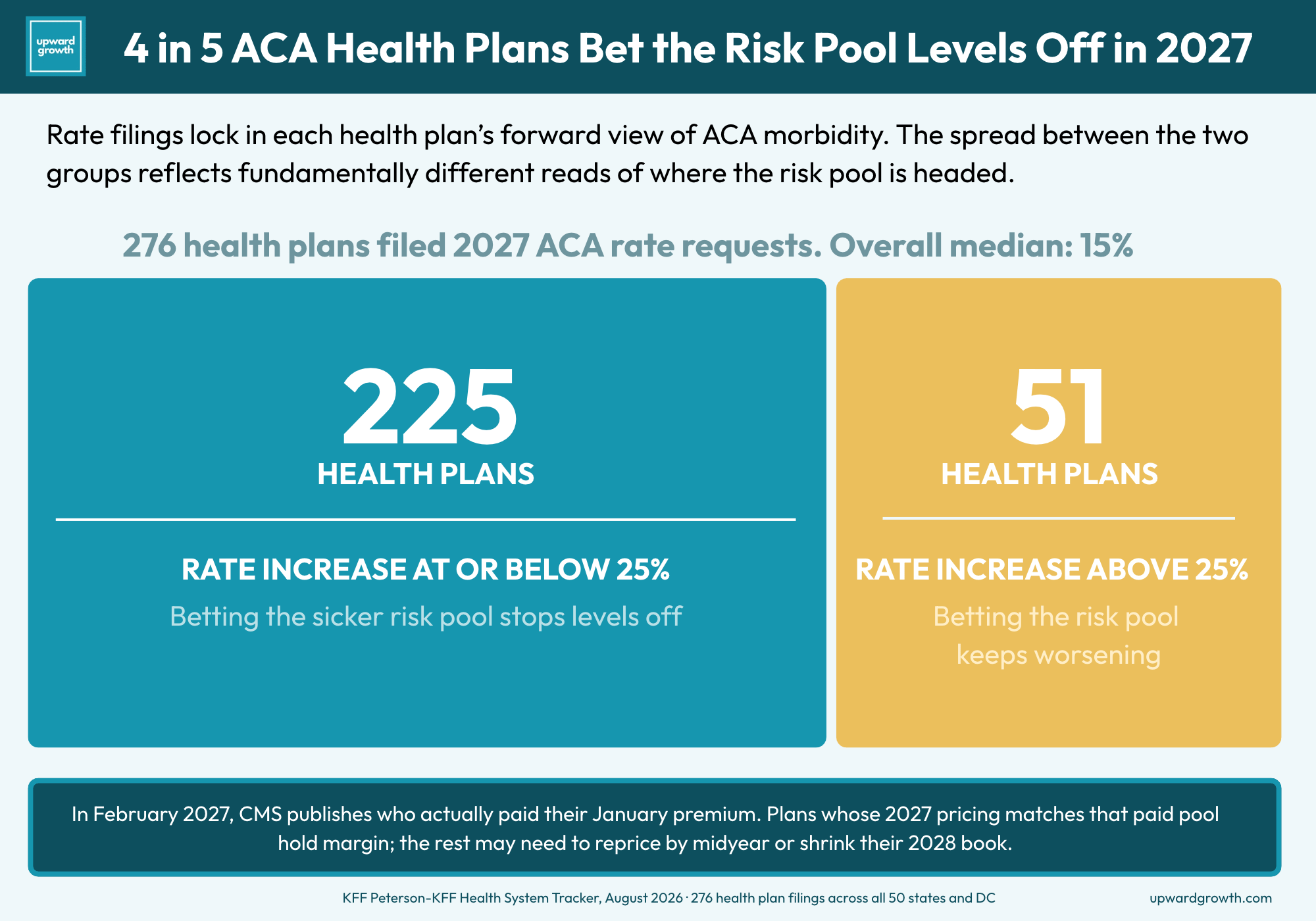
Those filings landed at a 15% median across 276 insurers, with 51 of those payers requesting above 25%. Plans are attributing roughly four percentage points of 2027 increases to morbidity worsening on top of the four points they already baked into 2026. That compounding is the data point worth sitting with. CFOs are managing a market where acuity keeps rising, which is a very different operating problem than a one-time jump. Analysis of first-month payment patterns across 80% of the ACA market showed paid members with about 10% higher morbidity than unpaid members, with only 86% of enrollees paying their first premium versus a historical effectuation above 92%. The working-age uninsured rate climbed to 11.2% for 2026, up from 8.9% in 2024, which is the sharpest two-year reversal in coverage trends since the ACA fully took effect.
The twelve or so plan exits announced for 2027 follow the pattern the May framework described, which the Aetna and Cigna discussion later picks up. The exits ran about as expected. What separates 2026 from 2025 is how the plans that stayed in actually performed.
Centene and Molina Priced the Same Risk Pool Into Opposite Outcomes
The split that showed up in Q2 2026 between Centene and Molina is cleaner and faster than I expected when I laid out the five posture framework in May. Both are Medicaid-core plans with an ACA book as an adjacent product line; both took material membership hits through 2026, and both priced against the same morbidity shift. Their Q2 Marketplace numbers moved in opposite directions.
Centene’s Marketplace membership fell roughly 40% year over year to about 3.5 million lives in Q2 2026, down from close to 5.9 million a year earlier, close to the percentage hit Molina took. The difference is reflected in the Marketplace line below the membership number. Centene’s Marketplace health benefit ratio moved from 90.6% in Q2 2025 to 79.2% in Q2 2026, an 11.4-point improvement on the ACA book specifically, and the consolidated Q2 operating result swung from a loss a year earlier to over a billion in profit. Centene attributed the improvement to pricing and risk transfer reflecting the acuity of the Marketplace membership, which translates to: management priced for the acuity shift and the pricing covered it. Worth flagging that roughly $0.50 per share of the Q2 beat came from non-recurring 2025 Marketplace and Medicare settlement items, so part of the headline isn’t run-rate. The operating trajectory on the Marketplace line is still dramatically better than anyone expected coming into the year. For 2027, Centene is holding at 29 states and exiting only Delaware and New Hampshire.
Molina went the other way on almost every number. The Marketplace book fell from 690,000 at Q2 2025 to 283,000 at Q2 2026. Its Marketplace medical care ratio moved against the company, from 85.4% to 88.9%. Marketplace medical margin dropped from $175 million to $69 million, and full-year EPS guidance got cut by $1.50 on Marketplace drag alone. CEO Joseph Zubretsky acknowledged on the Q2 call that the team had priced for an acuity shift but underestimated the stickiness of high-cost members, and the pullback for 2027 has landed at 7 states, down from 14.
This isn’t a story about Centene being better operators or Molina being worse ones. Both teams have built credible businesses over long time horizons, and both priced for the morbidity shift the April data surfaced. But where they differed is on what they expected the shift to do going forward.
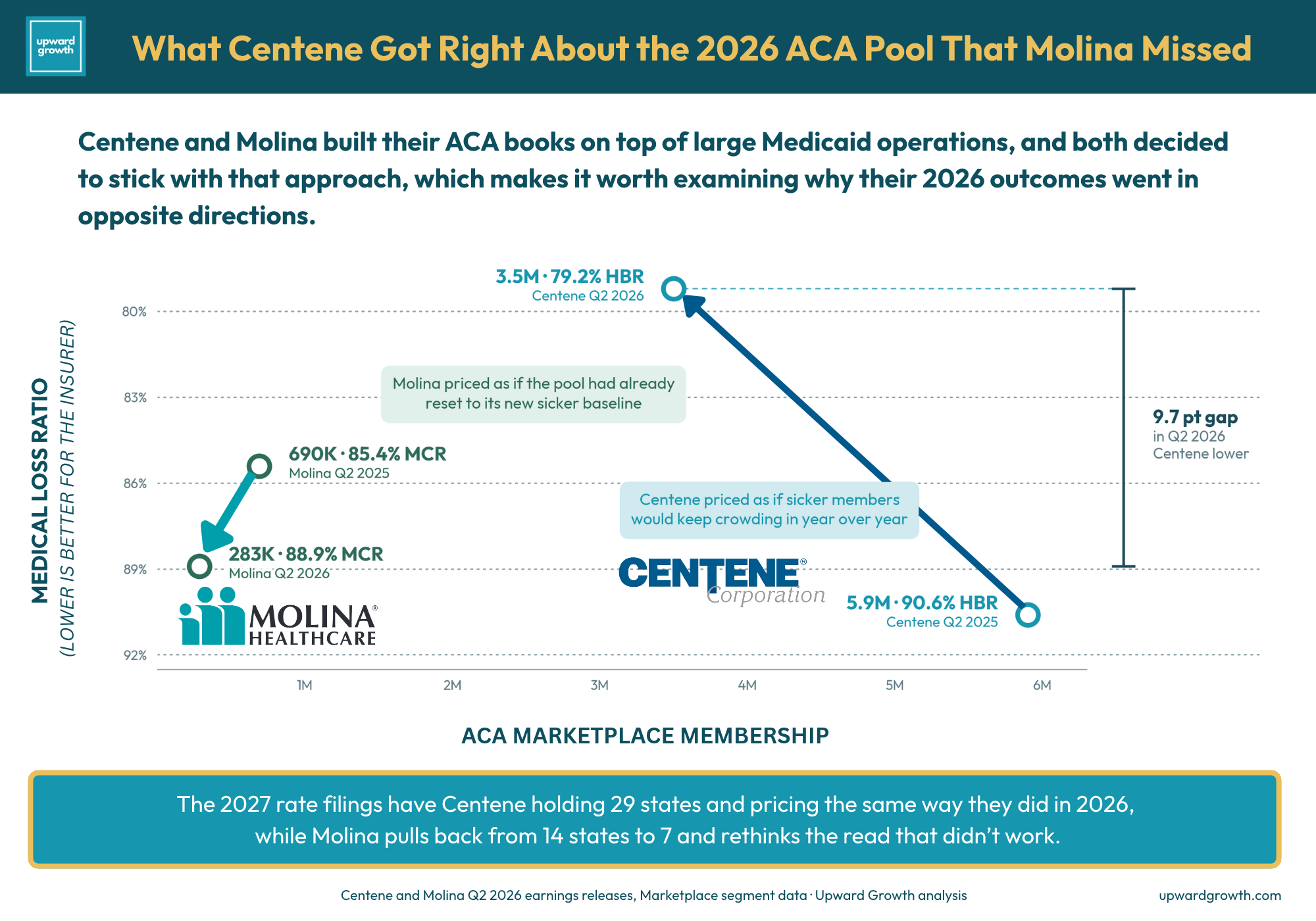
Molina seems to have priced the morbidity shift as a one-time step up, meaning a repricing to a sicker but relatively stable new baseline. That is a defensible actuarial read, and it is the read most payers filed against for 2026 the first time around. If the pool resets at a higher acuity and then stabilizes, a 30% rate increase for 2026 is a reasonable response, and the back half of the year should start improving as pricing catches up to the new acuity level. That isn’t what the Q2 numbers showed.
Centene appears to have filed against a different model. The read is that the pool would keep selecting against the plan year over year, because the people choosing to pay a January premium in a world without enhanced subsidies are increasingly the sickest slice of an already-shrunken pool. It is a less comfortable read to defend to a board, because it implies 2026 pricing is still catching up to a target that keeps moving in 2027, and 2027 pricing is still catching up to a target moving again for 2028. It also implies the operating math only stabilizes once ePTC restoration happens or the pool bottoms out at a new structural floor, whichever comes first.
The split between pricing against stabilization and pricing against continuing selection is a cross-functional alignment question that cuts across actuarial, product, and finance, and whichever read those three functions privately hold ends up shaping every input the pricing deck depends on, from benefit design and network configuration to SG&A, reserving posture, and the forward trend each team hands over. When the three agree on the read, right or wrong, the filing is coherent and defensible. When they don’t, it becomes a weighted average of three different assumptions about the market, which is harder to defend when the actual numbers come in off plan and harder to reverse-engineer afterward.
Both teams reported Q3 since the Q2 commentary that framed the May through August read. Molina’s Q3 ran a 92.5% Marketplace MCR against 88.9% at Q2, which Molina framed as normal seasonality and in line with company expectations. Full-year guidance was reaffirmed rather than raised, and the 14-to-six footprint execution for 2027 stays on track. The language asymmetry on the call is the tell on where the forward read actually sits. Zubretsky called “the beginning of the turn” on Medicaid margins specifically, with no equivalent framing on Marketplace. That reads as a team executing the one-time footprint reset at smaller stable scale, not a team that has shifted toward the continuing-selection view of the risk pool. It’s the first of the two framings this section laid out, and the one that points toward a similar outcome in 2028 if the underlying read still doesn’t match what the market is doing.
Centene’s Q3 came out this morning and extends the same read. Consolidated HBR of 92.7% beat expectations, driven by the Medicare segment, with Medicaid and Marketplace described as on track. Full-year adjusted EPS guidance rose another $0.40 to above $5.20. Marketplace coming in on track rather than surprising in either direction, which seems to confirm the acuity trajectory Centene priced for keeps proving out.
This matters past Molina and Centene because every ACA health plan is answering the same question internally, and most haven’t been forced to answer it publicly the way these two have. The spread of 2027 rate filings maps roughly to the split: the 51 health plans that requested above 25% filed the Centene read of what’s coming, while most of the plans at or near the 15% median filed something closer to Molina’s. OEP, the November 10 Q3 earnings cycle, and February 2027 effectuation data will settle whose read described the market that actually arrived.
Oscar’s Growth, Blues Unevenness, and the Aetna-Cigna Exits Through the Same Lens
The alignment that split Centene and Molina also shows up in the other three posture categories, in different operating shapes. Oscar’s tech-native growth, the uneven absorption pattern across the Blues, and the vertically integrated exits each run on their own operating model, but how aligned the pricing team is on the acuity trajectory they’re inheriting still sorts the outcomes inside each category.
Let’s start with Oscar. The membership growth to 2.96 million, the swing to positive operating income, and the stock price doubling in a year the broader market contracted are the numbers that made Oscar the 2026 ACA story. The number I didn’t expect is the 79.2% consolidated medical loss ratio holding steady while the book grew that aggressively. I expected the growth to come with a materially hotter MLR, because new membership typically runs sicker than mature membership in the first year. That didn’t happen, which means something in the operating model is doing more work than pricing alone can explain. Oscar’s tech stack and member engagement infrastructure are doing more work on the risk pool than the May framework gave them credit for. My May article, when discussing Oscar, emphasized operational efficiency and pricing agility, both of which held.
A second advantage doesn’t show up on the balance sheet. Oscar’s product and member-services functions run on the same tech stack, which makes the cross-functional alignment problem I described in the Centene and Molina section structurally smaller than it is for a traditional plan where product, actuarial, and finance work from different data pipelines. That isn’t the whole explanation for the 79.2% number, but it probably explains more than any single operational advantage. Oscar’s 150-plus additional metros for 2027 will expose whether the infrastructure advantage scales linearly with geography, or whether the first two years in new metros run hotter MLRs than the mature book because the member engagement model takes time to seat. My read is the second, and that it is a 2028 story more than a 2027 story.
The Blues absorbed the Aetna displacement through 2026 along lines that split the category in a worth-naming way. Every state has a dominant Blue, so the Aetna book had to land somewhere, but where it landed and how cleanly it got absorbed depended on the local Blue’s commercial profile. Blues with deep provider integration and a diversified employer and MA book took on the Aetna members without MLR deterioration. Blues in states where ACA sits concentrated inside a thinner commercial base ran defensively instead and let Centene or Oscar pick up the displaced members.
The same alignment that split Centene and Molina also shows up on the pricing side. Blues with deep provider integration and diversified books tend to run ACA on the same planning cycle and operating model as the rest of their lines, which produces a single enterprise view of the market when it’s time to price. Where ACA sits as a semi-standalone line, that alignment usually isn’t there, and the pricing filing ends up reflecting the local ACA actuary’s view without the enterprise behind it. The consolidation story playing out across the Blues is already sorting which Blue plays which role going forward, and the enterprise-aligned Blue and the semi-standalone-ACA Blue are structurally different operating companies at this point. Treating them as one buyer segment for the next eighteen months misses more than it catches.
Aetna and Cigna are the cleanest hold from my May article framework. The vertically integrated retreaters played out the way the capital allocation thesis called for, and there isn’t much to update. Aetna adjusted operating income was up 53% year over year to over $3 billion in its Q1 2026 release, validating the exit decision from a parent capital allocation standpoint. The $448 million premium deficiency reserve referenced in May was absorbed, and the margin story materialized on the timeline the thesis required. Cigna’s full 11-state exit for 2027 under incoming CEO Brian Evanko runs the same math against the Evernorth benchmark the parent is managing to. The exit decision and Centene’s decision to stay and price hard come from the same capital-allocation discipline, applied to parents whose adjacent businesses set very different margin benchmarks for what the ACA book has to clear. For example, Centene stays and prices hard because the Ambetter book is the margin story the parent needs. Conversely, Aetna and Cigna exit because the ACA book can’t clear the benchmark against the adjacent businesses the parent runs, and the capital allocation framework reaches the opposite answer when the parent portfolio is structured that way.

Where the ePTC Contrarian Call Landed Six Months Later
The Enhanced Premium Tax Credit (ePTC) through 2026 has largely followed the path Republican leadership telegraphed through the back half of 2025: limited incentive to spend political capital on restoration absent clear electoral pressure, and no near-term legislative off-ramp for health plans hedging their 2026 or 2027 pricing on it. The sequence that played out held that read up. The Senate failed to advance the Lower Health Care Costs Act by a vote of 51-48 on December 11, 2025, short of the 60 required for cloture. House Democrats then forced a discharge petition vote on a clean three-year extension in January, and the measure passed 230-196 with 17 Republicans crossing over. The Senate has not taken it up, and no floor action is scheduled heading into OEP.
The Senate rules behind passing a clean three-year ePTC extension are why planning for the enhanced subsidies to stay through 2028 is the operationally safe call, not just the political one. Senate rules let a minority block legislation unless 60 senators vote to end debate, which is a different problem than winning a majority. Even if Democrats sweep the November 2026 midterms, there aren’t enough Republican-held Senate seats on the ballot in states where Democrats can win to get them to 60.
The operational work between now and June 2027 is less about pricing posture in isolation and more about getting actuarial, product, and finance aligned on a single defensible view of what the market is doing.
That said, there’s a view beginning to circulate among health plan leadership teams that some form of partial restoration lands in a lame-duck session after the midterms, probably in a narrower income band or as a time-limited bridge attached to a year-end package, and that this would materially change the 2028 pricing picture. Partial restoration of that kind can move through a different legislative vehicle than a clean three-year extension, so the cloture problem above doesn’t close the door on it.
However, even if partial restoration lands at some point in 2027, it does not undo the selection pattern that built up through 2025 and 2026. Health plans that exited aren’t re-entering for at least one bid cycle. Members who became uninsured between 2024 and 2026 don’t return to the risk pool at the acuity they left it. And the plans now pricing against a continuing selection dynamic don’t suddenly reprice downward just because a subsidy returns, because the morbidity math underneath the pricing hasn’t reset. Restoration changes the forward slope without erasing the two years of selection that already happened. If I were advising a plan leadership team on 2028 bid assumptions, I would assume no restoration through at least the 2028 cycle and treat any restoration news as upside rather than baseline. That way the plan is positioned for restoration not landing, which is the harder scenario to recover from if the planning assumption was wrong, and any late surprise lands as upside rather than a stress test.
What the OEP Window Resolves Between November 1 and February 2027
OEP runs from November 1 through January 15, with December 15 as the deadline for January 1 effectuation. A few watchlist items from May either resolve or sharpen within that window.
Where Cigna’s displaced 369,000 members actually land is one of the questions OEP starts answering immediately. The 2026 Aetna displacement is spread across Centene, Oscar, Elevance, Molina, and Kaiser. The 2027 replacement cohort is thinner, because Molina is out of capacity, Blues pickup varies by state, and Oscar’s growth story is concentrated in specific geographies. If Cigna’s displaced members land disproportionately at Oscar, the tech-native growth story extends further than it did in the May read. A different distribution, with some states’ displaced members landing at Blues and others going uninsured, surfaces the single-insurer county problem as a 2028 story in markets where competitors already thinned out.
State-level effectuation rates in February 2027 are the other read worth watching through Q1. The 86% January 2026 payment rate is the baseline the April data established. A drop from there in 2027 means the health plans that priced for continuing selection described the market accurately, and the Centene-Molina split extends across the rest of the field. The reverse outcome, with payment rates holding or improving, would signal the market finding a new equilibrium at smaller stable scale, which puts 2028 bids on a different curve than today’s forward reads imply. My guess is the number drops again, probably into the low 80s, but it is a guess with wide error bars.
The first signals on 2028 posture are largely in from the Q3 reports that have landed, and they read as extensions of the Q2 split rather than a reframe from any side. Centene and Molina played out as extensions of the stabilization-versus-continuing-selection split described above. Elevance’s Q3 raised full-year adjusted EPS guidance to at least $29.00 and reinforced a 2027 earnings baseline that extends the enterprise-aligned diversified payer read, consistent with the Blues absorption pattern discussed earlier. Oscar’s Q3 lands in early November and is the remaining signal worth watching hardest, specifically whether the tech-native growth story extends at scale or starts to show the metro-expansion MLR seasoning the Oscar section flagged earlier. A clean extension across the categories tightens the thesis. A divergence raises doubt about which Q2 reads were durable.

What This All Means for Health Plans Heading Into the 2028 Bid Cycle
The structurally advantaged position looks different in each of the five posture categories I laid out in May, which grouped payers by their strategic read on the ACA shakeout: Medicaid-DNA plans making concentrated bets on the exchange book, tech-native plans leaning on their operational infrastructure, selective Medicaid managed care operators who built lighter ACA footprints off their core book, Blues who were going to default-absorb the exits in their states, and the vertically integrated plans making the capital allocation case to pull back. Six months in, the plans in the strongest position inside each of those reads have planning flexibility going into the 2028 bid cycle, which opens for filings in June 2027. Centene made a concentrated bet on the exchange book, priced for the acuity trajectory, and now has the Q2 and Q3 numbers to prove the read out. Oscar’s tech-native operational model held its MLR flat while the book grew 46%, signaling that the member engagement infrastructure is doing what the May framework thought it might. AmeriHealth Caritas Next ran a selective ACA footprint off a core Medicaid managed care operation and avoided the overexposure that forced Molina into significant 2027 service-area cuts. The Blues, with deep provider integration and diversified books, absorbed the Aetna displacement in their states cleanly, which is the enterprise-aligned read playing out on the ground. That flexibility converts into either market share capture in the counties competitors just exited or margin expansion against a smaller stable book, depending on how each team wants to spend it.
Payers on the losing side of 2026 face either further retrenchment along the Molina path or more fundamental operating model restructuring. The Molina path means pricing for a smaller book, and trading improved risk pool concentration for a materially smaller national footprint. Blues with concentrated ACA exposure and thinner commercial diversification face a different version of the same question: either doubling down on a defensible subset of counties or accepting that the ACA book becomes a smaller line inside a broader state-level strategy. For either group, the operational work between now and June 2027 is less about pricing posture in isolation and more about getting actuarial, product, and finance aligned on a single defensible view of what the market is doing. Payers heading into 2028 with those three functions operating from different assumptions are the ones most exposed to another cycle of outcomes landing off plan.
OEP opens November 1. Centene and Molina already reported Q3, and neither changed course. The remaining Q3 reports through mid-November, plus state-level effectuation data in February, are where the full test gets graded in public.
Final Thought
The Centene and Molina split is diagnosable because both teams have given the market enough language to read their forward posture against the acuity trajectory. The 50-plus plans who filed somewhere between the two reads are diagnosable the same way, well before February effectuation data or next spring’s earnings commentary makes it unmistakable. Readers who treat cross-functional alignment as a planning input between now and the June 2027 bid cycle will see which plans are durable before the market has fully sorted them.
OEP is also opening alongside the loudest healthcare conversation Washington will have for the next several months on ePTC restoration. Whether restoration lands or not, the two years of selection that have already shaped the ACA risk pool don’t reverse. The 2028 rate conversations are coming regardless, and health plans building their 2028 posture against a continuing-selection view of the market will face a different problem than plans still priced for stabilization.
If you’re working through what the Centene-Molina split and the broader ACA market shakeout mean for how your organization is positioned, Upward Growth is a health plan market advisory firm that works with health tech vendors, investors, provider organizations, and management consultancies to build strategy around how health plans actually buy, operate, and make decisions.
Thanks for reading.
Here’s to upward growth,
Ryan Peterson
The frameworks in the weekly Upward Growth newsletter help health plans, health tech vendors, investors, provider organizations, and consultancies understand the health plan market as it continues to shift.
If your colleagues are in those conversations, they should be reading this too.
💰 Invest In Your Team with a Paid Subscription.
💡 Pro tip: Many subscribers expense Upward Growth through their company’s professional development, training, or learning budget. Here’s a one-minute email template to get your manager to approve expensing your subscription.