

Upward Growth is a health plan market advisory firm. Our weekly newsletter covers payor market strategy, regulatory shifts, and go-to-market insights for health tech vendors, investors, provider organizations, and consultancies competing in the health plan market.
🤝 Work with us on payor market strategy: Contact us
🟦 Connect with the author, Ryan Peterson, on LinkedIn.
🎧 Listen to the Upward Growth Podcast: Apple | Spotify
📰 Newsletter sponsorships: Learn More
This week’s Upward Growth newsletter is sponsored by Kbrax

Kbrax: Integrated Care Platform for Health Plans
25 years of experience deploying care coordination at scale for the nation’s largest payers. Kbrax helps health plans reduce readmissions, close care gaps, and drive measurable cost savings by integrating physical and behavioral health into one platform. From risk stratification to automated care journeys to member engagement via mobile app, it’s the care navigation infrastructure your clinical teams actually need. Serving Medicaid, Medicare Advantage, and commercial plans.
.
Interested in sponsoring Upward Growth? Contact Us
A few updates from me before we get into it:
Just got back from RISE West in San Diego. The anxiety in the industry right now could be felt in the ballroom. Plan leadership and vendors are both trying to work through what the next 18 months actually look like, and this week’s article is a big part of that read. Full recap on LinkedIn if you want it.
I’m excited to be speaking at UiPath Fusion (Sept 22-25) in Las Vegas. UiPath is doing genuinely interesting work on the agentic AI side, and Fusion has a dedicated healthcare and payer track, including a session for Blues plans. My session picks up the same thread as this week’s article: how the pressures on plans stop looking like a list and start looking like one integrated squeeze, and where the right technology in the right places can help plans respond at scale. If you’re gonna being there, come say hello!
Also crossed 14,000 followers on LinkedIn recently. My marketing person said I need to mention it, so I’m mentioning it (lol). If we’re not connected there yet, let’s fix that. That’s where most of the between-newsletter conversation happens.
Three employer healthcare cost forecasts landed over the last three weeks: WTW at 11.1%, BGH at 9.2%, and Marsh this week at 8.2%, the highest projected employer trend since 2003. BGH's survey also documented something the cost numbers don't capture on their own: CFO involvement in employer plan decisions is now the norm at more than half of large employers, and cancer is moving up the cost driver list. The immediate read on all three is a commercial book story, and it is. But the same signal reshapes how Medicare Advantage (MA), Medicaid, and Affordable Care Act (ACA) plans have to operate for the rest of 2026 and into CY 2027, and that piece of it hasn't been much of the conversation yet.
Before we get into it, a quick word on how I'm using "commercial" throughout, since it will show up a lot. I mean the employer-sponsored line of business at diversified plans: the fully insured and self-funded coverage large and mid-sized employers buy for their workforces. It sits alongside the government lines (MA, Medicaid, ACA), and its profitability has subsidized thinner margins on those government lines for a decade. Squeeze commercial and every line inside the plan tightens, because the finances don't segregate by line the way the org chart does.
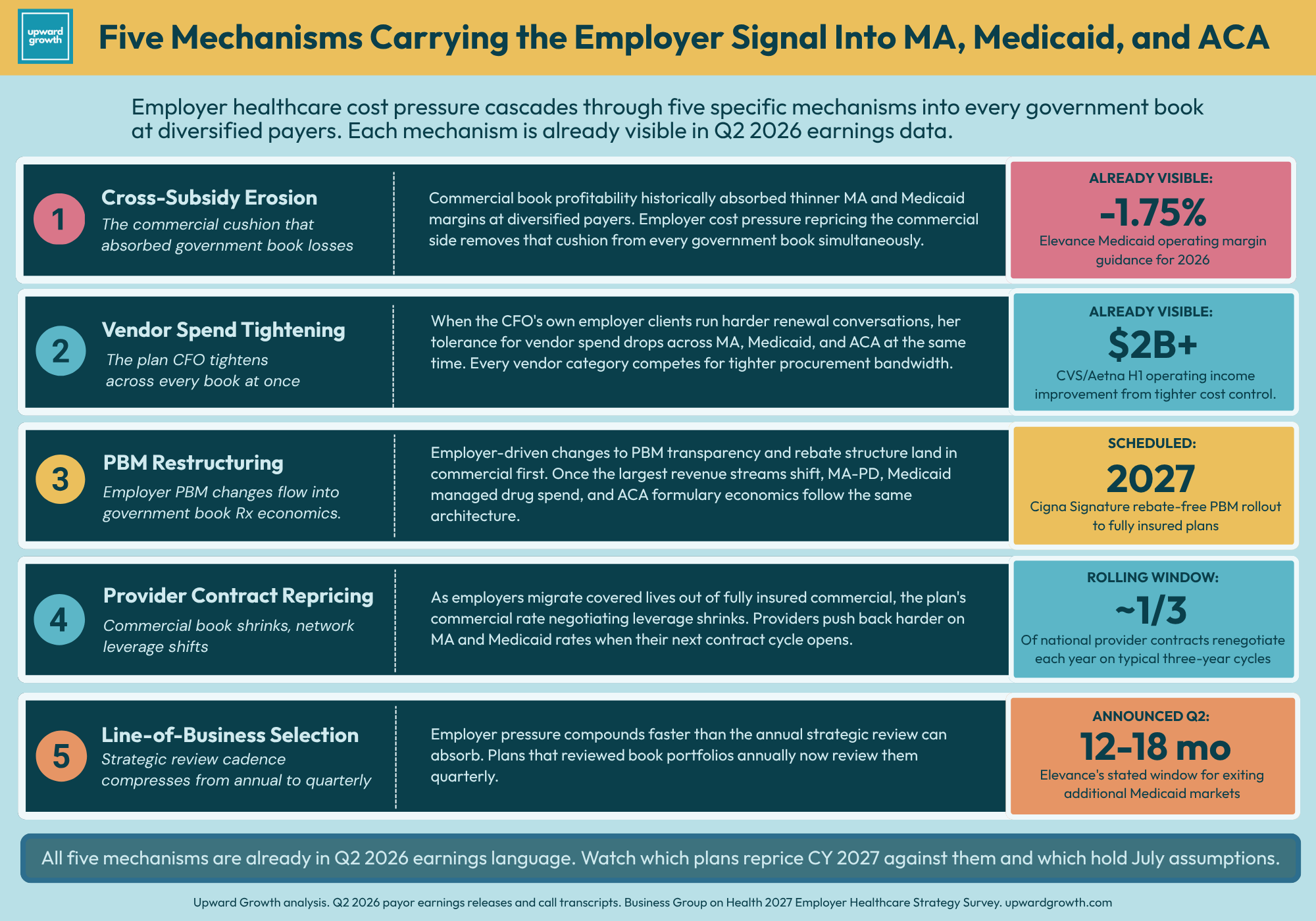
When employer CFOs pull up harder on their own commercial renewal conversations, plan CFOs get tighter across every vendor decision, not just commercial. When employers migrate covered lives out of fully insured commercial into Individual Coverage Health Reimbursement Arrangements (ICHRA) and level-funded arrangements, the plan’s negotiating leverage with hospitals shrinks for MA and Medicaid contracts too. When employers force PBM restructuring in commercial, the same rebate architecture reprices MA-PD and Medicaid managed drug spend on a lag of about a year. The pressure originates on the employer side and lands on the government side, and it’s landing on the CY 2027 operating decisions being made right now.
The way I want to work through this is to take the employer cost pressure those three surveys are describing and walk it across MA, Medicaid, ACA, PBM contracting, provider contracting, and how plans are picking which lines of business to run. All three land on commercial, but that pressure reshapes decisions being made this quarter across every book. What follows is what I see when I hold it up against each of those mechanisms.
This fits into what has been an unusually compounding year across every line of business for plans, tracked in prior pieces on the January Medicare Advantage reset, Q2 payor earnings and CY 2027, ACA rate filing exposure, and provider-sponsored plans deciding which lines are worth keeping.
The Market Is Moving Faster Than the Enterprise Commentary Suggests
The Q2 2026 earnings calls from the diversified national plans read as steady, with margins holding, guidance raised, and disciplined pricing paying off across the board. Analysts covering those calls have taken that as the sign that the pressure of the last two years is behind us. It isn’t. The Q2 commentary describes what already showed up in last quarter’s financials, and it lags what plans are deciding right now for CY 2027.
Both WTW's 11.1% before plan design changes and Marsh's 8.2% after cost-management measures are describing the same underlying dynamic from two ends of the same telescope: what employer costs look like before plans and employers respond, and what employer costs look like after they respond. Both endpoints are consistent with what plan finance teams are already absorbing on commercial renewal conversations for next year. None of it has surfaced on an earnings call (and probably won't until at least Q3 reports drop in late October). Meanwhile, benefit design finalization for CY 2027 MA is happening across September and October at every plan running an MA book, months before Q3 earnings will describe any of it publicly.
The pressure is already showing up in vendor decisions being made this month, in provider contract conversations being scheduled for early 2027, and in PBM rebate architecture being restructured on a commercial-first timeline. None of it looks like an enterprise problem yet, which is exactly why plans reading it now are already six months ahead of plans that will read about it on a Q4 earnings call.
The heaviest hit lands on plan finance, when the commercial cushion gets pulled.
The Commercial Cover That Absorbed Government Book Losses Is Gone
Diversified national plans have used commercial profitability to subsidize thinner MA and Medicaid margins for a decade. That structural cushion is being pulled now, at the same time employer pressure is intensifying, which is why the effect on the government lines gets sharper from here.
Commercial margins were already compressing before this, and the cross-subsidy story has been priced into the enterprise financials for a couple of years. What changes now is the step from commercial being compressed but still generating surplus to commercial being actively defended against a 9.2% projected trend, with the CFO at the plan's own large employer clients pulling up the vendor selection conversation at the same time. Those are different states, and they land on plan finance differently.
Elevance guided full-year 2026 Medicaid operating margin to approximately negative 1.75% and signaled 12 to 18 months of additional Medicaid market exits ahead. UnitedHealthcare’s Q2 tells the sharper cross-subsidy story. Commercial cost trends there are running above 11%, and management no longer expects commercial margins to recover to their structural 7%-plus level inside 2027. Medicare Advantage margins, by comparison, are expected to finish 2026 above 3%. The old diversified-plan math (commercial as the engine, MA as the thinner recipient) has inverted.
Elevance and UnitedHealthcare are absorbing the sharpest part of the hit, but neither one is the extreme case. The Big Seven publicly traded plans sit across a much wider range of commercial book weight, ranging from Cigna at roughly 95% commercial (after selling its Medicare business to HCSC in early 2025) to Molina at zero. Where each plan sits explains a lot about the strategic moves it is making right now, and which plans still have the most to lose.
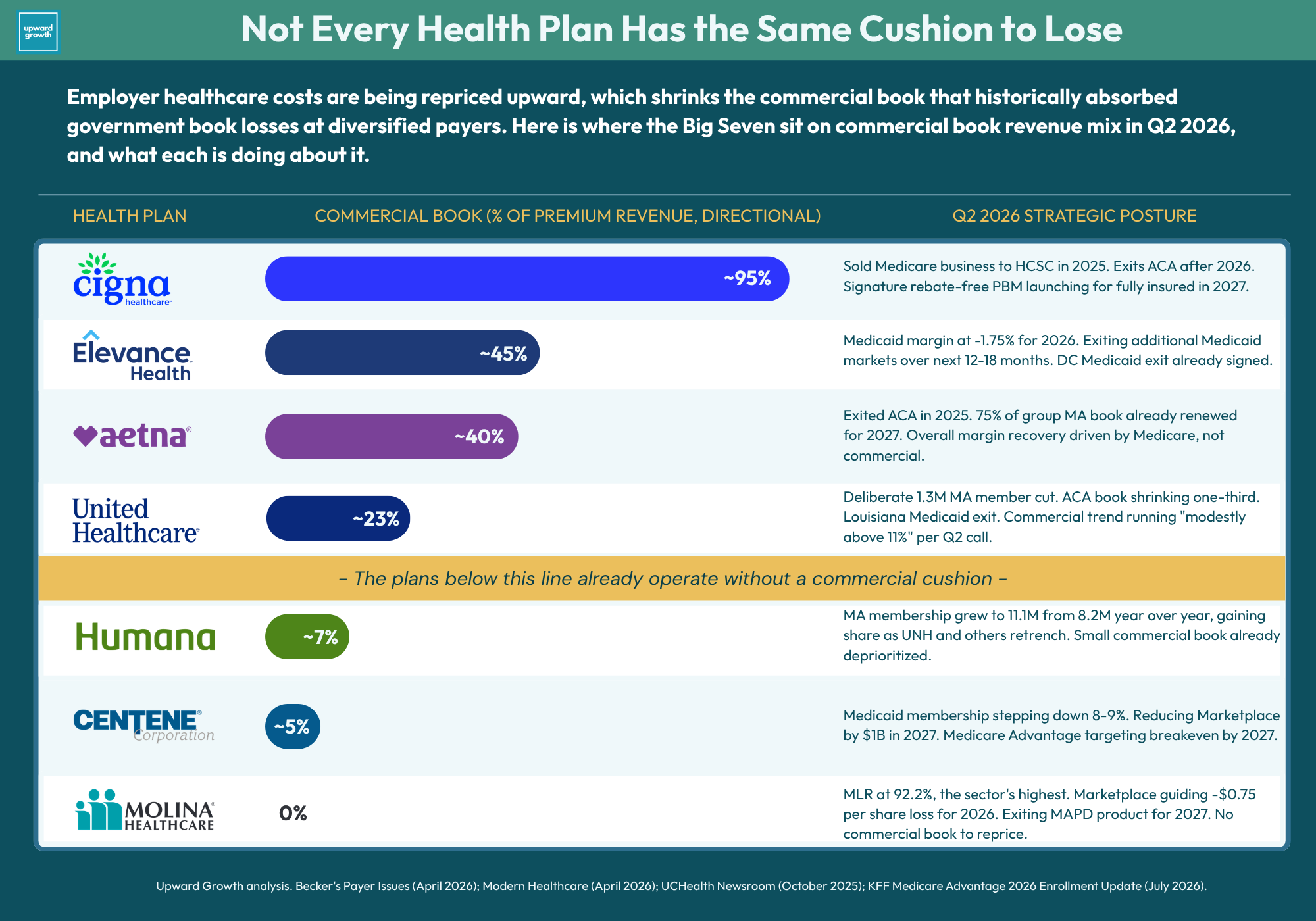
The commercial cushion that absorbed Star Ratings pressure on MA, Medicaid rate compression, and ACA member attrition doesn’t exist anymore. At the top of the chart (Cigna, Elevance, Aetna), that cushion is being pulled by employer pressure right now. At the bottom (Molina, Centene, Humana), it isn't there. Those plans either never had a meaningful commercial book to fall back on (Molina, Centene) or exited theirs already (Humana), and they've been operating in the world that Cigna, Elevance, and Aetna are just entering.
Two years ago, a marginal yes on a Star Ratings improvement vendor, a Medicaid care management platform, or an ACA member acquisition play was an easy call for plan finance at the top of the chart. That easy call is gone. For plan finance across the industry, this changes what it costs to say yes to any single vendor evaluation, and that is exactly the shift showing up in vendor scrutiny across every book right now.
Vendor Spend Scrutiny Just Tightened Across Every Book
I wrote in April about the five forces that had already tied operations and finance together in every vendor decision. The employer signal adds something new: pressure that originates outside the plan’s own line-of-business economics for the first time. When large employer CFOs push their own commercial renewals harder, plan CFOs feel it in every vendor decision they touch, not just commercial ones. BGH found that 59% of employers report increased CFO or finance team involvement in benefit and vendor decisions, and that employer-side pressure transmits into plan finance without segregating by line.
From outside the plan, the deal that stalled over the summer gets misread. Pipeline reporting logs it as a competitive loss. The actual cause is a plan finance team defending vendor spend across four lines of business under tighter scrutiny than at any point in the last three years. Anyone selling into MA, Medicaid, or ACA who is seeing deals slow down is watching their buyer absorb commercial pressure that doesn’t show up in the pipeline data.
The standard for vendor engagement is rising because of this. Plan finance teams will spend the hour on the vendor who walks in prepared for the ROI question at 70% of projected performance, models the outcome in language the CFO can bring straight into a budget meeting, and doesn’t need a second call to defend the assumptions. Anything softer than that stalls now, gets punted into next year, and often falls off the CY 2027 planning cycle entirely.
PBM contracting is where the tightening is most visible right now.

PBM Restructuring Starts in Commercial, Lands on Every Book
PBM contracting is where the commercial-to-government transmission is most visible right now. Employers are pushing hard on transparency, alternative rebate structures, and formulary control, and the survey documents an accelerating push across the respondent base. Pharmacy Benefit Managers (PBMs) contractually run separate operating models by line of business. State Medicaid PBM contracts are heavily regulated, and Medicare Advantage Prescription Drug (MA-PD) bid economics carry their own construct. On paper, the commercial and government-line PBM operating models sit in different contracts, under different regulators, with different bid economics.
In practice, the underlying economics don’t really care about that separation. The largest commercial PBM revenue streams are the ones getting restructured, and once those streams reprice, the rebate architecture and formulary economics that carried MA-PD, Medicaid managed drug spend, and ACA formularies get pulled along with it. Cigna Signature is scheduled to roll out to Cigna Healthcare's fully insured plans in 2027 and land as the standard offering across Express Scripts clients in 2028. A PBM that makes fee-based transparency the new commercial baseline can’t hold the old rebate architecture in place for its other books.
The commercial cushion that absorbed Star Ratings pressure on MA, Medicaid rate compression, and ACA member attrition doesn't exist anymore.
Optum Rx, Express Scripts, CVS Caremark, and Prime Therapeutics are absorbing the same pressure from their own commercial clients right now, and the industry is shifting toward pass-through and fee-based pricing across the board. Q3 earnings from Cigna, UnitedHealth, and CVS will show how each parent is positioning the commercial-first rollout inside its own PBM. Plan Rx procurement teams will be reading those calls for what they signal about MA-PD, Medicaid, and ACA repricing.
Q1 2027 is when MA-PD vendor pricing, Medicaid managed drug outcomes, and ACA specialty drug economics start shifting from the employer pressure landing now. Vendors serving Rx-adjacent categories across the government lines are downstream of a fight they may not be tracking. Plan Rx procurement teams are about to see rebate architecture conversations that used to sit inside commercial start showing up in MA and Medicaid contract negotiations.
The same pattern shows up in provider contracting, on a longer clock and with a heavier compounding effect.
Provider Contracting Gets Harder as the Commercial Book Shrinks
Commercial rates subsidize thinner MA and Medicaid rates in most national provider contracts, and that subsidy was already showing strain through 2025. The employer signal is what pushes it past the point where plans can lean on it heading into 2027.
Through 2025 and 2026, plans were the ones cutting providers, tightening networks to defend margin against the pressures already inside their books. What changes now is which direction the leverage cuts. As employer coverage restructures at scale, commercial shrinks at fully insured national plans, and so does the plan’s leverage in rate negotiations with hospitals and provider networks. Providers push back harder on MA and Medicaid rates in the next contract cycle. The plans that spent 2025 and 2026 cutting providers to defend margin are entering 2027 with less commercial leverage on the ones who stayed.
The BGH survey documents accelerating employer interest in ICHRA, level-funded plans, and captive arrangements. On September 3, CMS and the Small Business Administration announced ICHRA is now the CHOICE Arrangement (Custom Health Option and Individual Care Expense). The name changed, but the direction didn’t: fewer covered lives inside fully insured commercial, more covered lives in individual market and self-funded arrangements. Plans need commercial to be bigger to protect provider negotiating leverage, and it’s now going the other way.
Provider contracts typically renegotiate on three-year cycles, which puts roughly one-third of national contracts in the market each year. The 2027 cycles are where the pressure hits first, and the 2028 and 2029 cycles compound the effect over the next two years. Any plan planning CY 2027 needs its contract renewal schedule sitting on the desk this fall, not waiting until spring.
This lands on every government line’s unit costs at the same moment health plans have less commercial subsidy to absorb them. MA takes the hit through unit cost inflation in contracts renewing without the commercial rate leverage plans used to bring. Medicaid takes it through state rate development, since provider rate changes negotiated with less leverage feed into rate case conversations with state Medicaid agencies over the next 12 to 18 months. And ACA silver plan networks tighten because plans priced 2027 against a commercial line that will be smaller than they modeled.
Which is why plans are deciding line-of-business selection in Q4 this year instead of next spring.

The Line of Business Review Just Compressed From Annual to Quarterly
The line-of-business math provider-sponsored plans have been running for the past year is now running at plans of every size. The employer signal is the accelerant that pulls those decisions into this quarter instead of the 12-to-18-month cycle where they used to sit.
The health plans that have already made this call point at where the pressure is landing. Provider-sponsored Baylor Scott & White Health Plan (BSWHP) is exiting Medicaid managed care and the Individual Marketplace, regional player PacificSource is pulling back from ACA and Montana, integrated-system Providence is winding down most of its insurance business starting in 2027, and Medicaid-DNA operator Molina is consolidating to roughly six core states for the same year. Four different plan types running the same math and reaching the same conclusion inside the same six-month window.
Line-of-business selection has moved from a 12-to-18-month strategic review to a Q4 decision, because the pressure across every book is compounding faster than a plan’s typical review cycle. The plans running quarterly reviews are pricing CY 2027 with six months of lead time on the plans that aren’t, and that gap is what makes this the sharpest thing to watch through the rest of the year.
Q3 earnings will start showing where each plan sits.
Final Thought
The employer signal is reshaping how plans have to operate for CY 2027, months before any of it will land on an enterprise financial. Plans reading the shift now are already pricing 2027 with it factored in.
The CY 2027 bid window closed in June, but the operational calls that turn those bids into real strategy (vendor budgets, network moves, benefit design, provider renewals) are still being made through Q3 and Q4. Q3 earnings from UnitedHealth, Elevance, CVS, Cigna, Humana, Centene, and Molina will start showing which plans are moving on this. Listen for language on employer renewal conversations, PBM revenue trajectory, and provider contract renewal cadence.
BGH’s Ellen Kelsay called the 2027 survey “emblematic of a bigger-picture issue with the overall healthcare system.” The trigger came from the employer side, the cascade lands on the government side, and what a plan CFO decides is defensible right now is what CY 2027 execution actually runs against.
If any of what’s above touches how you’re reading your CY 2027 exposure, Upward Growth is a health plan market advisory firm that works with health tech vendors, investors, provider organizations, and management consultancies to build strategy around how health plans actually buy, operate, and make decisions. Contact us here.
Thanks for reading.
Here’s to upward growth,
Ryan Peterson
The frameworks in the weekly Upward Growth newsletter help health plans, health tech vendors, investors, provider organizations, and consultancies understand the health plan market as it continues to shift.
If your colleagues are in those conversations, they should be reading this too.
💰 Invest In Your Team with a Paid Subscription.
💡 Pro tip: Many subscribers expense Upward Growth through their company’s professional development, training, or learning budget. Here’s a one-minute email template to get your manager to approve expensing your subscription.