

Upward Growth is a health plan market advisory firm. Our weekly newsletter covers payor market strategy, regulatory shifts, and go-to-market insights for health tech vendors, investors, provider organizations, and consultancies competing in the health plan market.
🤝 Work with us on payor market strategy: Contact us
🟦 Connect with the author, Ryan Peterson, on LinkedIn.
🎧 Listen to the Upward Growth Podcast: Apple | Spotify
📰 Newsletter sponsorships: Learn More
🎁 Unlocked: This post includes the full deep dive
Most Tuesday articles start with a free section and then continue behind the paywall. Today’s post is left completely open so you can read the entire edition.
Paid subscribers get the full deep dive every week, plus playbooks, case breakdowns, and the ability to reply with their own questions.
Before we get into it: I hope everyone in the States had a safe and happy Fourth of July. The Upward Growth staff took the week off, which is why you didn’t get an edition last week. That was a last-minute call, and I should have flagged it in the newsletter ahead of time. Going forward, I’ll do better about announcing when we’re skipping a week.
Personally, I spent a good chunk of the break watching some World Cup and the Tour de France. (Well, reruns, as I’m not getting up at 4 AM to watch it live!) Watching a sporting event rerun changes what you notice: you already know how the stage ends, so the strategic decisions everyone made in the hours leading up to it come into sharper focus. The breakaway that would normally look ambitious looks doomed. The team that would normally look defensive looks like it made the right call two hours ago.
Not a bad way to read what CMS did around the ACCESS Model launch on July 5th. The stage is over, but it’s still worth examining what everyone was thinking in the six months leading up to it, and what those decisions signal about the ten years ahead.
CMS has spent the last decade running payment innovation experiments through CMMI, one bespoke pilot after another. Each had its own contract structure, measurement methodology, reporting requirements, and sunset conditions when Congress ran out of patience. Vendors selling to health plans watched them come and go. Investors mostly ignored them. Consultancies earned fees on the ones that stuck. The Congressional Budget Office documented that only four of the roughly fifty models CMMI has tested have been certified for expansion, and only one since 2018.
The ACCESS Model, which launched on July 5, looks like the same kind of experiment at first glance. Four clinical tracks, a 10-year test, Traditional Medicare beneficiaries only, and payment rates ranging from $90 to $420 per beneficiary per year. That top-end rate is thin enough that several scaled digital health companies passed on the first cohort, and the industry press covered the launch through much the same lens.
In the six months leading up to July 5, CMS assembled operational infrastructure around ACCESS at a scale no prior CMMI test has received at launch. It published a set of four core principles that define what makes a chronic care arrangement "ACCESS-aligned." It committed to publishing a sample provider agreement, standardized track-specific G-codes any payer can adopt, and a CMS-hosted FHIR API that will run outcome measurement for participants and aligned payers on the same infrastructure. And it got fourteen of the largest health plans in the country, representing 165 million member lives across Medicare Advantage, Medicaid, and commercial coverage, to publicly sign the ACCESS Aligned Payer Pledge committing to offer payment arrangements aligned with the model’s principles by January 1, 2028.
That machinery is what CMS is signaling about where outcome-based chronic care should go over the next decade, and if you step back, the Medicare payment rates are the least interesting piece of it. The reference architecture, the operational infrastructure, and the 14 major health plans that publicly committed to align with it before the model launched are what to pay attention to, regardless of whether you plan to participate.
CMS just signaled where outcome-based chronic care will go over the next decade, your health plan buyers' evaluation criteria will look materially different by the middle of 2027, and health tech categories just got repriced up or down. Four months ago I wrote that every health tech vendor would need a point of view on outcome-based pricing. ACCESS is the version in which CMS wrote the reference implementation for the whole market, and 14 major health plans have already signed on to build against it.
Take the example of Remote Patient Monitoring (RPM). In 2019, RPM codes existed, and reimbursement barely covered device costs. Same then, most digital health companies passed on the category. CMS iterated the codes, expanded eligible conditions, and the HHS Office of Inspector General documented Medicare RPM enrollees growing more than 10-fold from 55,000 in 2019 to 570,000 in 2022 with Medicare payments rising from $15 million to $311 million, continuing past $500 million in Medicare payments by 2024. The companies that built the operational and evidence infrastructure while payment was thin are the scaled winners today. ACCESS is the same shape of bet one level up, paying for outcomes rather than monitoring activity, and the ten-year commitment signals CMS intends to iterate.
🎙️ Episode 4 of the Upward Growth Podcast is the audio companion to this article. It goes one level deeper on why ACCESS-Aligned language shows up in health plan RFPs as early as this fall, and walks through the PE-side diligence patterns Ryan has been hearing recently.
What ACCESS Actually Is
ACCESS is a 10-year voluntary payment model in Traditional Medicare that pays participating organizations through Outcome-Aligned Payments (OAPs) tied to condition-specific performance thresholds. Four clinical tracks cover early cardio-kidney-metabolic (hypertension, dyslipidemia, obesity, prediabetes), cardio-kidney-metabolic (diabetes, chronic kidney disease, ASCVD), musculoskeletal (chronic pain), and behavioral (anxiety and depression). Per CMS, these conditions affect more than two-thirds of people with Medicare.
Per CMS’s Payments Amounts and Performance Targets document, OAP rates range from $90 to $420 per beneficiary per year, depending on the track and care period. Monthly payments are capped at 50 percent of the annual OAP over the care period, with the remaining 50 percent withheld until semi-annual reconciliation. Participants receive full payment if at least 50 percent of the aligned beneficiaries meet the outcome targets. Below that threshold, payment is proportionally reduced, capped at a 50 percent reduction. A Substitute Spend Adjustment reduces the OAP by up to 25 percent if aligned members receive duplicative services from other Medicare providers during the care period. A separate co-management fee pays primary care physicians approximately $30 per review, up to $100 annually per beneficiary, for coordinating with ACCESS organizations.
CMS accepted more than 150 organizations into the first cohort, the majority of which have never previously served Medicare beneficiaries. Rolling admissions continue through 2033. Only Traditional Medicare beneficiaries are eligible for the model itself, though CMS explicitly notes MA plans may independently adopt similar arrangements. Beginning in 2028, ACCESS OAP expenditures roll into ACO benchmark and performance year calculations for MSSP and ACO REACH.
Those are the mechanics. What CMS built around them is what really matters.
The Four Principles Behind an ACCESS-Aligned Arrangement
The launch marks a departure from typical CMMI behavior. CMS published a set of four principles that private payers can use when structuring their own outcome-based chronic care contracts, and it built the operational infrastructure that makes replicating that structure cheap.
Per Cigna’s announcement of signing the Payer Pledge, a payment approach qualifies as ACCESS-aligned if it adopts predictable recurring payments, accountability for clinical improvement or control, flexibility in care delivery that facilitates technology-enabled care, and coordination with primary care and referring clinicians. Those four principles are the anchor of the reference architecture. Every private-payer arrangement marketed as “ACCESS-aligned” over the next three years will trace back to them.
Around the principles, CMS committed to publishing a sample provider agreement structure and payment adjustment code, standardized track-specific G-codes any payer can adopt, and a FHIR-based reporting infrastructure with a CMS-hosted API for outcome measurement. Most of that collateral is expected to be delivered in phases through late 2026 and 2027, ahead of the January 2028 pledge deadline. Once it ships, what previously required a payer to build proprietary outcome measurement infrastructure, negotiate custom contract language, and hire actuaries to price a new arrangement becomes a plug-in kit maintained by the federal government.
CMS is engineering the private payer market's replication path in parallel with the Medicare launch, and doing it publicly enough that fourteen major health plans could sign on to align before the launch. The Pledge is looser than a strict contract. Signatories commit to offering an outcomes-based option for technology-enabled chronic care but retain discretion on which conditions to target, which outcomes to measure, which vendors to work with, and how the model gets operationalized. The technical commitment is a set of principles with productization support behind it, not a uniform contract each payer will execute identically, and that distinction changes very little strategically. The signatories collectively represent 165 million members' lives, committed to aligning by a specified deadline with the operational infrastructure the federal government is building on their behalf.
Who Signed On to the ACCESS Payer Pledge
The ACCESS Aligned Payer Pledge, signed in February 2026, drew the signatories that make the strategic signal difficult to dismiss.
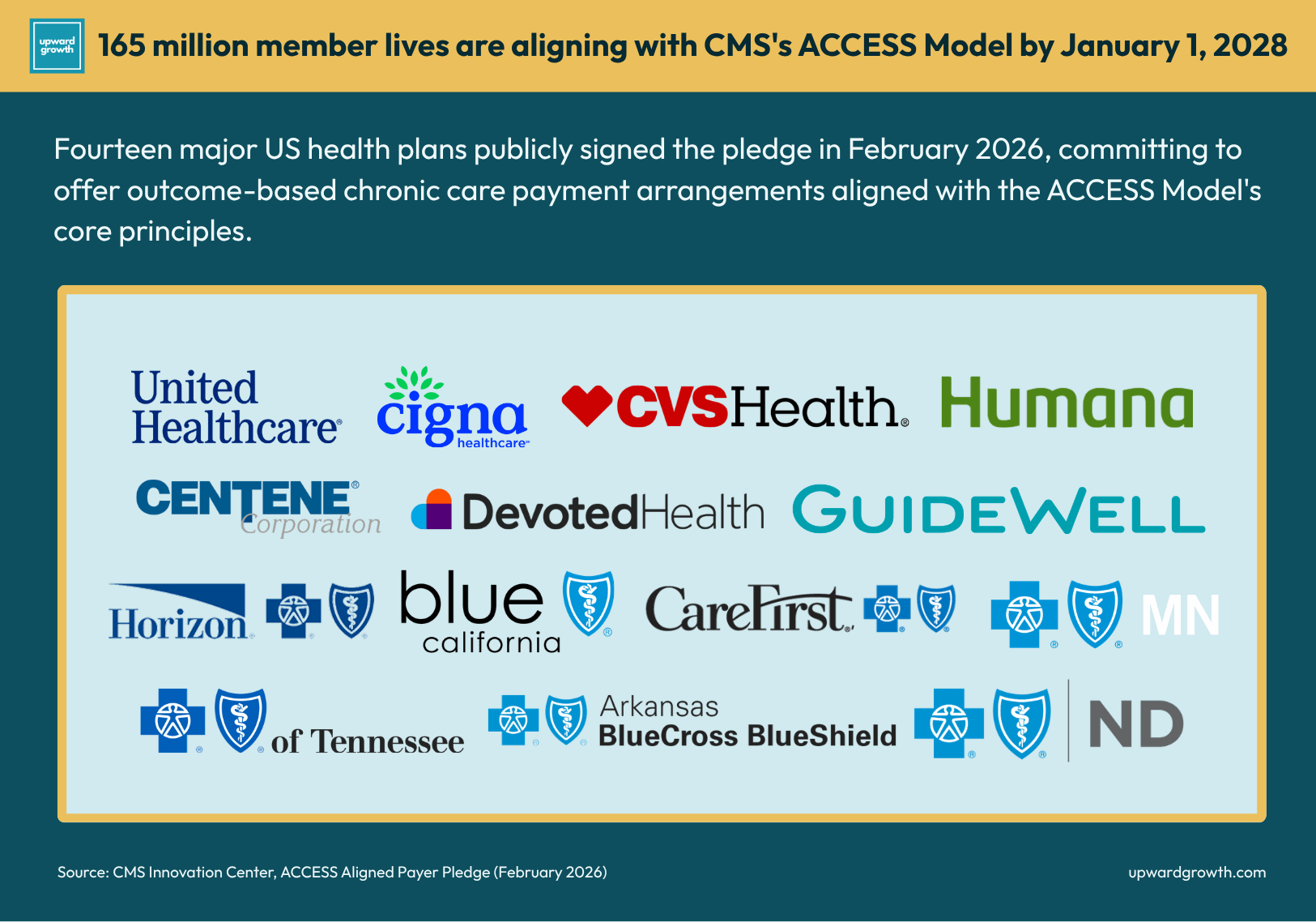
Four of the largest publicly traded national payers are on it: Humana, UnitedHealthcare, Cigna, and CVS Health. CVS also brings Caremark, its PBM subsidiary, along with an integrated PBM, retail pharmacy, and clinical services stack that reaches most of the largest self-insured employer relationships in the country. Centene brings the largest Medicaid managed care footprint in the country, at 17.9 percent of national Medicaid MCO enrollment as of Q1 2026 per HMA. Seven Blues plans signed on, and given how the Blues federation replicates operational patterns across state licensees, the practical reach extends past the seven names on the pledge.
The pledge has already moved from a voluntary experiment to a reference standard for the private-payer market. Non-signatory plans will be evaluated against ACCESS-aligned language whether they signed or not, and by 2027 their vendors will be pitching them arrangements they had no formal say in designing.
Where Health Tech Just Got Repriced
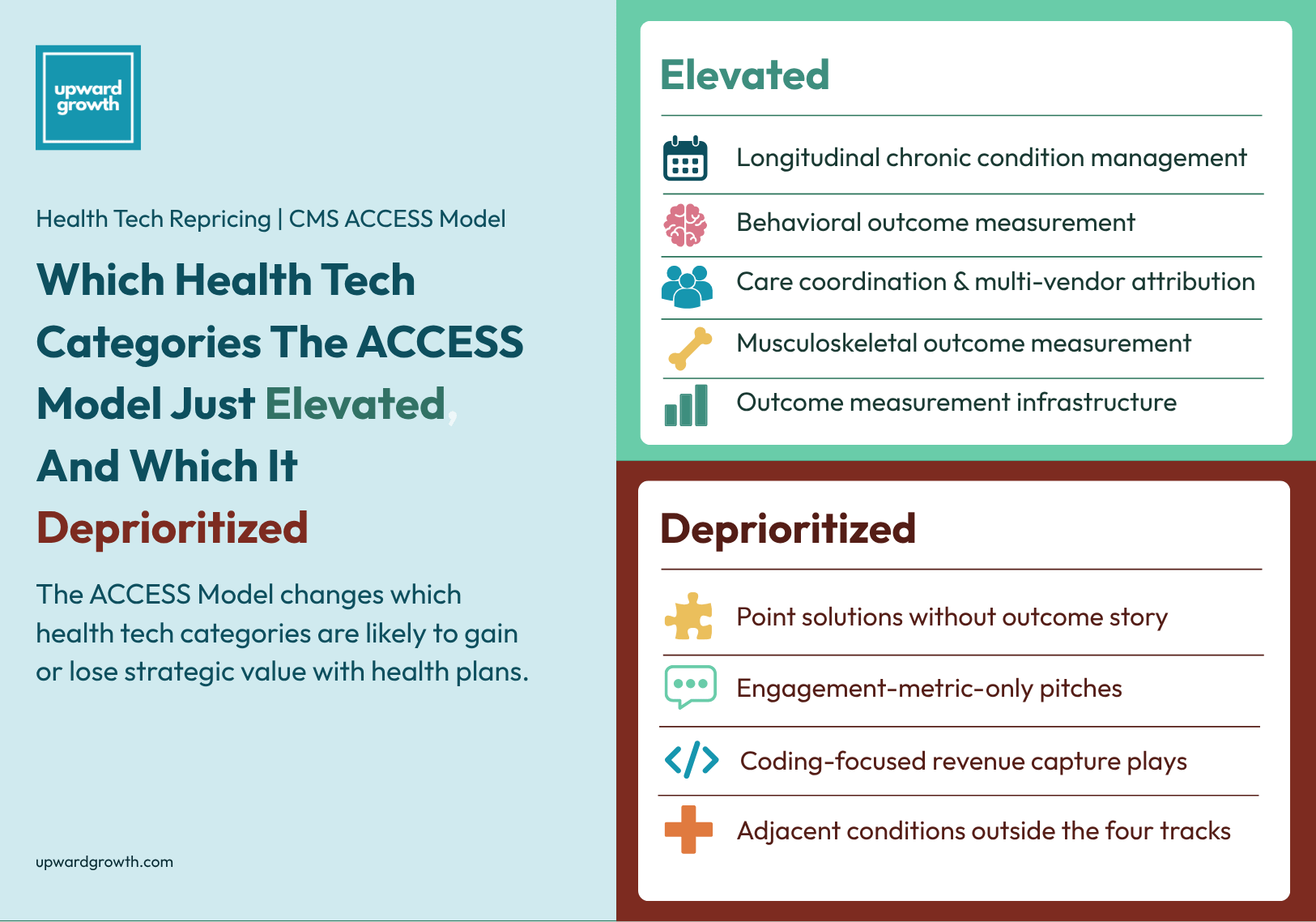
Over the next 12 to 18 months, the ACCESS framework becomes the yardstick your health plan buyer uses to evaluate every outcome-based pitch, whether or not you sell into Traditional Medicare. That reprices any health tech category evaluated on softer criteria before the launch. Some categories got elevated. Others got deprioritized.
What Just Got Elevated
Longitudinal chronic condition management with outcome accountability, particularly across the cardio-kidney-metabolic stack, is the clearest winner. If your value proposition is managing a chronic condition end-to-end with measurable outcome performance tied to a defined care period, ACCESS validated your category as the reference architecture. What earns the validation is longitudinal accountability for outcomes against a public threshold with technology-supported care as the delivery method, not the marketing label “chronic care management.”
Behavioral outcome measurement got a bigger lift than most vendors realize too. The anxiety and depression track places behavioral outcome measurement within the same reference architecture as physical health outcomes, using G-codes and API infrastructure to make outcome reporting an administrative workflow rather than a research project. Behavioral outcome measurement has been the least mature category in the outcome-based conversation for years, with measurement gaps documented across the industry. A public federal target changes the category's trajectory.
Care coordination and multi-vendor attribution moved up materially, through a mechanism most vendors have not connected to ACCESS yet. The Substitute Spend Adjustment (SSA) penalizes participants up to 25 percent if aligned members receive duplicative services from other providers, which requires knowing who else is touching your member and what they billed for. Any private-payer replication that includes an SSA-style clause requires the same visibility. Attribution, care coordination, and multi-vendor claims analytics are materially more valuable across MA, Medicaid, and commercial lines than they were before.
Musculoskeletal outcome measurement just got its biggest category re-rating in a decade. MSK has been largely treated as a commodity-priced, volume-driven business for years. Hinge Health and Omada’s public market receptions validated the outcome-based digital MSK thesis at the equity level in 2025. ACCESS validates it at the CMS reference architecture level, which changes how the category’s comp set gets read by health plan CFOs during their internal build-versus-buy conversations.
Outcome measurement infrastructure itself is the pick-and-shovel bet underneath all of it. Every private payer that intends to align by January 1, 2028 needs the measurement layer that enables them to do so. Most do not have it built at the scale ACCESS-aligned reporting requires, and those that try to build from scratch face a harder job than those that partner with vendors already carrying that infrastructure.
What Just Got Deprioritized
Now let’s look at the flip side. Point solutions without a longitudinal outcome story are not sitting as well. Simply put, if you cannot tie your work to a condition-specific outcome threshold measured over a defined care period, your health plan buyer’s evaluation framework now discounts you relative to a competitor who can.
Engagement-metric-only pitches are next on the list. “We drive 40 percent engagement” is a features-not-outcomes conversation against the ACCESS reference. The framework rewards outcome attainment rather than activity, and your buyers will make that comparison out loud in the next RFP even if they were willing to accept engagement metrics 12 months ago.
Coding-focused revenue capture plays are the third. This is not a new observation. Earlier this year, I wrote that CMS is systematically ending the risk adjustment arbitrage era by pulling revenue-arbitrage tools out of MA. ACCESS is the constructive half of the same policy strategy. Margin is moving from coding to outcomes. That trajectory now has a public reference architecture, standardized billing codes in the works, and a January 2028 private-payer alignment deadline attached.
Adjacent-condition vendors outside the four current tracks sit in the least clear position. Women’s health, oncology, geriatric syndromes, GI, and dermatology chronic conditions are pre-launch categories, and the chronic conditions plans are most likely to layer in independently are COPD and substance use disorders. Your health plan buyers’ near-term evaluation frame is CKM, MSK, and Behavioral for the next 18 months, with COPD and SUD as the credible adjacent candidates. Positioning work here is anticipatory, and vendors who acknowledge the gap and show they understand the shape of future track expansion will be evaluated more favorably than those who pretend the four tracks do not exist.
Over the next 12 to 18 months, the ACCESS framework becomes the yardstick your health plan buyer uses to evaluate every outcome-based pitch, whether or not you sell into Traditional Medicare.
The through-line across every category is the same argument. Your buyers’ evaluation criteria are becoming more stringent in a way that specifically favors vendors who have built the outcomes evidence stack rather than the outcomes narrative. ACCESS made that already-shifting trajectory explicit and dated it.
Portfolio companies and management teams within the elevated categories are facing a valuation and buyer-evaluation tailwind that will be evident in board conversations by Q3 2026. Companies outside the elevated categories are looking at an open repositioning window, with a mid-2027 deadline before the first ACCESS-aligned private-payer procurements are written. Vendors that have not started the repositioning work by the end of Q3 are visibly behind the ones that have. Which side of that line you land on depends on the line of business you sell into.
How ACCESS Alignment Reaches Your Buyer by Line of Business
Three distinct lines of business fall under the 165 million-member figure, each with its own buying cadence and path from the Payer Pledge to your pipeline.
Medicare Advantage
Humana, UnitedHealthcare, Devoted Health, Cigna, and the Blues signatories collectively run Medicare Advantage franchises that touch tens of millions of MA lives. Their alignment commitment directly conflicts with MA vendor selection in 2026 and 2027, well ahead of the January 2028 deadline. If you sell into any of those organizations’ MA books, expect the ACCESS-alignment principles to start appearing in vendor evaluation criteria in the next RFP cycle. Some of those RFPs are being written right now, and the CFO gate that MA plans have been running since 2025 on outcomes evidence just gained a public federal benchmark to point at.
Medicaid
Medicaid moves through Centene faster than any other signatory. Their commitment spans state Medicaid contracts in roughly two dozen states, and the same operational infrastructure that runs their commercial and MA books does not neatly bifurcate by line of business, so ACCESS-aligned arrangements will flow into their state Medicaid MCO relationships as those contracts come up for rebid. State Medicaid agencies have not yet published RFI language that references ACCESS by name, but the channel is already committed at the largest MCO level, where the real replication mechanics live.
Commercial and Self-Insured Employer
Employer coverage runs through CVS Health, a Payer Pledge signatory. Beyond Caremark, CVS operates one of the two largest PBM-and-clinical-services stacks in the country, and its footprint sits inside the vendor selection process at most Fortune 500 self-insured employers. How ACCESS-aligned payment structures enter those employer contracts through CVS’s stack over the next 24 months is the piece of the 165 million number that has received the least attention so far, and the specific thing vendors selling through national PBM or health services partners should be watching for is the language shift in employer RFP templates over the next four quarters.
Beyond those three channels, evaluation criteria will bleed into standard vendor RFPs at plans that never signed the pledge. When Cigna and UnitedHealthcare ask their vendors about ACCESS-aligned principles, competitor plans borrow the question set. It doesn’t seem far-fetched that questions like “How does your solution map to a condition-specific outcome threshold?” will appear in health plan vendor RFPs across all lines of business within 12 months, whether or not the plan asking it intends to formally align with ACCESS.
And finally, private-payer implementations will consolidate on a smaller, curated set of technology partners per condition category rather than distribute across the current long tail of point solutions, which is the typical outcome when a health plan operationalizes a complex network strategy. Which side of that consolidation your product sits on will be decided over the next 12 to 18 months.
The Positioning Runway Between Now and January 2028
The federal government just did work that vendors, investors, and provider strategy teams normally have to build for themselves. The practical work now is translating what CMS shipped into positioning decisions your buyers and boards will care about.
The ACCESS Request for Applications and the Payer Pledge documentation are strategic documents, not program launch materials. The OAP structure, the Substitute Spend Adjustment, and the four core principles that define ACCESS-aligned arrangements are the language your health plan buyers will use in evaluation conversations as early as Q4.
Every vendor pitch, product roadmap, and portfolio position now maps somewhere against the four tracks. Aligned, adjacent, or outside. Each position now carries a repositioning question and a timing anchor. Whether the conversation is with your buyer, board, portfolio company, or client, everything works backward from January 1, 2028. That deadline shapes private-payer alignment, which shapes the 2027 RFP evaluation criteria, which in turn shapes the positioning work you should be doing right now.
Provider organizations face a P&L question about whether direct participation in the ACCESS framework is more valuable than referral positioning to an ACCESS participant. The 2028 ACO benchmark inclusion means ACCESS-aligned attribution will affect ACO benchmarks and performance year calculations, materially changing referral economics for MSSP and REACH participants.
Plans will build the alignment mechanics themselves once CMS publishes the sample provider agreement and G-codes. Vendors will need help translating their story to a reference architecture they did not write, and that translation work is where the next 12 to 18 months of consulting demand actually lives.
Health plan buyers have been getting harder on outcomes evidence for two years already. ACCESS turns that from a slow shift into a dated one. And because this is a CMS-driven initiative with fourteen major health plans already aligned to it, the fingerprints show up in vendor evaluations regardless of whether the plan running the evaluation signed the pledge, participated in the model, or has any Traditional Medicare business at all. Every plan you sell into is now looking at your outcomes story through a framework CMS just published, and that starts happening this fall, not in 2028.

Final Thought
CMS rarely engineers the direction of a market this openly. When it does, the pattern is usually the same: modest reimbursement early, a small first cohort willing to build against thin economics, and a long iteration cycle that gradually widens the aperture. RPM followed that arc from 2019 forward. So did the shared savings work that eventually became MSSP, and the bundled payment models that reshaped how orthopedic groups think about episodes of care. The organizations that showed up early with the operational infrastructure to participate became the reference examples CMS pointed to when the model scaled, and the ones building alongside them captured the second-wave demand as private payers began replicating what worked.
The ACCESS Model is early in that arc, and what makes it different from prior CMMI experiments is the machinery CMS built around it before launch: a set of four principles that make an arrangement ACCESS-aligned, standardized billing codes any payer can adopt, a CMS-hosted API for outcome measurement, and a Payer Pledge already signed by every major national payer and a meaningful share of the Blues. Read the ACCESS Model as a signal of where CMS believes outcome-based chronic care should go for the next decade, and read the Payer Pledge as the first meaningful private-payer response. The reimbursement rates will iterate. The reference architecture, once the major payers commit to align with it, does not.
If you are working through what this means for your positioning, your messaging, or your go-to-market strategy, Upward Growth is a health plan market advisory firm that works with health tech vendors, investors, provider organizations, and management consultancies to build strategy around how health plans actually buy, operate, and make decisions.
Thanks for reading.
Here’s to upward growth,
Ryan Peterson
The frameworks in the weekly Upward Growth newsletter help health tech sales and marketing teams navigate payor conversations as the market continues to shift.
If your colleagues are in those conversations, they should be reading this too.
💰 Invest In Your Team with a Paid Subscription.
💡 Pro tip: Many subscribers expense Upward Growth through their company’s professional development, training, or learning budget. Here’s a one-minute email template to get your manager to approve expensing your subscription.