

Upward Growth provides health tech leaders with the playbooks and proof to transform complex markets into real growth. Each week, we deliver clear, practical strategies on positioning, messaging, and growth, so leaders can close enterprise deals and build repeatable momentum.
🤝 Work with us on payor market strategy: Contact me
🟦 Connect with the author, Ryan Peterson, on LinkedIn.
🎧 Listen to the Upward Growth Podcast: Apple | Spotify
📰 Newsletter sponsorships: Learn More
I’m in Chicago this week speaking on a panel about performance improvement in Medicare Advantage at the HEDIS Risk Stars conference. Prepping for it, I keep landing on the same observation: what vendors bring into health plan meetings is rarely what plans are actually evaluating them on. There’s a gap between vendor pitches and plan-buying behavior that is often overlooked, and it’s why many good programs from credible companies stall before they get a fair hearing.
The shorthand of the gap: vendors are pitching their results. Plans are evaluating their durability. Most pitches deliver on the first and underdeliver on the second, which is why even credible programs lose ground.
If you sell into health plans on Stars, the dynamics below will look familiar, whether for quality, risk adjustment, prior authorization, utilization management, care management (or anything else with a clinical or revenue outcome attached). You’ve probably lost a deal and blamed the pricing, the timing, or the competitor. The real explanation is usually somewhere else: an evaluation lens that the plan was running the whole time that your pitch wasn’t built for.
The Three Things Plans Are Calculating While You Pitch
Your plan champion is running three calculations while you pitch, and none of them are directly about your product. All three decide whether your deal advances long after the pitch ends.
Start with the money. Plans are managing tighter margins, Medical Loss Ratio (MLR) pressure amid rising medical cost trends, and the downstream effects of recent Centers for Medicare & Medicaid Services (CMS) rulings on rates, risk adjustment, and prior authorization. Every vendor relationship gets read through a CFO lens now. What does the program lift, what’s the revenue impact, what’s the administrative load, what’s the off-ramp if it doesn’t work? Vendors who can’t answer those four questions in the pitch are answering “no” on the plan’s behalf.
Then there’s the team itself. Plan quality, risk adjustment, clinical, and operations teams aren’t adding headcount. They’re inside a market that’s still tightening operations as margins compress, and every implementation has a full-time equivalent (FTE) cost the plan absorbs. Your pitch isn’t only competing against other vendors. It’s competing against the plan team’s own capacity, and a sharper pitch doesn’t win that fight. The way health plan teams score vendors has only gotten sharper.
The third calculation is the chain of reviewers your champion has to walk your deal through after you leave. Clinical, operations, finance, strategy, and increasingly the board. Each has different questions, different evidence thresholds, and different reasons to say no. When your champion can’t translate your program for each of those audiences, the deal stalls in committee. Your job stops being the pitch in front of you and starts being whatever your champion needs to win the next four conversations without you.
Everything underneath this sits on top of that third calculation, including the one question in the average outcomes pitch that decides whether your champion can defend your evidence when you’re not there.
Your plan champion is running three calculations while you pitch, and none of them are about your product directly.
Why Your Outcomes Numbers Don’t Land the Way You Think
Plans aren’t evaluating your outcome data for how strong the number is. They’re evaluating it for defensibility. Whether the number you led with in your pitch can be defended by a non-clinical reviewer two layers above your champion, when the program doesn’t track exactly to plan in month 14. That reframe (from “is the number good” to “is the number defensible to people reading it cold”) is the part most vendors don’t internalize.
The engagement-cohort question is where this shows up most cleanly. Most pitches lead with a version of “members who engaged with our program saw an X-point lift on Y measure,” followed by a chart, a logo wall, and a question about timing. The next question the plan asks decides whether you advance: what happened to the members who didn’t engage, and what was the lift across the entire eligible cohort.
Your engaged-cohort number tells you what happened to the members who said yes. The plan needs to know what the program will do at the population level. That’s the level Star Ratings, Healthcare Effectiveness Data and Information Set (HEDIS) measures, Consumer Assessment of Healthcare Providers and Systems (CAHPS) results, risk adjustment recapture rates, and prior-auth turnaround commitments are all calculated against, not the cohort level your case study captured. The gap between what vendors claim about outcomes and what their evidence base actually supports is wide enough to be measured across hundreds of digital health companies, which is exactly the gap plans are trying to close when they ask the cohort question.
A smaller eligible-cohort number doesn’t kill the deal. Being unprepared for the question does. The vendor who answers, “Engagement-cohort lift was X, eligible-cohort lift was Y, and here’s the engagement rate that bridges the two,” is handing the buyer a defensible answer for the next reviewer. The vendor who hears the question for the first time from the buyer is handing them nothing.
A reframe that fixes most of this on the spot:
Instead of: “Members who engaged saw an X-point lift on Y measure.”
Try: “Across the eligible population, we delivered a Z-point lift on Y measure, with an X-point lift among the engaged sub-cohort and an engagement rate of W%.”
Same story. Same data. But surfaced in the order the plan actually needs to evaluate it. Denominator first, sub-cohort second, engagement rate third, methodology underneath. That ordering is the operational version of what makes a case study actually move a deal forward. Plans are buying evidence at the population level your contract will cover, not impressive numbers at the cohort level your case study happened to capture, whether the underlying outcome is member engagement, recapture rates, denial reduction, or anything else with a clinical or financial result on the line.
The cohort question is the cleanest test of that lens, but it isn’t the only test.

Criteria Health Plans Weigh Beyond Your Evidence
Even when your evidence holds up, the deal isn’t won. Plans weigh four other things about your offering before they commit, and these are the questions that surface in the second meeting, the procurement review, and the contracting cycle, long after you thought the hard part was over.
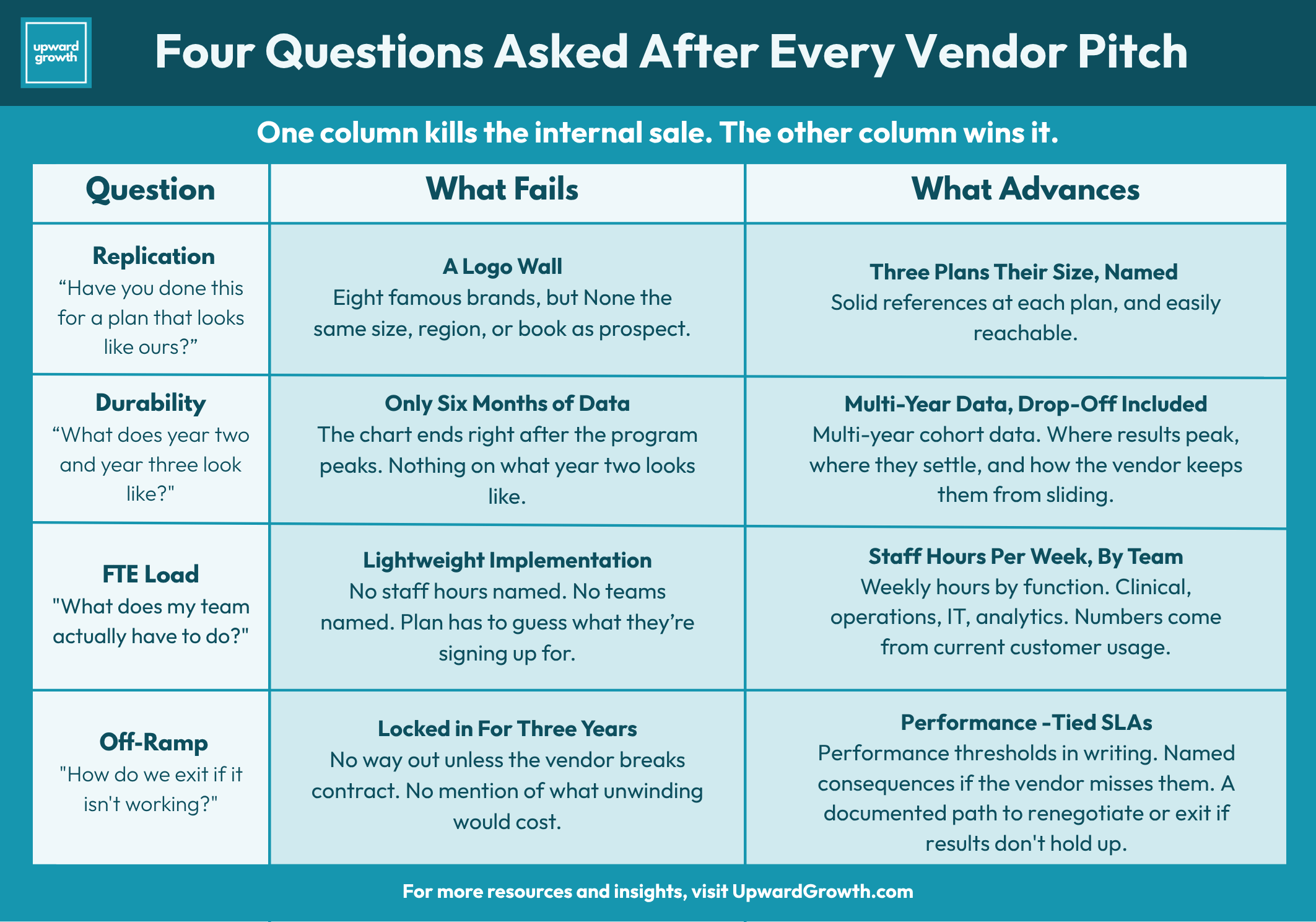
Replication at their size and book mix. Plans want to know where else you’ve deployed at their member count, line-of-business mix, and population complexity, and whether they can call the quality lead or risk adjustment lead at that plan directly. A regional Blue with 400,000 Medicare Advantage (MA) lives, and a Dual Eligible Special Needs Plan (D-SNP) population, isn’t interested in case studies from a national plan running a commercial program. They want plans that look like them, and the peer-reference circuit among the Blues, the regional independents, and the provider-sponsored plans is fast and active. Vendors who proactively offer a named peer reference at a comparable plan close that gap before the buyer has to ask.
Durability of outcomes over time. Most outcomes-oriented programs show their strongest results somewhere between month six and month nine, then slide. That slide is a known pattern, and plans have been burned by it enough times that they ask about it explicitly. What does year two look like? Year three? The stakes are sharper for plans that slipped below the 4-Star line in the 2026 ratings, because a partnership that delivers a one-year bump and then slides isn’t a strategy a plan can ride into the next bid cycle. The buyer who’s been through one of these slides is the toughest one on this question because they remember the cleanup. Vendors that win durability come with multi-year data and an honest story about what happens after the strongest results land, and how they keep them from sliding further. Vendors that lose it come with one impressive number…and a hope that nobody asks about year two.
Operational load on the plan team. What does the plan actually have to do to run your program? How many FTEs are from member services, IT, clinical, analytics, and reporting? How many cross-functional meetings, weekly status reviews, and one-off data pulls? If the answer is some version of “your team will love working with us!” the plan hears either a vendor who hasn’t deployed at scale or one hiding the real cost. The same teams running benefit design, provider contracting, risk adjustment, and Stars in 2026 are the ones evaluating your program. Every FTE-hour you ask for has an opportunity cost that the plan is calculating in real time.
Off-ramp clarity. The plan needs to know what happens if the program underperforms. What the performance thresholds are, what the consequences are when the vendor misses them, and how the contract adjusts when results don’t hold up. A multi-year contract with no accountability built in is read as risk by a buyer who has watched too many vendors confuse certainty with control. The vendors who handle this best put real performance accountability into the contract, sometimes before the buyer thinks to ask.
Most pitches don’t address these criteria at all. Strong programs don’t lose ground on the evidence. They lose ground on what comes after it.
What Separates the Vendors Who Advance
The vendors who keep their deals moving consistently do three things. Preparation, specificity, and adaptation.
Preparation that’s specific to the plan you’re in front of. Plans can tell within five minutes whether you read the earnings call, looked at the supplemental benefit changes, understood the book mix between MA, Medicaid, and Commercial, and know what their Star Ratings did in the most recent release. A vendor who opens with, “We know you slipped on three measures in last year’s release, your D-SNP book grew faster than your general enrollment, and your 2026 bids signaled tighter benefit design. Here’s what that means for the program we’re discussing,” often earns more credibility in two sentences than a generic pitch earns in 45 minutes. Plans aren’t asking you to do their work for them. They’re asking you to prove you’ve done your homework, especially when their own buying posture has been paralyzed by market uncertainty.
Preparation also means bringing a one-page implementation sketch into the first conversation: integration points, data exchange model, FTE asks, decision gates, week-one through month-six timeline, and a candid view of where things typically go sideways. The sketch doesn’t have to be perfect. It has to exist. Showing it signals you’ve done this at scale and gives the plan team something concrete to react to. The underlying move is sensemaking in complex B2B sales: the best sellers reduce the buyer’s cognitive load most effectively, and a one-page sketch carries more weight than a longer pitch.
Specificity about what you’re not. Vendors who name a specific strength, draw a clear boundary, and point to a partner for what falls outside it earn more credibility than vendors who claim to deliver across the full performance stack. Plans have learned to discount full-stack claims by default, because they haven’t held up in implementation. Specificity, including the parts where you’re deliberately not the answer, reads as maturity to a buyer who’s already thinking in portfolios. It tells them you’ve thought about how you fit alongside the other vendors in their book, which is the world they actually operate in.
Adaptation to the audience inside the buying committee. Clinical wants methodology, sample sizes, and confidence intervals. Operations wants FTE detail, implementation timelines, and downstream effects on existing workflows. Finance wants the ROI math at the population level, with the cohort assumptions surfaced. Strategy wants competitive positioning and the multi-year story. Vendors who run the same materials through every audience aren’t selling. They’re contributing to the message fatigue that’s costing them deals. Remember: Tailoring the materials to each audience is the difference between a closed deal and a stalled one.
We’ve covered the three calculations every plan champion is running while you pitch, what plans are actually reading for when they evaluate your outcomes claims, the four criteria they weigh beyond your evidence, and what separates the vendors who keep their deals moving. Below is the operational layer underneath all of it: the five questions to pressure-test your outcomes claims before you pitch a plan again.
Paid subscribers get this, plus 50+ frameworks, scripts, and deep dives built for health tech teams selling to health plans. One qualified conversation from these frameworks is worth more than a decade of subscriptions.
Upgrade to a paid subscription to keep reading.
