

Upward Growth is a health plan market advisory firm. Our weekly newsletter covers payor market strategy, regulatory shifts, and go-to-market insights for health tech vendors, investors, provider organizations, and consultancies competing in the health plan market.
🤝 Work with us on payor market strategy: Contact me
🟦 Connect with the author, Ryan Peterson, on LinkedIn.
🎧 Listen to the Upward Growth Podcast: Apple | Spotify
📰 Newsletter sponsorships: Learn More
🎁 Unlocked: This post includes the full deep dive
Most Tuesday articles start with a free section and then continue behind the paywall. Today’s post is left completely open so you can read the entire edition.
Paid subscribers get the full deep dive every week, plus playbooks, case breakdowns, and the ability to reply with their own questions.
Most people who aren't elbows-deep in CMS regulation cycles have never heard of the Medicare Payment Advisory Commission (MedPAC). They should. MedPAC is one of the few sources of analysis that consistently shapes what the Centers for Medicare and Medicaid Services (CMS) does next.
Congress chartered MedPAC in 1997 as an independent advisory body, and twice a year, in March and June, the Commission publishes a report to Congress with formal recommendations on Medicare policy. The report is the closest thing the program has to a neutral technical read on what's working and what isn't.
While the recommendations are not binding, they tend to be adopted at a higher rate than those of most advisory bodies. The site-neutral payment policy, which is reshaping outpatient hospital procurement right now, traces directly back to MedPAC. In fact, the current Medicare Advantage (MA) coding intensity adjustment exists because MedPAC pushed for it for a decade before Congress required it.
The June 2026 report dropped this past Monday. Three findings inside it should change how anyone selling into health plans (or backing the companies that do), thinks about who’s buying inside MA plans for the rest of 2026 and into 2027.
In its June 2026 Report to Congress, the Commission attached $22 billion in higher-than-justified MA payments in 2026 to coding intensity alone. It documented $23.7 billion in improper MA payments for fiscal year 2025. And the same report endorsed a federal role for technology in fixing Medicare enrollment, in the same chapter that flagged the broker channel as part of the problem the technology is meant to solve.
The health plan CFOs I talk to do not need MedPAC to tell them coding intensity is a margin issue, prior authorization is a political issue, or member acquisition costs are out of control. But what they do need is the dollar figures cited back to them by their boards, compliance teams, and actuaries, which is now happening for the rest of the bid review cycle.
For readers of this newsletter, this means each MedPAC finding will change how health plans evaluate vendors over the next 18 months. Recognizing which finding falls within your category and which plans are most exposed to it is what separates the vendors who adjust their positioning this quarter from those who get filtered out of 2027 procurement decisions without knowing why.
🎙️ Episode 3 of the Upward Growth Podcast is the audio companion to this article. It walks through how MedPAC's June report is reshaping the procurement conversation inside MA plans across risk adjustment, utilization management, and member experience, and names three live questions over the next 90 days that will shape what plans buy in 2027. Apple | Spotify | Web
The MA Plans Capturing the $22 Billion and the Ones Leaving It on the Table
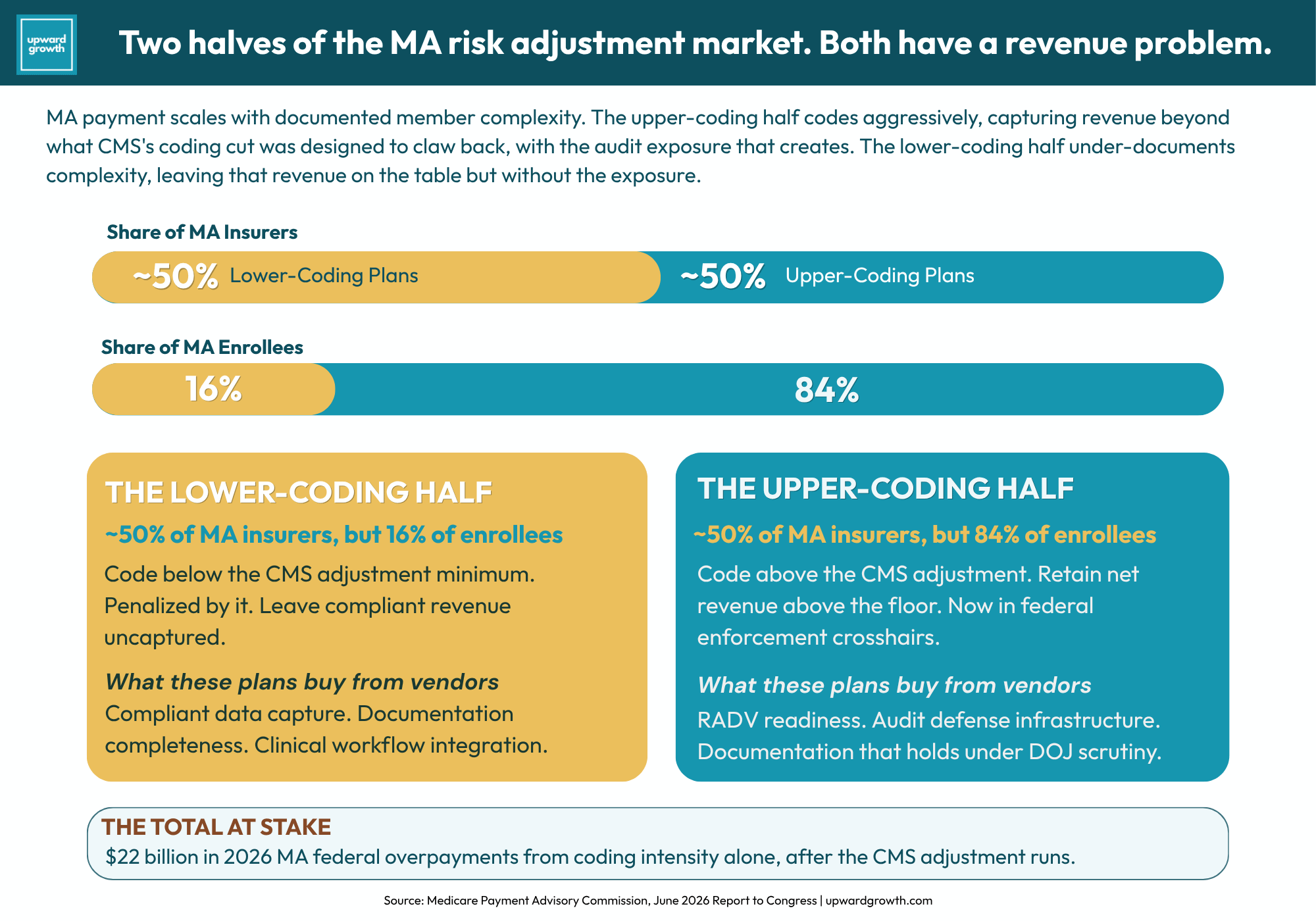
MedPAC’s June report estimates that the federal government will overpay MA plans by $22 billion in 2026 from coding intensity alone. The required coding intensity adjustment cuts MA risk scores by 5.9 percent (the statutory minimum), but the actual coding intensity gap between MA and traditional Medicare is closer to 10 percent. The four-point delta is the $22 billion.
The split underneath the average is the part of the Commission’s recent reporting that should have gotten more attention, as the headline and the operational reality are two different numbers.
By insurer count, the market is roughly split down the middle. About half of MA insurers code below the 5.9 percent adjustment minimum and get penalized by it. The other half code above the adjustment and retain net revenue from the gap. By enrollment, though, the split is quite lopsided. The half-coding above the adjustment covers 84 percent of MA enrollees because the upper-coding plans cluster in the nationals and the PE-backed regionals, where enrollment is concentrated. The other half covers 16 percent. The market is split 50/50 by plan count and 16/84 by member count, and the second number is the one you should be more aware of its implications.
The upper-coding half is concentrated in large nationals with mature risk adjustment operations and integrated provider assets, and in regional plans owned by private equity or backed by PE-style growth capital that have built risk adjustment into their operating models as the principal margin lever.
The lower-coding half is concentrated in mid-sized regional Blues with conservative compliance postures, provider-sponsored plans whose physician networks resist the documentation workflow burden, dual-eligible-heavy plans whose populations are clinically complex but documented unevenly, and newer entrants who built their networks faster than they built their risk adjustment infrastructure.
So, half of MA plans are coding above the CMS intensity adjustment, and the other half are coding below it. The Inovalon and Harvard study MedPAC cited found that MA enrollees use 18 to 22 percent fewer services than comparable fee-for-service (FFS) Medicare beneficiaries, with the variance concentrated in plans that document chronic conditions less aggressively, rather than in plans gaming the system. Plans that document chronic conditions aggressively end up coding above the federal floor. Plans that do not end up below it.
The distribution is due to the coding intensity gap, not primarily to fraud. It is about documentation completeness, encounter data submission discipline, clinical workflow integration with risk adjustment, and the operational maturity of the chart review and member outreach functions.
Half of MA plans are coding above the CMS intensity adjustment. The other half are coding below it. Your risk adjustment pitch needs to know which half you’re selling to.

What Compliant Capture Actually Means in 2026
Compliant capture means the process of pulling documented but uncoded clinical complexity from a member's record into the risk adjustment submission. It is legal, expected, and aligned with how CMS designed the program. Plans submitting hierarchical condition category (HCC) codes that reflect conditions clinicians have documented and treated are doing the work the payment system asks them to do. (HCC codes are the diagnosis groupings CMS uses to set risk-adjusted payment per member.) The work of submitting HCCs that are not supported by documentation, or that are based on chart reviews that pulled diagnoses providers had not validated, is the work the Department of Justice and the Office of Inspector General (OIG) have been recovering against. The split in MedPAC's data is between plans that have built mature, compliant capture and plans that have not. It is not a matter of honest plans versus dishonest plans.
That line matters more right now than at any point in the program’s history, because the federal enforcement posture has shifted hard.
The OIG published its first MA-specific compliance program guidance in twenty-six years in February. The Department of Justice recovered $6.8 billion in False Claims Act settlements in fiscal year 2025, with MA risk adjustment named as a top enforcement priority. Elevance booked a $935 million risk adjustment accrual in early May, which triggered every other publicly traded plan to run an internal audit pass against the same exposure. Risk Adjustment Data Validation (RADV) audits are now expanding, and CMS has announced it will apply extrapolation to recover overpayments at scale.
Each of those facts has been in the trade press separately. MedPAC’s report consolidated them into a single document, attached the $22 billion figure, and put it before Congress in the same week the bid cycle was closing.
High-Coding Plans and Low-Coding Plans Are Buying Different Things Now
A plan in the upper-coding half is no longer making risk adjustment vendor decisions with the same internal stakeholders it had eighteen months ago. Compliance, legal, and the chief financial officer are now sitting at the table. The question those teams are asking is not how much more capture can you produce. It is whether the work the vendor already did holds up. Will the documentation survive an extrapolation-based audit? Will it withstand DOJ scrutiny? Does the chart review methodology align with what the OIG flagged as low risk in the February guidance? Do the contract terms put the audit liability on the vendor, or leave it sitting with the plan? Vendors who built their pitch around capture volume as the headline are walking into those conversations answering questions they did not prepare for, in front of stakeholders they did not previously sell to.
A plan in the lower-coding half is asking a different procurement question. Those plans are looking at the $22 billion figure and recognizing that their upper-coding competitors are being paid more per member by CMS for documenting the same kinds of patient complexity. The lower-coding plans are leaving compliant revenue uncaptured on their own membership, in a margin environment where every dollar of compliant capture matters more than ever. The growth, finance, and revenue cycle teams within those plans remain the decision-making authorities. Their internal political problem is that increasing coding intensity in 2026 will require doing so under the most aggressive federal enforcement posture in the program’s history. The procurement question becomes how to do the work compliantly at scale, with audit-defensible documentation built into the workflow from the start.
This is the next iteration of the regulatory squeeze that has been building since the OIG guidance landed in February and accelerated through the Q1 2026 payor earnings cycle. Every publicly traded plan that reported in April or May named margin discipline as the operating posture for the rest of the year. Risk adjustment is one of the largest single levers in the margin equation. MedPAC just made the upper and lower halves of the market visible at the same time the enforcement posture forced them to behave differently.
Risk adjustment is one of three dollar magnitudes that MedPAC applied to plan operations. The second was buried deeper in the report and got even less coverage.
CMS Just Validated the Procurement Structure for AI Utilization Management
MedPAC's second number worth your attention is $23.7 billion in improper MA payments for fiscal year 2025. What CMS is already doing to recover that money is the part the trade press missed. The Commission’s chapter on Medicare payment operations walks through the Wasteful and Inappropriate Service Reduction (WISeR) Model, a Center for Medicare and Medicaid Innovation (CMMI) demonstration that launched in 2026. WISeR tests artificial intelligence (AI) and machine learning-based prior authorization in fee-for-service Medicare for high-volume services with established overutilization patterns, including cervical fusions, knee arthroscopy for osteoarthritis, and percutaneous vertebral augmentation. The model excludes inpatient stays, emergency services, and anything in which a delay could harm a patient.
CMS contracts with what it calls “participating data companies” (AI vendors, in commercial terms) to conduct medical reviews on flagged claims pre-payment. Vendors are paid a percentage of the expenditures avoided through appropriate care. The contract structure is essentially identical to the way MA plans have purchased utilization management services for the better part of two decades. The difference is that the agency itself is now the buyer, and the procurement vehicle is operating in fee-for-service Medicare under a federal demonstration.
The political weight of that procurement structure hasn’t been fully realized yet. The OIG’s 2018 report on MA prior authorization denials and its 2022 follow-up audit set in motion a decade of regulatory pressure on how plans had been operating in the category. The 2022 audit found MA plans denied prior authorization requests that met Medicare coverage rules 13 percent of the time. The Interoperability and Prior Authorization Final Rule (CMS-0057-F) went into effect on March 31st of this year and made prior authorization metrics publicly visible at the plan level for the first time in program history. WISeR is the agency taking the same direction of travel and inverting it. Instead of regulating how plans use prior authorization, the agency is contracting directly with AI vendors to run it itself, using a shared-savings structure that aligns vendors' economics with denial accuracy and clinical appropriateness.
Read in that sequence, WISeR matters less as a demonstration and more as a signal. The federal government is now buying AI-driven prior authorization under a shared-savings contract, and the language inside that contract makes the public health case for the work itself. That is what AI utilization management vendors had been waiting for through all of 2025, when the AI label carried headline risk and no federal customer existed to point to. Whether the demonstration will survive long-term is less known; however, the fact that the procurement validation now exists means vendors selling AI-driven UM to health plans can point to it tomorrow.
The commercial side of the UM market is moving in the same direction. Cigna placed eviCore on strategic review on April 30, with incoming CEO Brian Evanko explicitly framing the rationale as industry standardization and automation, making the asset a better fit elsewhere. eviCore is the largest pure-play utilization management asset in the commercial health insurance industry. The strategic review, in the broader context of Evanko’s portfolio rationalization, reads as a sales process with the buyer pool already in mind. Whoever buys eviCore (a strategic acquirer with adjacent utilization management capabilities, a private equity sponsor building a vertical, or a recapitalized standalone with a different growth model) will become the comp that resets multiples across the utilization management category for the next eighteen months.
The federal procurement validation and the commercial market repricing are happening simultaneously, and the MedPAC report quantified the established commercial precedent for both. The Commission cited KFF analysis showing 1.7 prior authorization requests per MA beneficiary in 2024 compared with 0.02 per FFS Medicare beneficiary, an 85-fold intensity differential between the two programs before WISeR even ran a claim. It also incorporated interviews with hospital representatives reporting 17 percent of inpatient claims initially denied by MA plans, with overturn rates on appeal of 60 to 80 percent. MA plan representatives pushed back during those same interviews, framing prior authorization as a tool to prevent inappropriate or wasteful care. Both readings are now on the record in a federal document, which means both can be cited in procurement conversations from whichever side of the table a vendor is selling.
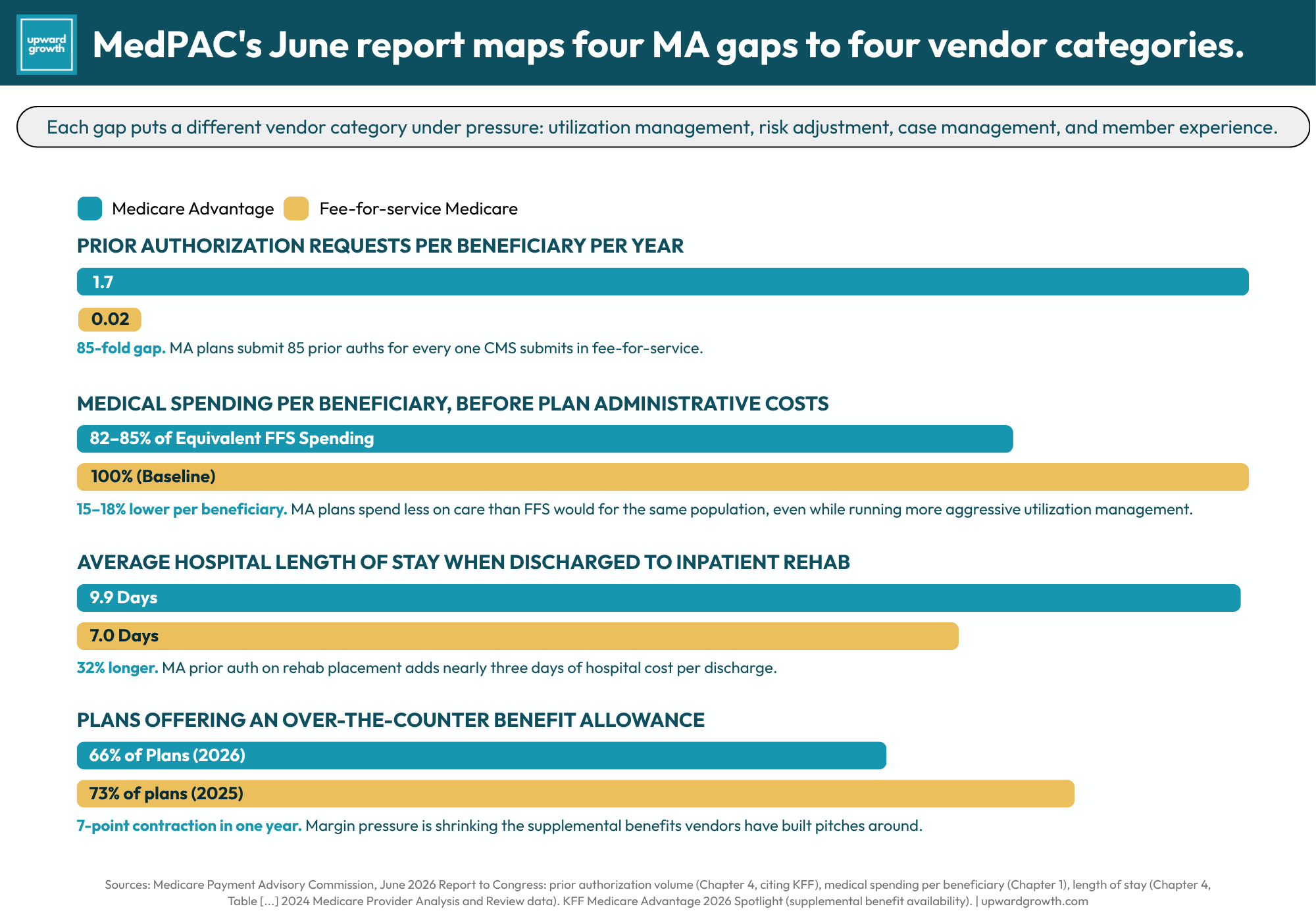
For vendors selling AI-enabled utilization management or payment integrity into health plans, the ground has shifted. Through 2025, the AI label was a positioning liability, which is why so many vendors quietly buried it in their decks. They do not have to anymore. CMS just signed a federal contract for the work, and the language inside that contract makes the public health case for it. The reframe for the commercial pitch is to lead with clinical appropriateness, audit-defensible denial methodology, and shared-savings accountability. AI gets to be a how, not a what. The reason it matters is that health plans want to be able to defend their decision to buy the work in front of the same compliance teams now sitting at the risk adjustment table, and WISeR gives them the language to do so.
The third finding got its sharpest commentary forty-eight hours after the report dropped, when CMS itself responded to a related court case in a way that made the finding land harder.
Why the June 17 CMS Memo Sharpened the Member Experience Pitch
The third MedPAC chapter carries the most direct implications for vendors selling into plans for member acquisition, retention, and experience. It is also the chapter most vendors will skip.
Medicare enrollment is genuinely hard. Beneficiaries face dozens of plan options, complicated coverage rules, and tradeoffs between MA and traditional Medicare that they often do not fully understand until they are living with the consequences. Decisions made during the initial enrollment period carry permanent financial implications, and most beneficiaries make them with little help. CMS funds the existing help, primarily through Plan Finder and the State Health Insurance Assistance Program (SHIP), but funding has not kept pace with MA enrollment growth. MedPAC put it directly in the report, writing that "there may be a need for additional updates to Plan Finder and greater support for SHIP, as well as an increased role for technology to help reduce the complexity of the choices that beneficiaries face."
That single sentence is the federal endorsement of the member experience technology category as a policy answer to enrollment complexity. Vendors selling decision-support tools, digital member onboarding, clinically informed enrollment guidance, supervised broker enablement, and plan comparison engines now have a federal advisory body citation they did not have before. The procurement justification shifts. A pitch that previously had to compete on “we help your members shop better” can now compete on “we help your members shop in the way the Commission advising Congress says they should be shopping.” The difference matters more in front of a chief financial officer or chief compliance officer than in front of the member experience team, because the citation moves the conversation from elective spend to advisable spend.
The same chapter creates the headwind on the opposite end of the same workflow. MedPAC named MA marketing growth and Third-Party Marketing Organizations (TPMOs) as contributors to beneficiary confusion and specifically called out insurance agent compensation. CMS caps initial enrollment commissions but does not cap supplemental bonuses, and the Commission flagged concerns that agents may be financially incentivized to steer beneficiary decisions toward certain plans through uncapped bonus payments. The chapter does not propose a specific rule change. It does signal that the next round of marketing rule tightening is coming, and the political risk sits on the unsupervised side of the channel, which has been the direction of travel since the TPMO rule changes in 2023.
And on June 17, CMS issued an updated guidance memo on the 2027 Quality Bonus Payment ratings, following the May Clover v. HHS ruling. CMS recalculated 2026 Star Ratings on a "better of" basis, meaning a contract keeps the higher of its original rating or the recalculated rating, with no plan exposed to a downgrade. The narrowness of what the agency conceded matters more than the recalculation itself. CMS removed the measures the court ruled it lacked authority to collect, but kept the measures the court flagged for rulemaking deficiencies. CMS has until late July to file its notice of appeal. The recalculation is structured to accommodate the court order without conceding the legal grounds underlying the program.
Read against the MedPAC endorsement of member experience technology, the agency's narrow Clover compliance reshapes one piece of the vendor pitch. Member experience vendors whose ROI math is built mainly on Stars uplift are now selling into a procurement environment where the regulatory citation underneath that math is legally contested. A plan CFO evaluating a member experience pitch in Q3 2026 cannot get a confident read from their own legal team or actuary on what the Stars architecture will look like in 2027 or 2028. CMS has not yet filed its appeal, but is expected to before the late July deadline. If the Eleventh Circuit eventually hears the case, it could overturn the ruling, narrow it, or affirm it in part. CMS could also pursue accelerated rulemaking on the procedural finding to cure the defect identified by the court. Congress could intervene. Each path produces a different Stars architecture, and none is predictable enough for a CFO to underwrite a vendor relationship priced solely on Stars uplift.
The move for member experience vendors is to reframe the ROI conversation around outcomes that hold regardless of how the Stars architecture resolves. Member retention. Friction reduction in the enrollment workflow. Gap closure that maps to clinical and operational value independent of measure specifications. Risk adjustment data quality that improves through better member engagement. Cost-of-care reductions tied to earlier intervention. Each of those holds up in front of a CFO regardless of how the Clover litigation resolves. Stars uplift becomes the bonus on top, not the headline.
The same dynamic hit equity-focused vendor categories after the CY 2027 Final Rule’s health equity rollback, when plans serving dually-eligible populations still needed the work, but the regulatory citation under the pitch went away. The procurement conversation shifted from “you have to” to “you choose to.” Choosing to requires a stronger ROI case than a regulatory citation ever did, and the vendors who already had that ROI case kept selling. The vendors who had built the pitch on the citation lost their footing for two or three quarters. The member experience category is now in that same transition, accelerated by the timing of the agency’s Clover response.
The CFO Filter Is Now Folding the Three MedPAC Findings Into the Same Question
The three findings are located in three different places within the plan's operating model. They share one operational consequence that ties them together.
The risk adjustment vendor conversation now includes compliance, legal, and the chief financial officer. The utilization management vendor conversation now includes the same compliance function, which is weighing in on risk adjustment vendor selection. The member experience vendor conversation now includes the chief financial officer asking whether the ROI math survives litigation the plan’s own legal counsel cannot predict. The common pattern across all three is that the procurement decision authority inside the plan has migrated up and across, away from the line-of-business owner who used to be your champion.
The CFO filter has been doing this for a while. I wrote about it last fall when the financial discipline shift was first making vendor renewal conversations look different. The pattern keeps showing up because the underlying pressure continues to compound. The CFO filter started tightening in 2024, accelerated during the Q1 2026 earnings cycle, and is now incorporating MedPAC’s three findings as additional lenses within the same filter. Each new lens makes the filter finer. Each new lens raises the procurement bar. Each new lens means the champion you have in the plan is bringing your pitch to a wider set of internal stakeholders than they did a year ago.
The practical implication is that your next plan conversation is one your champion is preparing to defend in front of a wider audience. The work this quarter is making your champion’s defense easier. That means the deck answers the compliance question before compliance asks it. The ROI model survives the CFO’s stress test before the CFO runs it. The audit liability terms are written in language that legal will not need to rewrite. The clinical and operational outcomes are documented in a way that holds regardless of which specific federal rule survives or evolves over the next eighteen months.
A vendor who has done that work before the Q3 conversation gives their champion something to defend with. Without it, the champion absorbs harder questions on the vendor's behalf, from a wider set of people than were asking them six months ago.

Final Thought
None of the three findings in MedPAC’s June report requires Congressional action to reshape what plans buy. The regulatory architecture underneath each one could still move. The Clover ruling could be narrowed or overturned. The WISeR Model could end the way several CMMI demonstrations before it have ended. The coding-intensity adjustment could be re-engineered by a future CMS administrator with a different posture. None of that changes what is in front of you this quarter.
The operating question is which buyer is making the procurement decision inside each plan in the second half of 2026, and whether your pitch is built for the version of that plan they are running now or the version they were running eighteen months ago. MedPAC grouped the buyers, attached the numbers, and put the grouping in a federal document that boards and chief financial officers will be reading for the rest of the summer. The work this quarter is to read the grouping, find your buyer in it, and rebuild around what that buyer is being asked to defend.
If you want to think through what any of this means for your positioning or your next renewal conversation, reach out.
Thanks for reading.
Here’s to upward growth,
Ryan Peterson
The frameworks in the weekly Upward Growth newsletter help health tech sales and marketing teams navigate payor conversations as the market continues to shift.
If your colleagues are in those conversations, they should be reading this too.
💰 Invest In Your Team with a Paid Subscription.
💡 Pro tip: Many subscribers expense Upward Growth through their company’s professional development, training, or learning budget. Here’s a one-minute email template to get your manager to approve expensing your subscription.