

Upward Growth is a health plan market advisory firm. Our weekly newsletter covers payor market strategy, regulatory shifts, and go-to-market insights for health tech vendors, investors, provider organizations, and consultancies competing in the health plan market.
🤝 Work with us on payor market strategy: Contact us
🟦 Connect with the author, Ryan Peterson, on LinkedIn.
🎧 Listen to the Upward Growth Podcast: Apple | Spotify
📰 Newsletter sponsorships: Learn More
Before we get into it: this month marks five years of Upward Growth. When I founded the firm in 2021, the bet was that the health plan market needed an advisory practice that actually explains how it works, in language health tech vendors, provider organizations, investors, and consultancies could act on. Five years in, that bet still feels right. What has not changed is that plans still have to buy carefully, and the companies selling to them still have to earn their way in. Upward Growth will keep advising clients through that reality, and this newsletter will keep sharing what we see in the market. Thanks for reading, whether you've been here since the beginning or you subscribed last week.
For a year now, I have been tracking a pattern of market resets rolling across the four biggest lines of health plan business. It started with Medicare Advantage’s reset last August. In May, I wrote about the five plan postures forming during the 2026 ACA shakeout. In June, I wrote about MA, Medicaid, ACA, and employer coverage all taking pressure at once. Medicaid, on the one-year mark of the One Big Beautiful Bill Act (OBBBA), is the sharpest example of the pattern yet.
OBBBA didn’t create one new Medicaid market. It created three.
Medicaid has always varied state by state. What is different this time is that OBBBA has already repriced the Medicaid market in three ways at once. Repricing should not be mistaken for shrinking. Repricing means the same MCO book of business, the same vendor contracts, and the same member panels are now worth different amounts than they were a year ago. Nothing about the underlying business changed on July 4, 2025. What changed is what buyers will pay for it, what contracts they will write, and what management will guide toward, because OBBBA changed what those pieces are worth in the field. Molina and Centene have marked down their own Medicaid books in earnings guidance. States are marking supplemental payment mechanisms down through the provider tax phase-down. Vendors are being pushed to reprice contracts under new terms. Members and providers in some states have already absorbed the marks. Others are about to.
The Medicare Advantage reset has been a rolling eighteen-month wave of federal pressure, including rate compression, risk adjustment overhauls, Star Ratings reweighting, and benefits scrutiny. Every MA plan is absorbing that wave at its own pace, but because MA is a fully federal program, all plans are absorbing it against the same regulatory backdrop. Medicaid is different. It took one federal shock, OBBBA, and its repricing is being absorbed three different ways because the program is a federal-state partnership. The feds set the terms. Each state chooses how, when, and how much to absorb them.
Even if you do not sell into it, the pattern is worth understanding. This is where federal-to-state fragmentation shows up most clearly. As Washington keeps pulling levers, reading how federal action travels through state execution into plan operations, and then into member and provider experience, is going to matter more, not less. OBBBA year one is the clearest example of that translation chain.
The rest of this piece walks through where the repricing is already visible in the data, how it is landing state by state, what MCO leadership is doing about it below the surface, and why the repricing is going to hold through 2028.
The Repricing Is Already Visible
The OBBBA repricing already happened. Two market patterns from 2026 show me why: publicly traded MCO parents have marked down their Medicaid books in earnings guidance, and CMS spent 2026 telling states they are on their own.
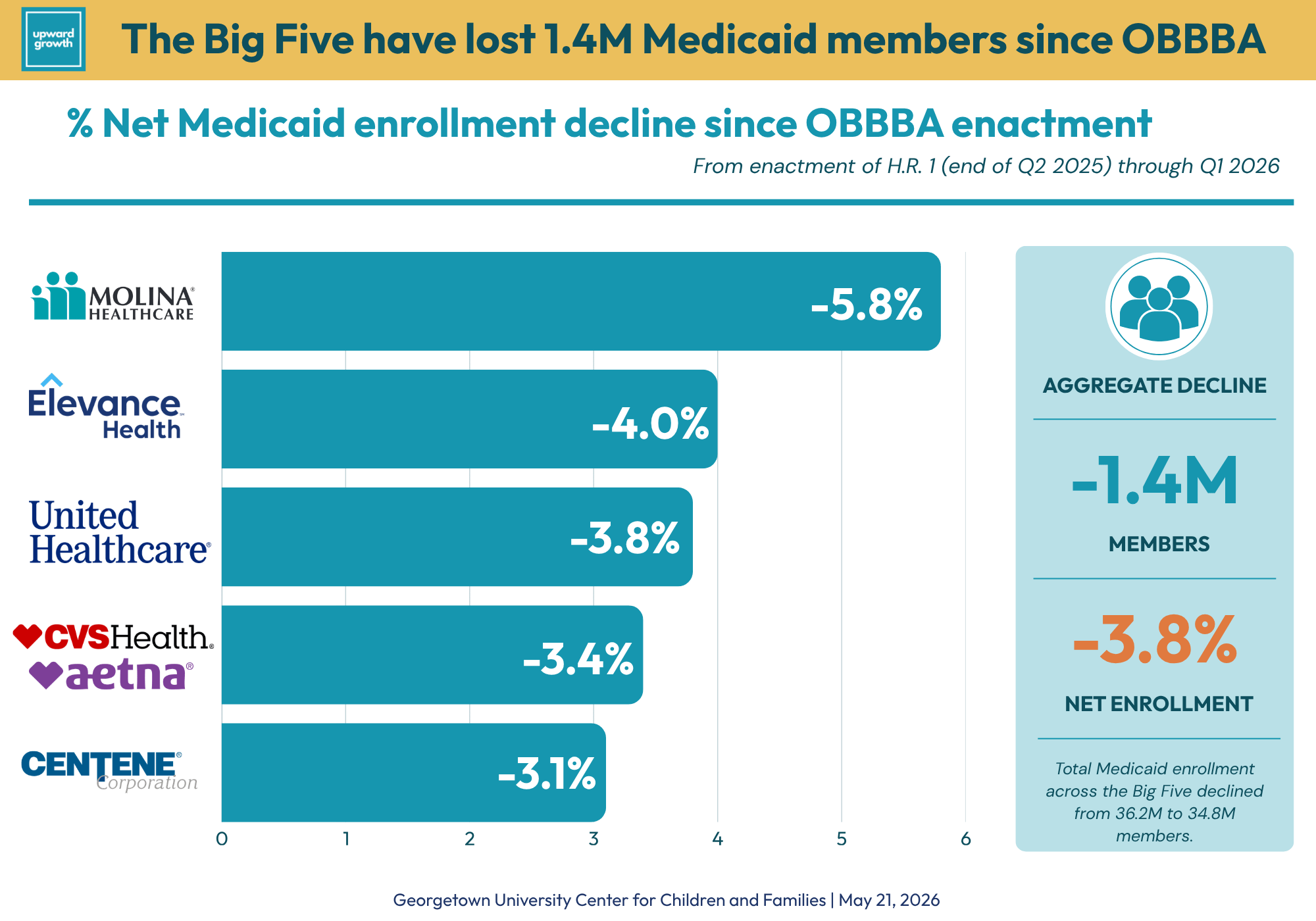
The first is that MCO parents have already marked down their Medicaid books based on their own earnings guidance. The Big Five publicly-traded Medicaid MCOs are down 1.4 million members, or 3.8 percent, since OBBBA passed, but the raw number understates what management is actually pricing in. Molina and Centene both took their 2026 Medicaid membership assumptions to negative 6 percent year-over-year in Q1, worse than the negative 2 percent range both were carrying at the start of the year. Molina reaffirmed guidance rather than raising it as UnitedHealth and Elevance did, citing an ongoing challenging cost environment. Neither is trying to grow through the disenrollment wave; both are defending margin through cost discipline. RAND projects semi-annual redetermination alone will produce administrative attrition of roughly 923,000 people, not because they are ineligible, but because of paperwork failures. Molina and Centene are already running their books to that reality, and every other MCO parent is doing the same math. The marks are showing up in the FY 2027 planning documents plans are handing their vendors this quarter.
The second is that CMS spent 2026 telling states they are on their own. In January, CMS negotiated $600 million (M) in Medicaid technology vendor discounts through a narrow pledge with 10 state Medicaid systems incumbents. On April 28, CMS rolled out a state Medicaid IT modernization roadmap at its All-State Webinar, outlining what state Medicaid Enterprise Systems must build, in what sequence, without a matching federal build to help states get there. On June 1, CMS released the interim final rule on work requirements, giving states three months of usable procurement runway before the August 31 outreach deadline, down from six. And last week, CMS proposed the rule that codifies OBBBA’s provider tax pullback, accelerating $246 billion (B) in additional federal savings, discontinuing the 75/75 Test loophole, and bringing taxed health insurers under CMS oversight for the first time. Read together, those four moves say that the cuts are landing on schedule, that federal implementation support is narrow and uneven, and that every state has to fund its own price adjustment.
Both patterns say the same thing: the repricing is priced in at the parent-company level and endorsed at the federal level. Below is what it looks like state by state.
How the Three Markets Are Absorbing It
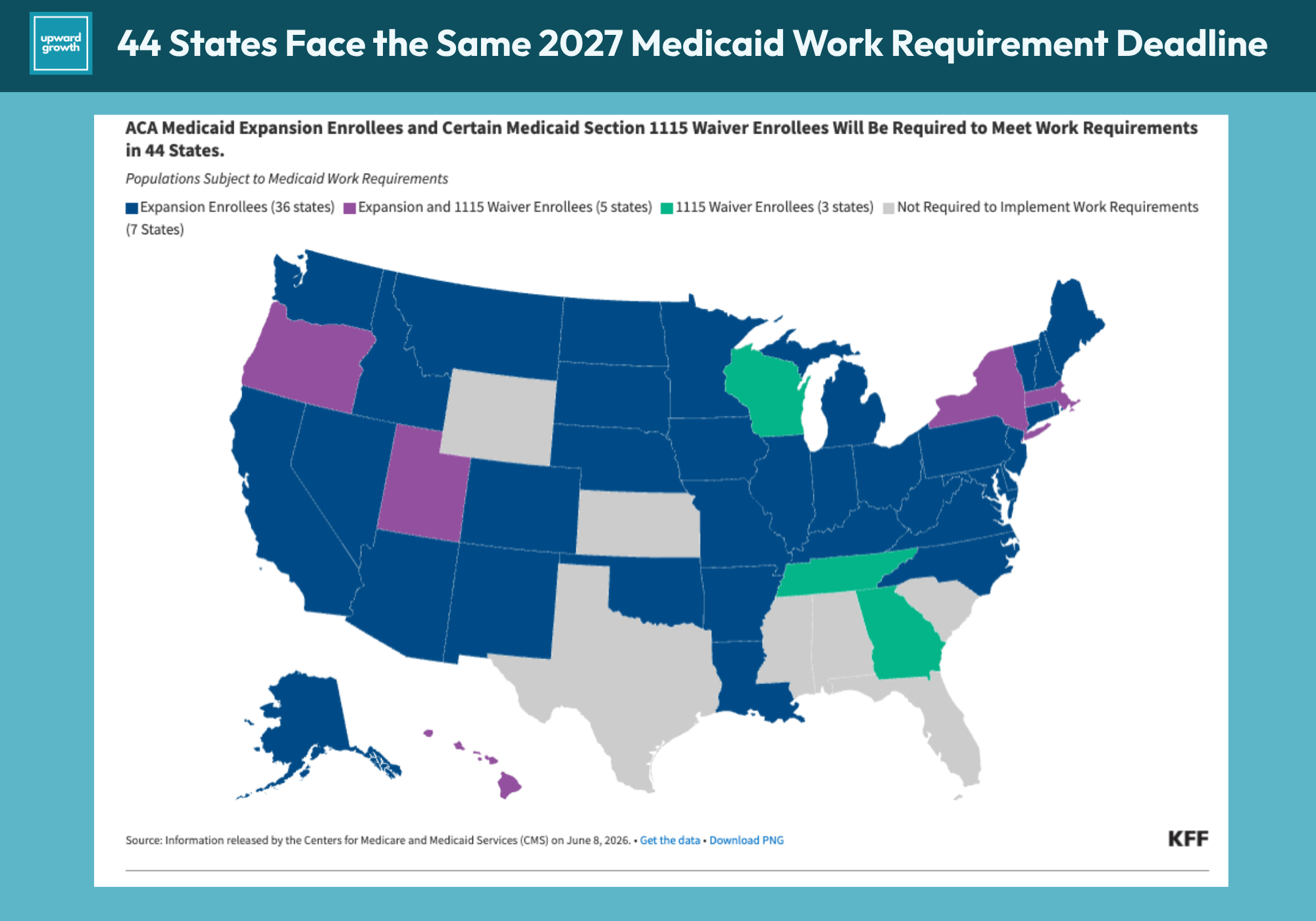
The 44 states required to implement OBBBA work requirements by January 1, 2027 are making three different strategic choices about how to absorb the repricing. The choices matter more than the timing. Four states are running live tests ahead of the deadline. Roughly thirty are building to the January 1, 2027 hard start on the standard federal timeline. And roughly ten are seeking the good-faith extension that pushes the compliance deadline to December 31, 2028, though CMS’s own June interim final rule assumes only two of those ten will be approved.
I have been calling these three postures Early Implementers, Deadline Builders, and Extension Seekers, and each is producing a different piece of the repricing for the members, providers, plans, and vendors inside those states.
Early Implementer states
This is where the coverage side of the repricing lands in real time. Members are cycling off, providers are absorbing revenue losses, and plans are running monthly marks against an actual disenrollment wave rather than a forecast. Nebraska hard-launched May 1 through a state plan amendment, betting on speed and becoming the template the rest of the country will read against. Montana followed July 1 through a state plan amendment and a Section 1115 waiver, seeking additional state-level exemptions and testing how much state-level customization the federal framework will actually allow. Iowa is scheduled for December 1 as the cautious version of an early move, giving itself runway to correct anything Nebraska surfaces before it goes live. And Arkansas launched a soft-launch version July 1 that notifies enrollees but disenrolls no one until January 2027, structured that way because Arkansas is the one state in the country that has lived through a full-fledged work requirement program before. Arkansas 2018 ran for less than a year and cost 17,000 people their coverage, overwhelmingly due to paperwork issues. That memory is why Arkansas 2026 looks structurally different from Nebraska 2026, even though both went early.
Nebraska is the loudest of the four because it went first and it went hardest. State estimates put 20,000 to 40,000 Nebraskans on track to lose Medicaid coverage, and Arkansas 2018 suggests that most of this will stem from administrative failures rather than actual ineligibility. Nebraska did not increase staffing to handle the new verification workload, which is why the same failure pattern is baked in. The provider-side impact is landing this quarter, not next year: Bluestem Health, a Federally Qualified Health Center (FQHC) serving 8,400 Medicaid patients, has estimated that 10 to 15 percent of its caseload could be disenrolled, resulting in a $400,000 to $600,000 annual hit to the clinic. Multiply that across the FQHC and rural hospital network in any Early Implementer state, and the provider-side repricing is a large amount of money leaving safety-net balance sheets right now.
Within the plans for these four states, work-requirements infrastructure is an operational build in Q3 2026. Outreach, member communication, eligibility integration, and retention vendors are in active procurement conversations that will close before the end of the calendar year. Chief Operating Officers are watching the ratio of members who lose coverage due to paperwork issues versus those who are actually ineligible, because that ratio determines whether each state’s enforcement model holds up politically and legally. For vendors calling into those conversations, the winning category is the one that can operate at the pace of a live workflow. The losing category is the one running enterprise sales motions into a workflow that will not wait.

Deadline Builder states
This is where the forecast side of the repricing is getting marked most aggressively. The disenrollment wave has not hit yet, but the CFO is pricing FY 2027 as if it has, and every rate negotiation, budget compression, and vendor renewal is happening around the expected mark rather than the actual one. Roughly thirty are choosing this path: they funded FY 2027 eligibility modernization, aligned their Medicaid director statements with the January 1, 2027 deadline, and posted procurement notices for community engagement infrastructure between April and July. The KFF survey of state implementation plans shows most of these states are adopting less restrictive verification policies than the law technically allows, which is a bet on avoiding the paperwork-driven disenrollment Nebraska is walking into now.
The first practical shock for enrollees in these states arrives August 31 with the beneficiary notification letters. The harder part comes on January 1, 2027, when compliance verification begins with no test period in place. Providers in these states are already sitting inside FY 2027 rate negotiations run against a member base projected to shrink meaningfully in the first half of 2027, and Pew’s analysis of the compounding state budget pressure is worth sitting with, because the fiscal squeeze on the state and the fiscal squeeze on the provider are the same squeeze approaching from different angles.
Inside the plans in these states, the crunch is tightest of the three. Building to a January 1, 2027 hard start with no test period means these plans cannot afford implementation error and cannot afford to overspend on categories that will not survive the next reprocurement scorecard. (Reprocurement is the state Medicaid managed care rebid cycle: MCOs have to compete every few years to keep or win the contract to serve a state’s Medicaid book, and losing it means losing the entire book of business in that state, not one contract line.) CFOs are running two parallel exercises: modeling the FY 2027 member-loss curve and cutting whatever vendor spend does not align with state reprocurement measures. Relationship equity is not saving incumbents in this bucket, because the CFO is not asking whether the vendor delivers value in the abstract. They are asking whether the vendor’s outcomes appear on the score their contract will be judged on. The reprocurement lens does not just decide net-new vendor spend anymore. It decides renewals, and that shift is where the sharpest repricing pressure inside the whole market is being applied.
Extension Seeker states
This is where the fiscal side of the repricing lands, independent of enrollment. Coverage looks stable today, but the provider tax phase-down is starting to eat state financing before the good-faith extension window closes, and the plan operating environment is being reshaped by state-level fiscal drag rather than by member churn. The extension technically pushes full compliance to December 31, 2028, but CMS is granting initial extensions only in six-month increments, and states must demonstrate continued good-faith effort each quarter to keep them. Extension Seeker is a rolling quarter-by-quarter negotiation with CMS rather than a two-year deferral anyone can bank on. The signals on the state side are consistent: no eligibility system rebuild funded in the FY 2027 budget; public statements from state Medicaid directors about needing more time; delayed or absent procurement notices for community engagement work; and open questions in state fiscal notes about whether the work can be funded within existing revenue.
Enrollees see coverage that looks stable, but Extension Seeker states are, on average, the ones with the least fiscal room to soften the impact when it does land. Whenever implementation finally arrives, the state will have less capacity to fund soft-landing infrastructure than a Deadline Builder state has today, resulting in a steeper coverage cliff on the back end. The provider picture is worse yet. OBBBA phases down the provider tax rate cap from 6 percent to 3.5 percent starting in late 2027, cutting roughly half of the base by 2031, and caps state-directed payments at lower rates. Both mechanisms are used by states to fund supplemental payments to providers, which constitute a meaningful share of rural hospital and safety-net revenue in expansion states. Extension Seeker states are the ones with the least cushion to backfill any of it.
The operating environment inside the plans in these states is doubled. MCOs are running two forecasts simultaneously: one that assumes the state’s extension request is approved, and one that assumes it is not. Given CMS’s own estimate that only two of ten will be approved, the second forecast is doing more of the work. Some plans are enforcing preemptively because they read the good-faith exception as narrow. Others are rebuilding FY 2028 assumptions and treating January 2027 as a target rather than a hard deadline. Neither posture is safe, and both are expensive.
For vendors, deals in these states have relationship value but not near-term revenue, and the repricing here looks like extended timelines and reduced deal sizes rather than lower unit prices. Paralysis inside these plans traces to the state Medicaid agency rather than to MCO leadership, and it is a version of the dynamic I wrote about earlier this year when I said vendors are not losing health plan deals to other vendors, they are losing them to forces inside the plans. What the February piece did not fully anticipate was that the largest source of that internal paralysis would trace all the way back through the plan to the state Medicaid agency itself.

Four Behavior Changes Inside Health Plans
If the two market patterns in the free section are the marks visible from outside the plan, then the four behavior changes in this section confirm that the repricing is real inside the plan. Vendor rationalization has climbed to CEO level, the reprocurement calendar has become the filter that runs first on every material decision, incumbents are getting cut in categories where they used to be automatic, and the entire Medicaid story on Q1 earnings was cost discipline. Four behavior changes worth naming, in that order.
Vendor decision-making continues to climb the org chart. I wrote about this last year in the CFO Filter piece, when the pattern was first showing up: vendor decisions that used to sit at the VP level were being pulled up to the plan president or CFO for review because the CFO wanted the analytical case against the state scorecard before the incumbent was waved through. One year later, that pattern has not just held, it has accelerated. You can hear it in Q1 2026 earnings commentary. Centene CEO Sarah London described her Medicaid margin improvement as coming from “targeted and increasingly scaled initiatives to modernize and standardize processes to better manage medical cost trend.” That is enterprise-level language for a set of decisions that used to sit two or three layers down inside a Medicaid segment. When the CEO is on the earnings call describing process standardization and vendor rationalization as the Medicaid strategy, the org chart has already moved, and it moved because the assets underneath were being marked down and the CFO needed direct line of sight to defend the marks.
That was one of four behavior changes in this section, kept above the paywall so you get a feel for what the paid tier looks like. The other three, plus the forward read-through 2028 and what the Big Five parents’ state-mix exposure is going to surface across the Q2 and Q3 earnings cycle, are also in the paid section below.
Paid subscribers get all of it, plus 50+ frameworks, scripts, and deep dives built for health tech teams selling to health plans. One qualified conversation from these frameworks is worth more than a decade of subscription.
🔓 Upgrade to a paid subscription to keep reading.
