

Upward Growth is a health plan market advisory firm. Our weekly newsletter covers payor market strategy, regulatory shifts, and go-to-market insights for health tech vendors, investors, provider organizations, and consultancies competing in the health plan market.
🤝 Work with us on payor market strategy: Contact us
🟦 Connect with the author, Ryan Peterson, on LinkedIn.
🎧 Listen to the Upward Growth Podcast: Apple | Spotify
📰 Newsletter sponsorships: Learn More
This week’s newsletter is presented in partnership with RISE

The risk adjustment conversations you can’t have in a webinar
Every fall, risk adjustment leaders from health plans and provider organizations gather at The RISE Risk Adjustment Forum to compare approaches, pressure-test strategies, and hear how their peers are navigating the same regulatory and operational challenges. 71% of attendees are director level or above, with perspectives spanning coding, compliance, legal, actuarial, provider engagement, and payment integrity. New this year in Orlando: dedicated D-SNP sessions, an ACA risk adjustment workshop, and a live RADV audit simulation.
Interested in sponsoring Upward Growth? Contact Us
A few updates from me before we get into it:
I finished reading The Ghost Map this weekend, which is Steven Johnson’s book about John Snow tracing the source of the 1854 London cholera outbreak. It is a legitimate page-turner about amateur science and persistence, and it is also a reminder that mapping something new, whether a disease, a market, or an operating environment, tends to come from the people willing to knock on doors and count the data themselves. If you are looking for a book that reads fast and stays with you, I highly recommend it.
A subscriber survey is coming to your inbox in the next few weeks, and the reason for it is simple. I want your feedback so I can make sure this newsletter keeps earning its place in your inbox every Tuesday. When it lands, please take four minutes to help shape what shows up next.
And if this newsletter provides value, consider sharing it with a colleague or someone who might enjoy it. That kind of word of mouth is how it keeps growing.
Indiana just released the first major state Medicaid Managed Care Organization (MCO) reprocurement written for the operational environment created by the One Big Beautiful Bill Act (OBBBA). That's why this state Medicaid procurement matters to any health plan executive, health tech leader, or investor whose book touches a national payor.
The Indiana Family and Social Services Administration (FSSA) called the release the “Mother of All Procurements.” Four Medicaid programs, roughly $68 billion in contract value, about 1.4 million Hoosier lives, and one bundled award to each winning MCO instead of separate awards by program. It is the state’s largest health care procurement ever, and it is the first bid in the post-OBBBA operating environment. When the awards land in July 2027 and contracts start on January 1, 2029, the winning MCOs will be running the first post-OBBBA state Medicaid book at real scale. The losing bids will become case studies for every state Medicaid agency with a reprocurement coming behind Indiana’s.
As I wrote at the one-year mark on OBBBA, most of what has been written about OBBBA since it was signed has been forecast, not observation. Indiana is the first place the market gets to see what OBBBA looks like when a state writes it into a scope of work that bidders have to answer against.
The MCOs bidding into this reprocurement (Elevance, Centene, UnitedHealthcare, Humana, and CareSource) run Medicare Advantage, ACA, employer benefits, and other state Medicaid businesses at the same time. What they build for one line of business shows up in how they operate the others, and where they choose to concentrate operating investment to answer Indiana will shape how they show up in MA, ACA, and commercial for the next several years. And what Indiana rewards in its scoring will inform the Texas, Florida, Louisiana, Kentucky, Georgia, and Ohio Medicaid reprocurements running behind it through 2029.
What follows is the argument that the state Medicaid buyer is becoming more demanding at the same moment the federal buyer is pulling back on plan operations, and what that trade means for a health plan CEO pricing their operating model for the next 18 months.
Bidders Have to Show Readiness, Not Promise It
The state Medicaid procurements released between OBBBA's signing in July 2025 and Indiana's release in late August 2026 were written before the OBBBA operational requirements (work requirements, tighter eligibility redetermination rules, reduced retroactive coverage) had been translated into specific state-level policy. Bidders responded by promising to build for the OBBBA environment once the specifics landed. But Indiana changed that and published the specifics before releasing the RFP.
FSSA published its Healthy Indiana Plan (HIP) work requirement rules roughly seven weeks before releasing the Request for Proposal (RFP), forcing bidders to answer against specific rules rather than plausible expectations. The pattern extends beyond work requirements. FSSA also published its proposed HIP 3.0 1115 waiver application in early August, laying out a program redesign around copayments, healthy behavior incentives, and enrollment controls that winning bidders will be operating under. A bidder who started building when OBBBA was signed can show the state evaluator concrete infrastructure and member-level outcomes, while a bidder who waited for regulatory certainty is answering the same questions with a promise.
For example, when Texas or Ohio drafts its own RFP language over the next 12 months, the drafters will have Indiana's evaluation approach in front of them as a framework already tested against legislators, auditors, and courts. The evaluation math changes when a bidder can walk the state evaluator through actual member communication workflows, actual redetermination pilots, actual value-based contracts already in production. That is a different evaluation than most historical Medicaid procurements, which graded narrative and capability rather than artifacts. And because Indiana is bundling all four of its Medicaid programs into a single award instead of separate awards by program, the evaluator gets to score integrated operational capacity across the entire book at once.

CMS Is Shrinking Federal Requirements While Indiana Is Expanding State Requirements
Federal regulatory posture on plan operations has shifted this year. The CY 2027 Final Rule, published April 2, rescinded the mid-year supplemental benefits notification requirement and several other member-facing operational requirements in Medicare Advantage. Legal analyses tracking the rule have described the CY 2027 package as advancing a broader deregulatory agenda on member-facing plan operations. That posture is not confined to MA. CMS rescinded the health-related social needs framework in early 2025 and shifted to case-by-case review of social determinants of health 1115 requests, softening the federal ask on operational categories state Medicaid agencies had been asked to build around. The market reflex has been to price this posture as relief on the plan's operating model.
That reflex is wrong. Indiana's RFP asks bidders to demonstrate value-based purchasing sophistication with defined progression across the contract term, targeted enhanced benefits design tied to specific member populations, and incentive infrastructure with measurable engagement targets. Each of those requires operational depth well beyond what the federal floor now demands. Rhode Island's most recent MCO RFP pushed in the same direction, folding independent behavioral health parity review, executive compensation transparency, and state approval of subcontractor relationships into its contract language. State Medicaid agencies have been sharpening what they require of MCOs across the last two RFP cycles, and Indiana is arriving as federal requirements pull back.
States are becoming the more demanding buyer on plan operations, which means MCO operating models are getting more expensive to run even as federal requirements contract.
So why is this happening? The answer explains why the trend does not reverse when the White House changes. State Medicaid agencies own the fiscal risk on their programs in a way CMS does not. When a plan misses on quality or member outcomes deteriorate or a state’s Medicaid spending goes sideways, it is the state Medicaid director who has to sit in front of the legislature and defend it, not the federal government. That accountability structure has not changed with the political weather in Washington, and likely won’t. State Medicaid agencies have learned across the last decade that the way to manage that fiscal and political risk is to write increasingly specific operational requirements into their MCO contracts, so they have levers to pull when something goes wrong. The current CMS pullback on plan operations does not change that math. It makes state agencies more assertive, not less, because when the federal ask on plan operations shrinks, the state has to compensate to hold plans accountable.
For the health plan CEO trying to take all of this in, the operating cost curve for the next contract cycle sits above the previous one, not below it. The MCOs bidding into Indiana are running two sets of operating infrastructure now, one calibrated to satisfy CMS and one calibrated to satisfy the state Medicaid buyer. The federal set on plan operations is getting smaller while the state set is getting larger and faster, and the second set is compounding because each additional state that adds an operational requirement adds it on top of what other states have already asked for. Where a plan invests its next dollar of operational capacity, and how it prices that capacity across its book, gets shaped by that trade.
The broader operating pressure the market absorbed across the first half of 2026 hit MA, Medicaid, ACA, and Group at the same time, and this is one reason it did. A plan with a large Medicaid book is funding capabilities to serve state buyers that a Medicare Advantage-only plan does not have to fund, and the finance team inside that plan is making different calls about where to spend. Those calls affect what the plan is willing to pay for, negotiate on, or roll out on the MA side, on the ACA side, and inside its commercial book. If a vendor deal that used to close in Q2 has slipped to Q4, the forces inside the plan driving that reallocation are one reason, and Indiana is a leading indicator of how much more of this is coming.

Two Moves That Changed What Indiana’s Bidders Are Actually Bidding Into
In November 2025, FSSA terminated MDwise’s Medicaid managed care contract effective January 1, 2026, roughly eleven months before it was scheduled to run out. The state said MDwise was the most expensive and the lowest-quality plan in Indiana’s HIP and Hoosier Healthwise (HHW) programs, and that federal rules only required Indiana to keep three plans in market. MDwise fought the termination in Marion County court and lost. Roughly 300,000 members had to select a new plan mid-cycle.
What the MDwise fight demonstrated matters more than its specifics. Medicaid managed care incumbents have historically won renewal at the next reprocurement, and MCO strategic planning has been built on that expectation. A plan that ran its program acceptably and stayed in good standing with the state kept the book through the next cycle. Indiana just showed that a state agency will pull the contract mid-term when the performance case is bad enough, and will absorb the political and legal cost of doing it. That is a different bid dynamic than what has been true for a generation, and it changes how incumbents allocate bid preparation resources. It also changes how incumbents at other states read their own upcoming reprocurement, because if incumbency can be broken in Indiana, it can be broken elsewhere.
Indiana’s PathWays for Aging program, the state’s managed long-term services and supports (LTSS) program, has been in operational trouble almost since its mid-2024 launch. Two of the three participating MCOs were placed on corrective action plans shortly after go-live, the three insurers owed more than $100 million in late or improperly denied Medicaid payments to nursing homes. Earlier this year Indiana passed a law that will move long-stay nursing home residents out of PathWays managed care and back to fee-for-service before the new RFP contracts even start.
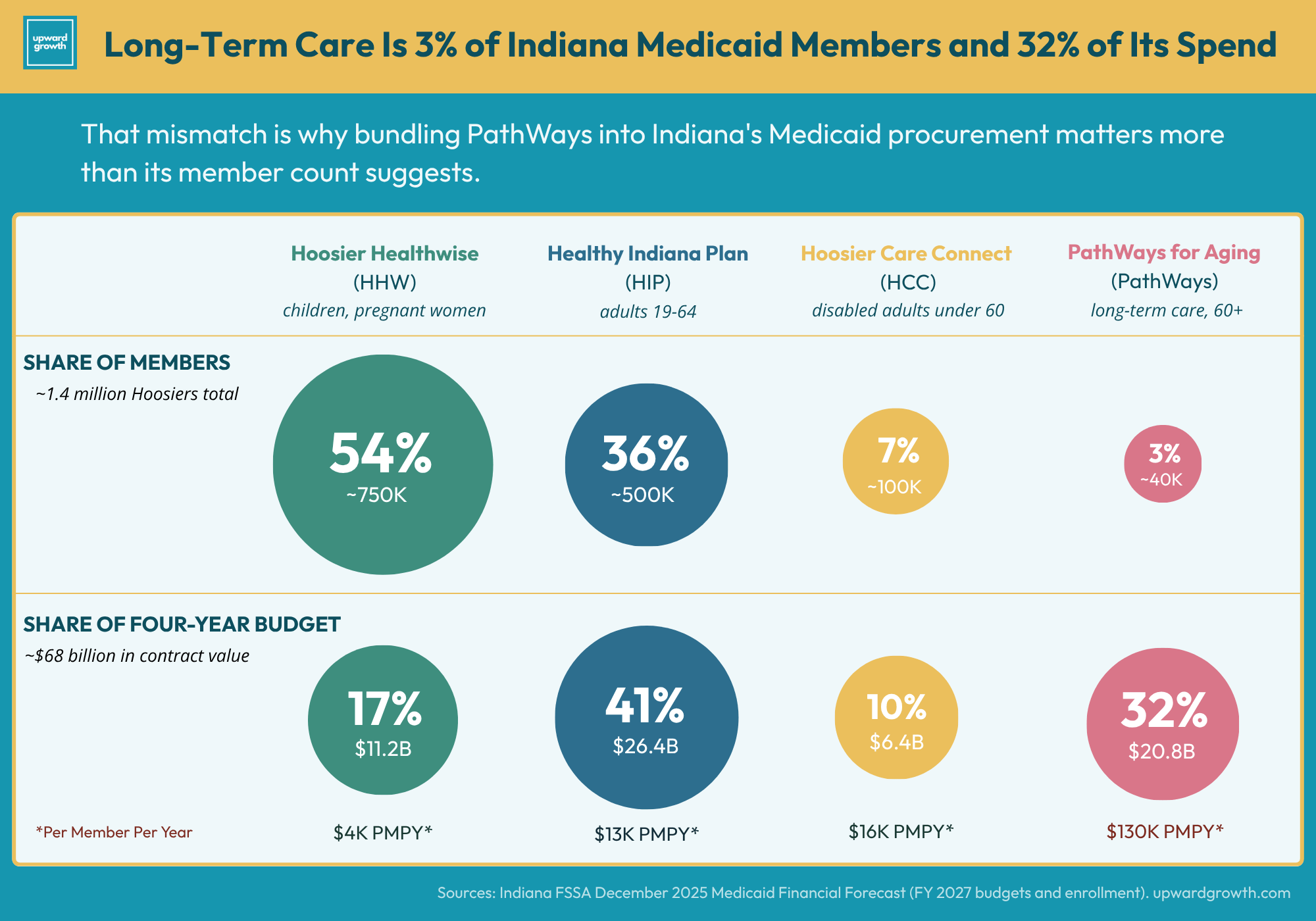
Peer state agencies are reading that move carefully. Indiana made a full commitment to managed LTC three years ago and has publicly walked part of it back because the operating model was not working, and it has reset the scope of the next contract accordingly. Other states with LTSS transition trouble in recent years, and there have been several, are watching how Indiana structures the new PathWays scope in this RFP. Bundling PathWays into the same reprocurement as HIP, HHW, and Hoosier Care Connect, rather than running a separate LTSS procurement, is Indiana’s way of saying LTSS accountability will now sit inside the same performance framework as the rest of the Medicaid book. That framework is going to become the reference model for peer state agencies dealing with their own LTSS problems. The same underlying logic is what drives plans choosing which lines of business to keep investing in.
Between MDwise and PathWays, Indiana has shown the incumbency assumption cannot be leaned on the way it has been, and that a state buyer will restructure a program mid-cycle when the operating model breaks. Bidders are answering this RFP on a different foundation than the industry has been standing on.
Indiana Is Going Stricter Than the Federal Floor on Work Requirements
Winning bidders inherit fully implemented work requirements at contract go-live in January 2029. Interim contract holders operate under them starting January 2027. That means the operational infrastructure to serve the environment, from eligibility system integration through appeals capacity, is being tested in production during the window bidders are writing their responses. Indiana chose the sequencing so the interim contract holders’ operational learning would flow into the winning bidders’ plans by the time contracts start.
Indiana requires quarterly compliance verification and a three-month lookback for eligibility determination, both stricter than the federal minimum. It is one of a small group of states that go beyond what OBBBA established as the baseline for how work requirement compliance gets verified. The operational muscle a bidder demonstrates to serve Indiana has to work at that stricter setting, and what Indiana rewards in its scoring becomes a reference for peer states going stricter than the federal floor.
The stakes at that member scale are real. A Health Management Academy survey covered in Indiana Capital Chronicle found that 47% of Indiana Medicaid enrollees did not know work requirements were coming, 42% said they would ration medications if they lost coverage, and 32% said they would use emergency rooms more. Interim contract holders will operate in that environment starting January 2027, and whatever they learn about serving those members will flow into the winning bidders’ plans by the time contracts start.
For a plan whose own state reprocurement is coming inside the next 24 months, the build decision on work requirement operational infrastructure is Q4 2026 or Q1 2027, not 2028. Waiting until your own state’s RFP drops to start building the capability puts you behind bidders who already built it to bid for Indiana, and behind interim contract holders who accumulated the operational learning at real member scale through 2027 and 2028. That timing gap shows up in bid scoring.
Why Peer State Agencies Are Already Reading Indiana’s RFP as a Template
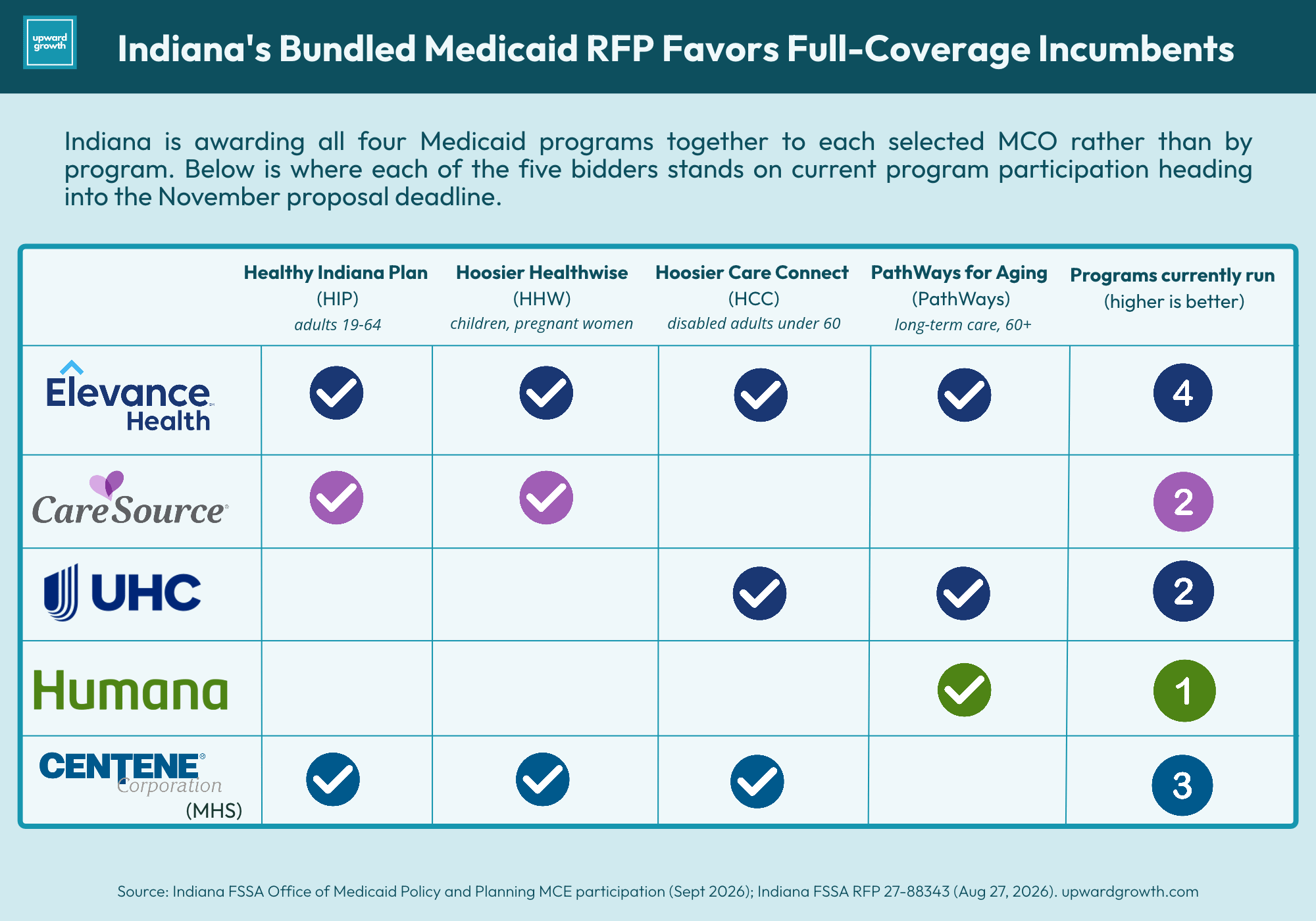
The all-four-programs-together award structure changes the math for every incumbent. Elevance runs all four programs today and has the deepest operational track record to defend, though its PathWays performance carries real vulnerability given the corrective action history. Centene, UnitedHealthcare, Humana, and CareSource each run partial books, which means each must prove capacity for programs it does not currently operate, either by building it or by lining up a subcontractor the state will accept. Humana faces the sharpest version of the problem, since it operates only in PathWays and is absorbing pressure separately across its Medicare Advantage business. Bidders who already run all four start the RFP with an advantage that scales with how thin the partial-book bidders' answers look on paper.
The reprocurement wave running from 2027 through 2029 includes Texas, Florida, Louisiana, Kentucky, Georgia, Ohio, and others. The size of the wave depends on which contracts get extended again, but the state agencies inside it are reading Indiana’s approach.
Two forces are pushing the Indiana template into peer-state RFPs faster than a normal RFP cycle would allow.
The first is the consultancy layer. State Medicaid agencies do not draft these RFPs from scratch; they hire external counsel and procurement consultants who work across multiple state procurements at once and bring language patterns with them. The “mother-of-all-procurements” framing gave the RFP a public profile that pulls the language into peer state drafting faster than a routine reprocurement would. As Chris Mitchem framed it in a recent Indiana Capital Chronicle op-ed, Indiana is applying category management to Medicaid, and that framing gives peer state agencies cover for adopting the same approach.
The second force is political alignment. Indiana Governor Braun signed nine “Make Indiana Healthy Again” executive orders in April 2025 with Health and Human Services Secretary Kennedy and Centers for Medicare and Medicaid Services Administrator Oz present, and the RFP references the state’s health initiative in framing its priorities. Republican-led state Medicaid agencies with procurements coming inside the next 24 months are aligning around similar language on member accountability, benefit design, and value-based purchasing, and the scoring pattern Indiana establishes moves fastest into Texas, Florida, Georgia, Ohio, Louisiana, and Kentucky. Democratic-led state agencies will draw from different parts of the template but will draw from it too, because state-level operational specificity on plan operations is politically neutral once the MCO has built the capability.
What plan CFOs are absorbing across this picture is that states are becoming the more demanding buyer on plan operations, which means MCO operating models are getting more expensive to run even as federal requirements contract. Plans that read that curve early will build the operating infrastructure at better margin than the plans that read it late, and they will bid into the reprocurement wave from a stronger position when their own state’s RFP drops.
A Final Thought
Indiana just gave the market its clearest look yet at what the state Medicaid buyer becomes when the federal ask on plan operations pulls back, and the state ask expands to fill the gap. Peer state agencies are reading it, and national MCOs are building against it. If your operating model, your positioning, or your investment thesis assumed federal requirements would keep carrying the operational specificity, the window to update is now, not after the July 2027 awards land. Whoever reads the curve early will be operating from a materially better position 18 months from now than whoever waits for the awards to make it official.
If any of this shifts how you are thinking about your positioning, your messaging, or your go-to-market strategy, Upward Growth is a health plan market advisory firm that works with health tech vendors, investors, provider organizations, and management consultancies to build strategy around how health plans buy, operate, and make decisions. Contact us here.
Thanks for reading.
Here’s to upward growth,
Ryan Peterson
The frameworks in the weekly Upward Growth newsletter help health plans, health tech vendors, investors, provider organizations, and consultancies understand the health plan market as it continues to shift.
If your colleagues are in those conversations, they should be reading this too.
💰 Invest In Your Team with a Paid Subscription.
💡 Pro tip: Many subscribers expense Upward Growth through their company’s professional development, training, or learning budget. Here’s a one-minute email template to get your manager to approve expensing your subscription.