

Upward Growth is a health plan market advisory firm. Our weekly newsletter covers payor market strategy, regulatory shifts, and go-to-market insights for health tech vendors, investors, provider organizations, and consultancies competing in the health plan market.
🤝 Work with us on payor market strategy: Contact me
🟦 Connect with the author, Ryan Peterson, on LinkedIn.
🎧 Listen to the Upward Growth Podcast: Apple | Spotify
📰 Newsletter sponsorships: Learn More
🎁 Unlocked: This post includes the full deep dive
Most Tuesday articles start with a free section and then continue behind the paywall. Today’s post is left completely open so you can read the entire edition.
Paid subscribers get the full deep dive every week, plus playbooks, case breakdowns, and the ability to reply with their own questions.
A federal judge just threw twenty Medicare Advantage (MA) Star Ratings measures out of one health plan’s rating calculation. The order itself is narrow, but the reasoning behind it is not.
On May 27, 2026, Judge Lisa Godbey Wood of the Southern District of Georgia set aside Clover Health’s 2026 Star Rating and ordered the Centers for Medicare and Medicaid Services (CMS) to recalculate it. The court found that CMS lacked statutory authority to use ten of the measures at all, and that CMS had skipped the rulemaking process required to change the specifications on the other ten. The financial stakes for Clover alone, by Clover’s own accounting, are roughly 120 million dollars in quality bonus and related payments for a single plan year.
You have probably seen headlines like this before. SCAN, Elevance, UnitedHealthcare, and Humana have all been in court over their Star Ratings in the past two years. Some won, and some lost. CMS recalibrated, and most readers who don't live inside Stars moved on after a news cycle. Every prior case fought about the math. Clover fought about the foundation. The court agreed on the foundation.
That distinction is why Clover matters even if you don’t sell into Stars, don’t model Stars, and don’t have a regulatory affairs lead who reads Technical Notes for sport.
LinkedIn has been full of strong coverage since the ruling dropped. Jenn Kerfoot at DUOS has been pulling on the legal threads with two pieces worth reading, one on the structural difference between Clover and prior cases and a second on the potential circuit split forming between Judge Wood in Georgia and Judge Reed O’Connor in Texas after Humana filed a notice of supplemental authority on June 2. Melissa Smith of Newton Smith Group, Ana Handshuh of CAT5 Strategies, and Kevin Lamb of WilmerHale recently ran a webinar through RISE that walked through both the holdings and the operational response health plans are now mobilizing. And Jessica Assefa, Mick Twomey, and Phillip Collins of Press Ganey released a three-part video series modeling the financial impact across hundreds of contracts. All of them are worth your time, and all of them are doing the heavy lifting on the legal, operational, and analytical sides.
As for my take, I'll translate what happened, why Clover is a fundamentally different kind of case from every prior Star Ratings lawsuit, and what the ruling means for the vendor executive, investor, consultant, or plan leader who has to react to it. I am not a lawyer or a Stars calculation expert. I take complex regulatory events and turn them into practical reads for the people who have to operate through them.
You will leave with three things. A clean way to explain why Clover is structurally different from the prior cases without sounding like you read a hundred pages of court filings. A frame for how this ruling lands in the middle of the broader pressure environment that Medicare Advantage has been absorbing over the past eighteen months. And a three-zone framework for figuring out exactly where your company, your portfolio, or your client sits.
Why Clover Is Different From the Court Cases That Came Before It
To understand why this ruling lands differently, start with the cases that came before it.
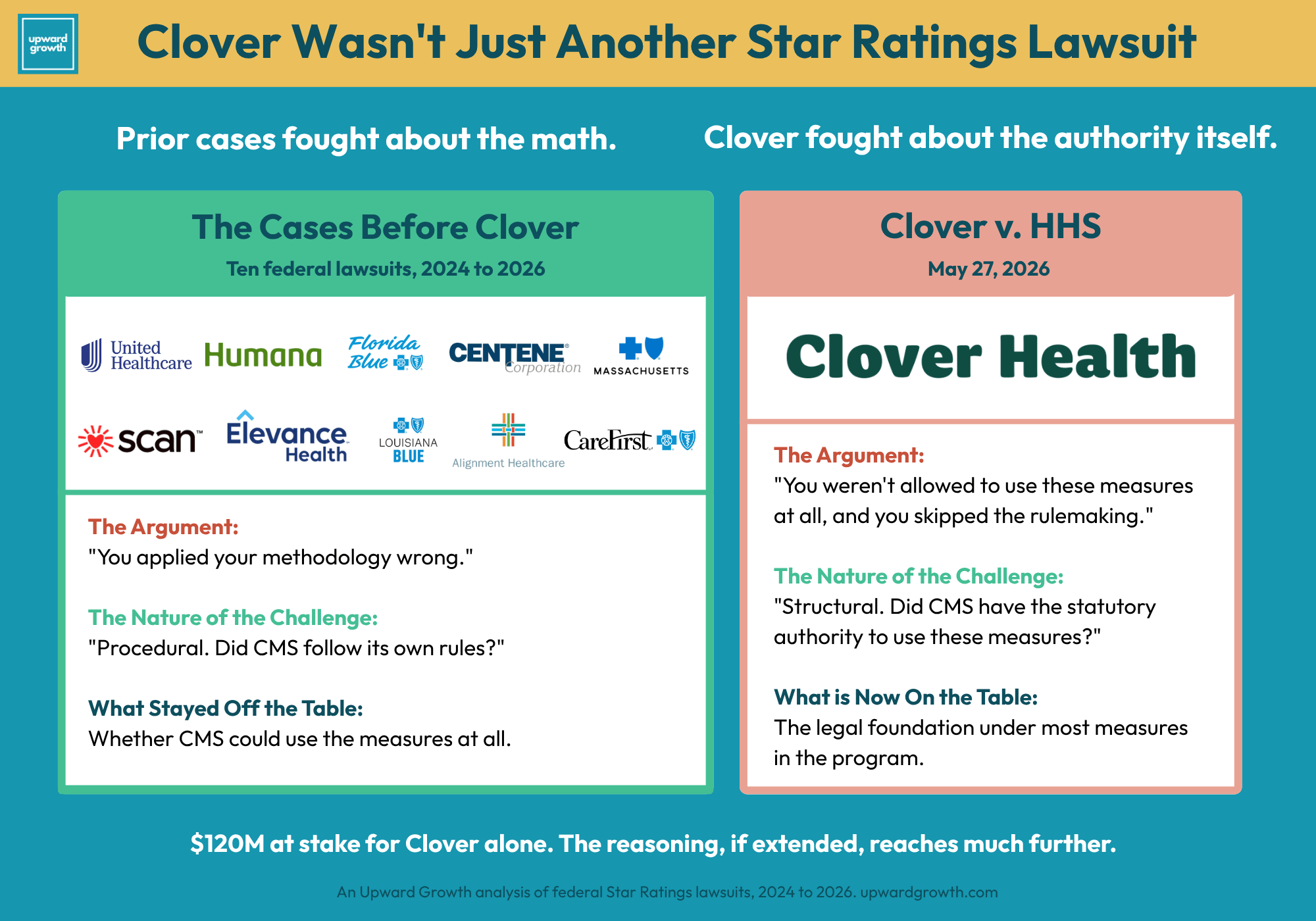
SCAN Health Plan sued CMS in 2024 over how the agency applied cut points and guardrails to its 2024 rating. Elevance Health filed a similar challenge in the District of Columbia, then again in Texas. UnitedHealthcare sued in the Eastern District of Texas in late 2024 over a single secret-shopper phone call that the plan said had been counted unfairly. Centene sued in the Eastern District of Missouri the same fall over a similar secret-shopper dispute and ended up with a 200 million dollar recalculation in its favor. Alignment Healthcare filed in the District of Columbia in January 2025, challenging the Tukey outlier rule and the role of CMS contractors, and won a partial recalculation in June. Humana lost a procedural fight in the Northern District of Texas in October 2025 and is now on appeal at the Fifth Circuit. Blue Cross Blue Shield plans from Massachusetts, Florida, and Louisiana have all been in court at various points. CareFirst is the latest, alleging roughly 32 million dollars in lost bonus payments tied to its 2026 calculation.
If you scanned these as a category, you saw “plan sues CMS over Star Ratings” headlines and moved on. That was a reasonable read at the time because, as a category, the earlier cases all asked variations of the same question:
Did CMS do the math right? Did the agency apply its own cut-point methodology in the right order? Did the Tukey outlier deletion run on time and apply to the correct contracts? Did the guardrail caps work the way the rules said they would? Did the secret-shopper call get counted fairly under the protocols CMS itself wrote?
When the plans won (and they did win some), the remedy was always the same shape. Recalculate this one plan’s rating for this one year using the right math. But the measures and the methodology stayed in place. The program's architecture kept running. CMS adjusted, the affected plans got their payments squared up, and the rest of the industry watched the news cycle pass.
Clover did not ask whether CMS did the math right. Clover asked whether CMS was ever allowed to use the inputs in the first place.
Clover’s lawsuit raised two arguments the court ultimately agreed with, and the specifics explain why the legal theory has so much room to run. The first was that 10 of the measures in its 2026 rating were based on data that CMS had no statutory authority to use for Star Ratings. The Medicare Act states that the ratings shall be determined based on data collected under a specific quality improvement provision, which includes exactly three sources: the Healthcare Effectiveness Data and Information Set (HEDIS), the Health Outcomes Survey (HOS), and the Consumer Assessment of Healthcare Providers and Systems (CAHPS). Clover argued, and Judge Wood agreed, that ten of its measures were pulled from data outside that pipeline: Prescription Drug Event (PDE) data that CMS gathers for Part D payment reconciliation, call center monitoring data that CMS collects itself, and Independent Review Entity (IRE) contractor data on appeals.
Clover’s second argument was that CMS changes the specifications on a separate set of ten measures every year through Technical Notes and other sub-regulatory guidance, but the Medicare Act requires formal notice-and-comment rulemaking whenever CMS establishes or changes a substantive legal standard governing payment for services. Star Ratings drive Quality Bonus Payments (QBPs) and rebate percentages. QBPs and rebate percentages are payments for services. The measure specifications themselves, the court found, are therefore substantive legal standards that require the kind of rulemaking CMS never did. That second holding is the one with the longer reach. The first could, in theory, be cured if Congress amended the statute to authorize the data sources CMS has been using. The second cannot be cured that way. It can only be cured by CMS actually running its measure specifications through the same kind of public rulemaking it uses for an annual Final Rule. The notice-and-comment requirement, if applied broadly, touches almost every measure in the Stars program, because almost every measure has had its specifications adjusted through Technical Notes at some point.
Clover is a structural challenge, whereas the prior cases were procedural. The prior plaintiffs asked whether CMS followed its own rules. Clover asked whether CMS had the statutory authority to write those rules in the first place. The judge ordered a narrow recalculation for one plan's 2026 rating, but the reasoning is portable. Any plan whose rating turns on PDE data, IRE data, monitoring data, or specifications that moved through Technical Notes rather than rulemaking can now make the same argument Clover made and point at the same opinion.
This is the throughline Jenn Kerfoot has been pulling on across her writing, and it traces back to a much bigger shift. In 2024, the Supreme Court overturned the Chevron doctrine in Loper Bright Enterprises v. Raimondo, ending forty years of judicial deference to federal agencies’ own statutory interpretations. For the four decades before that, when CMS said “this is what the Medicare Act lets us do,” courts mostly took the agency’s word for it under what was called Chevron deference. Loper Bright told judges to read the statute themselves and apply their own independent judgment. Health Affairs has a strong primer on what that shift means for healthcare regulation if you want a deeper read.
Judge Wood read the statute herself, and she came out somewhere CMS did not. Judge Reed O’Connor in the Northern District of Texas read the same provision in the Humana case last October and came out closer to CMS, which is exactly why Humana stapled the Clover ruling to its Fifth Circuit appeal on June 2. Two federal judges, same words, opposite answers, one potential circuit split forming in real time. The end of Chevron was supposed to produce exactly this. It is producing exactly this.
A few caveats worth holding onto. One district court ruling is not binding precedent outside the Southern District of Georgia. CMS has sixty days from the May 27 ruling to file a notice of appeal and will almost certainly do so. The Eleventh Circuit will rule sometime in the next twelve to twenty-four months. The Fifth Circuit will rule on Humana on its own timeline. CMS may pursue accelerated rulemaking to address the procedural finding before any appeal resolves. Congress could step in with a statutory fix, though that gets harder in an election year. The ruling could be narrowed on appeal, affirmed in full, or split with parts upheld and parts reversed.
🎙️Episode 1 of the Upward Growth Podcast is the audio companion to this article.
It picks up the Clover v. HHS thread and pushes it further, including why this ruling reaches health tech vendors and investors whose products have nothing to do with Stars on the surface. Apple | Spotify | Web
Eighteen Months of MA Headwinds, and Clover Is Just the Latest
Every plan you sell to, invest in, or advise has been absorbing pressure from multiple directions for the past eighteen months. Clover is the latest pulse in a pattern that has continued to create headwinds for the MA market.
Risk Adjustment Data Validation (RADV) is the most obvious shift. The Department of Justice (DOJ) recovered 6.8 billion dollars through False Claims Act cases in fiscal year 2025, with risk adjustment as a top enforcement priority. The Office of Inspector General (OIG) released its first MA-specific compliance guidance since 1999 in February 2026, the first time in twenty-six years the office has issued targeted guidance for the program. RADV audit activity has been accelerating. Risk adjustment now sits at the executive table inside every plan.
Prior authorization transparency rules went into effect at the same time. As of March 31, 2026, under the CMS Interoperability and Prior Authorization Final Rule (CMS-0057-F), every plan in the country had to publicly post its prior auth metrics, including denial rates, turnaround times, and appeals outcomes. I wrote a full breakdown of what those numbers reveal across the major payors, but the short version is that the variation is significant and the pressure is no longer about whether plans hit the deadline. It is about what their numbers say to regulators, providers, and competitors, all of whom can now see them. Compliance and operations teams that thought they had finished the prior auth work in March are now being called on the numbers in June.
Market geography has been shifting at the same time. National plans have exited counties, exited entire states, and rationalized product portfolios over the last two enrollment cycles. KFF analysis on the 2026 plan year found supplemental benefits contracting across the board: over-the-counter (OTC) allowances dropped from 73 percent to 66 percent of plans, meals from 65 percent to 57 percent, and transportation from 30 percent to 24 percent. Roughly 1.8 million members were forced to choose new plans heading into 2026. The health plan you knew two years ago is not the plan you are talking to today, and the membership and benefit picture they are managing is different, too.
Margin discipline has become the public posture across every publicly traded plan. UnitedHealth Group, Elevance, Molina, Centene, and CVS all reported Q1 2026 earnings within a few weeks of each other, and all five chose to defend margin over chasing enrollment. Humana named the three percent sustainable margin target by 2028 as Priority One. Cigna installed an actuary as its new chief executive. Every plan’s actuarial team is running the bid build with more discipline than they had eighteen months ago, and the budget conversation vendors and partners are walking into is harder than it was.
Then came the Elevance $ 935 million risk adjustment accrual in early May, triggered by a CMS notice from late February regarding historical risk adjustment data submission practices. Every plan in the country is now running its own audit pass on its historical submissions before regulators come asking. The whole industry reorganized around it. Compliance and legal teams got a meaningful authority bump in the procurement chain that is unlikely to be reversed soon.
The CY 2027 Final Rule landed in April with the largest Stars overhaul in a decade. CMS removed 11 measures, added 1 (Depression Screening and Follow-Up), and dismantled 4 sets of health equity requirements in a single document. The Rate Announcement that came out alongside it was friendlier than the preliminary numbers suggested in January, but the risk model freeze that produced the friendlier number is temporary. CMS effectively told plans they have one more cycle of relief, and then the math gets harder again.
None of this is happening just to Medicare Advantage. The One Big Beautiful Bill Act (OBBBA) cut nearly a trillion dollars from Medicaid, and most national plans run Medicaid and Affordable Care Act (ACA) lines of business alongside MA. When plans cut capital in response to Medicaid losses, the MA-side budget shrinks too. Pressure on one line of business at a multi-line plan is pressure on the others. The senior team at the plan you are talking to is splitting its attention across all of it, and the share left over for any new vendor conversation has gotten smaller.
The Clover decision does not arrive in a stable environment; rather, it arrives atop an accumulation. The attention, the budget, and the procurement bandwidth at the plan you are trying to sell to, invest in, or advise have already been consumed by RADV, by prior auth transparency, by market contraction, by margin discipline, by the Elevance accrual, by Final Rule changes, by Medicaid cuts. Clover is the next thing, and it is the first in the pattern to ask whether the underlying machinery of one of the program’s biggest revenue levers was ever legally built in the first place.
When a system this layered absorbs this much pressure this fast, the buyer changes. Not just the buyer’s mood. The buyer’s actual identity inside the plan.

More Functions Are Now Weighing in on Stars Decisions
For most of the last decade, if you were selling something that touched Stars, your champion at a health plan was most likely a Stars or Quality Improvement executive. That person owned the relationship, ran the internal business case, walked the contract through procurement, and signed off on implementation. The decision authority sat with them, and the supporting cast (legal, finance, compliance, actuarial) signed off on what the QI/Stars team brought forward.
Inside the plans now running their full response to Clover, this is no longer a Stars workplan topic. Legal, finance, actuarial, compliance, enterprise risk management, board governance, investor relations, and operations are all weighing in, and that broader involvement is likely to persist as long as Clover remains unresolved. Your existing champion at a plan is currently running scenario math on every contract and every open payment year, and the conversations they used to handle alone now involve more people. The procurement path for any vendor category that touches Stars goes through more reviewers than it did six months ago.
What this looks like depends on which side of the deal you sit on. Vendors need to help their existing champion brief upward to an audience that thinks in legal risk and financial exposure rather than measure performance. Investors should model a two- to four-quarter procurement freeze as the base case for portfolio companies with Stars-exposed revenue. Consultants have meaningful work helping health plan clients run cross-functional modeling exercises. And Providers in value-based and shared savings arrangements that tied to Stars performance should expect their plan counterparts to be in a unique contracting posture for the next few quarters.
This pattern is not isolated to Stars. McGuireWoods noted that the OIG’s first MA-specific compliance guidance in 26 years heightens scrutiny of investors, vendors, and providers contracting with MA plans. Prior authorization metrics are now visible to general counsel offices that did not previously consider them. Supplemental benefit verification requirements added a compliance layer to what used to be a benefits design conversation. The slowdown vendors are feeling inside plans is the cumulative effect of these authority shifts happening at once. Clover is the most recent and visible one.
The deeper pattern is the same one I wrote about after the Elevance accrual hit and after the Final Rule landed. Compliance and finance are weighing in on procurement decisions in ways they were not eighteen months ago. The CFO filter has gotten tighter. There is more legal involvement than there used to be. Clover added to both.
Three Zones of Exposure to the Clover Ruling
The most useful exercise to run this week, whether you sell to plans, invest in companies that do, or advise either side, is figuring out which zone of exposure you actually sit in.
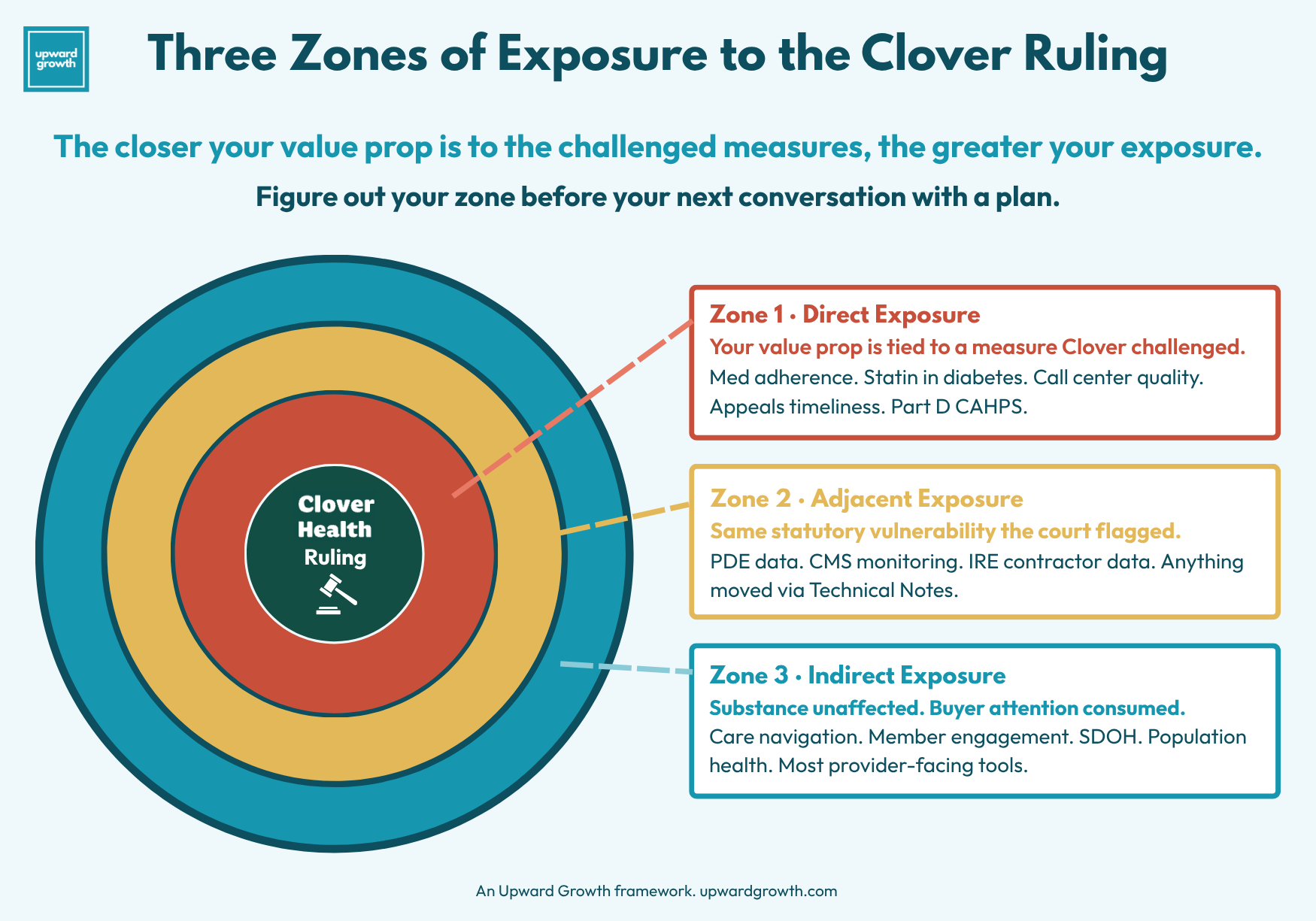
The first zone is direct exposure. Your value proposition is explicitly tied to one of the twenty measures Clover challenged, or to the measure-specification machinery the court found procedurally invalid. Medication adherence vendors on the Part D side. Statin use in persons with diabetes. Call center quality vendors (foreign language, TTY availability). Appeals timeliness. Care for older adults. Several of the CAHPS-driven Part D consumer measures. If your last health plan quarterly business review (QBR) included a slide titled something like “our impact on adherence” or “our improvement in call center metrics,” you are in zone one. Your buyer’s question in the next conversation will not be whether you think the measure will survive. They know you cannot answer that. Their question will be whether your value still holds if the measure changes or disappears. Walk in with three answers ready: what your value looks like if the measure stays, if it falls out, and if it comes back through rulemaking with different specifications. The vendors having that conversation right now are getting different treatment than the ones brushing past it.
The second zone is adjacent exposure. Your measure is not in the Clover suit, but it shares the same statutory or procedural vulnerability the court flagged. The Press Ganey video series walks through this in detail across Part 1, Part 2, and Part 3, showing how the legal reasoning, if extended, reaches measures that ride on PDE data, on CMS-collected monitoring data, on IRE contractor data, and on parts of CAHPS the court called out specifically. And if your measure was added or modified through Technical Notes rather than codified rulemaking, the procedural holding the court reached on the second set of ten could apply to you, even though Clover did not name your specific measure. The honest move in zone two is acknowledging the adjacency directly. Better that the buyer hears it from you than from a board member sending them a Becker’s article.
The third zone is indirect exposure. Your value proposition has nothing to do with the specific measures or the specifications. Care navigation. Member engagement. Population health platforms outside the measure machinery. Social determinants of health (SDOH) solutions. Broader analytics. Most provider-facing tools. The substance of what you do is unaffected on the merits. The operating environment around your buyer is not. Procurement freezes can last two to four quarters, champions get pulled into cross-functional response teams, and pipeline forecasts that looked clean in March stop moving by July. The forces inside the plan that slow your deals down are the same forces that just got compounded.
If your sales pitch leans on “CMS requires plans to do this” as a shortcut for closing, that shortcut got a question mark next to it. The clinical, operational, and competitive reasons your work matters still hold. The regulatory citation does not carry the same weight it did three weeks ago because the buyer now has to ask whether the requirement will survive, which version will survive, and on what timeline.
The same dynamic hit the equity-focused vendor categories after the Final Rule’s health equity rollback. Plans serving dually eligible populations and plans competing on quality in markets with significant disparities still need that work. The conversation shifts from “you have to” to “you choose to,” and “you choose to” requires a much stronger return-on-investment (ROI) case than a regulatory citation ever did.
Walk through which zone you are in before your next substantive conversation, with a plan. Have an answer ready for the questions you are about to get asked.
How to Operate While the Case Works Through the Courts
The companies that operate well through this kind of uncertainty share three habits: scenario fluency, a defensible ROI case, and operating without freezing. None of them requires you to be a lawyer or a Stars expert. (If you want the underlying theory, here is a foundational framework on strategy under uncertainty worth reading.)
Your buyer does not want a vendor or partner who pretends Clover did not happen. They also do not want one who leads with panic. The valuable posture is being able to engage on the substance of what the ruling does and does not change for the work you do together, without overclaiming expertise you do not have. If a plan asks what happens to your ROI when the measure goes away, give them the numbers by running some scenarios. The scenarios may be imperfect, but at least both sides are on the same page about the possibilities.
Regulatory citations were always shortcuts. They closed deals quickly because the buyer’s compliance team would push the work forward, whether the financials were tight or not. That shortcut is weakened, and in some categories it is gone. Clinical, operational, competitive, and member experience cases all still work; they just take longer to develop and require stronger evidence. The vendors who can stress-test their ROI at seventy percent of projected performance and still defend the math to a chief financial officer (CFO) are the ones who keep getting funded.
Procurement freezes happen. They do not last forever. The companies that come out the other side stronger are the ones that use the freeze period to deepen relationships, refine positioning, build the case studies that prove out the work, and avoid burning cash chasing deals that are not going to close in the current window. I wrote about this last winter when the broader market mood shifted into uncertainty, and the same playbook applies here. Discipline beats activity. Patience beats panic. Plans notice which vendors show up prepared and which ones show up panicking.
For investors, the litigation overhang on Stars-exposed assets is real, but it is not uniform. Companies in zone one need to be assessed on scenario math. Companies in zone three are unaffected by the ruling itself, but their buyers at the plan have less time and attention to give right now, which slows deals down. Diligence questions worth adding to your standard list: where each measure or capability falls across the three zones, the portfolio company’s exposure to procurement freeze, how the company is handling the question with existing customers, and what its plan-side relationships look like at the legal and finance level, rather than just the Stars team level.
For consultants and advisory firms, your plan clients need help thinking through this, whether they have asked yet or not. They are sitting in cross-functional working groups thinking through scenario math, vendor management exposure, and board communication, and not every plan is set up to do that work well in-house. There is room to be useful here without claiming legal expertise. The most concrete deliverable you can offer a plan client this quarter is a map of which existing plan vendor contracts have Stars-linked performance terms and which need to be revisited.
For health plan executives reading this, the cross-functional response your team is already running is the right starting point. The piece I would add is vendor contract exposure. The twenty measures in the Clover suit affect thousands of vendor contracts industry-wide, many of which include Stars-linked payment terms, performance guarantees, or shared-savings arrangements. Scenario modeling that stops at QBP impact and skips the contracts is only running half the exercise.
Final Thought
I wrote, when the CY 2027 Final Rule came out, that the agency’s throughline was “fewer rules, higher stakes, and a smaller set of requirements they fully intend to back up with enforcement.” That read held. The Elevance accrual was enforcement showing up. Clover is the other side of the same coin, a court showing up to ask whether the rules CMS has been enforcing were ever legally built.
The throughline underneath all of this is the end of Chevron deference. Loper Bright told judges to read statutes themselves rather than defer to the agencies enforcing them. That means judges sometimes reach different conclusions, which is exactly what Judge Wood and Judge O’Connor did with the same Medicare provision. That dynamic will produce more rulings, more uncertainty, and more opportunities for plans to challenge CMS in the years ahead.
Companies that operate well in this environment can sit with the uncertainty. They hold sharper ROI conversations when the regulatory citation no longer carries the close. Their champions inside health plans trust them enough to bring them into the wider conversation when legal, finance, compliance, and the board join it.
The legal theories at play in Clover, Loper Bright, and the Allina notice-and-comment requirement both cross programs. The same arguments could surface in Medicaid managed care, in Affordable Care Act (ACA) marketplace plans, in commercial quality programs that ride on federal data sources or specifications. Stars is just the first complex MA program to get hit with this. It will not be the last federal program where these theories show up.
If you are working through what this means for your positioning, your messaging, or your go-to-market strategy, Upward Growth is a health plan market advisory firm that works with health tech vendors, investors, provider organizations, and management consultancies on exactly this kind of question. We help companies build strategy around how health plans actually buy, operate, and make decisions, including in moments like this one when the rules under the program are themselves being challenged. Get in touch.
The frameworks in the weekly Upward Growth newsletter help health tech sales and marketing teams navigate payor conversations as the market continues to shift.
If your colleagues are in those conversations, they should be reading this too.
💰 Invest In Your Team with a Paid Subscription.
💡 Pro tip: Many subscribers expense Upward Growth through their company’s professional development, training, or learning budget. Here’s a one-minute email template to get your manager to approve expensing your subscription.